• Home
  • About Us
  • Blog

Tag Archives: wild birds unlimited

Attracting Orioles to Your Yard

Posted on April 12, 2021 by Rosann Kovalcik

Graffius Oriole 3 small


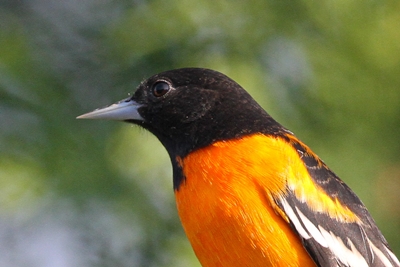
In search of an adequate food supply to raise a family, thousands of Baltimore Orioles migrate from Central America to Michigan during springtime. What does it take to attract these vibrantly plumaged orange and black birds to our yard?

When the male arrives, he is in search of a territory that will provide the basics – food, water, shelter and places to raise young – those elements allow him to carry on his genetics, the sole purpose of migration.
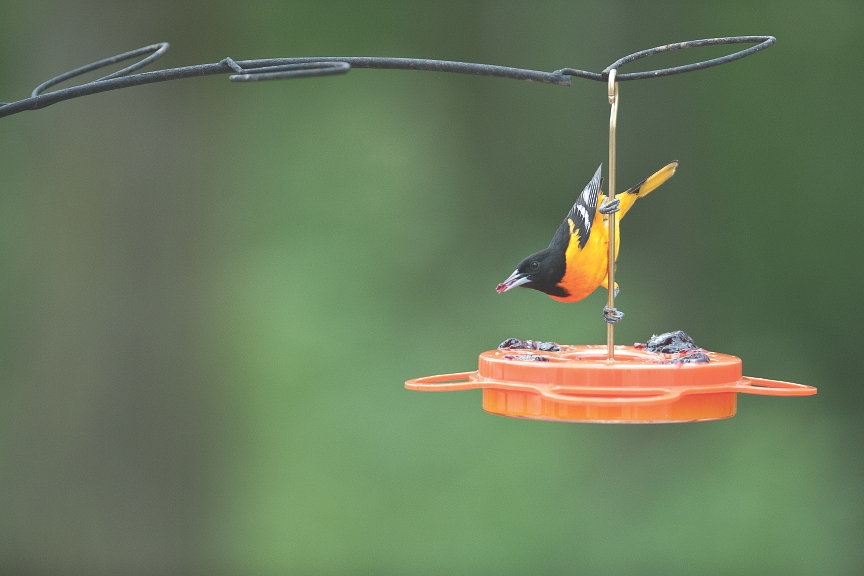
 

Undoubtedly, you will hear Orioles before you see them. The male Baltimore Oriole’s song consists of a short series of paired notes, repeated 2–7 times, lasting 1–2 seconds. The pure, liquid, flute-like sounds have a full, rich tone. Once you accustom yourself to its song, you will be able to search for them visually.

Orioles can be found in open woodlands, woodland edges, and riparian woodlands and in our shade trees in suburban neighborhoods. They do not prefer deep forests.
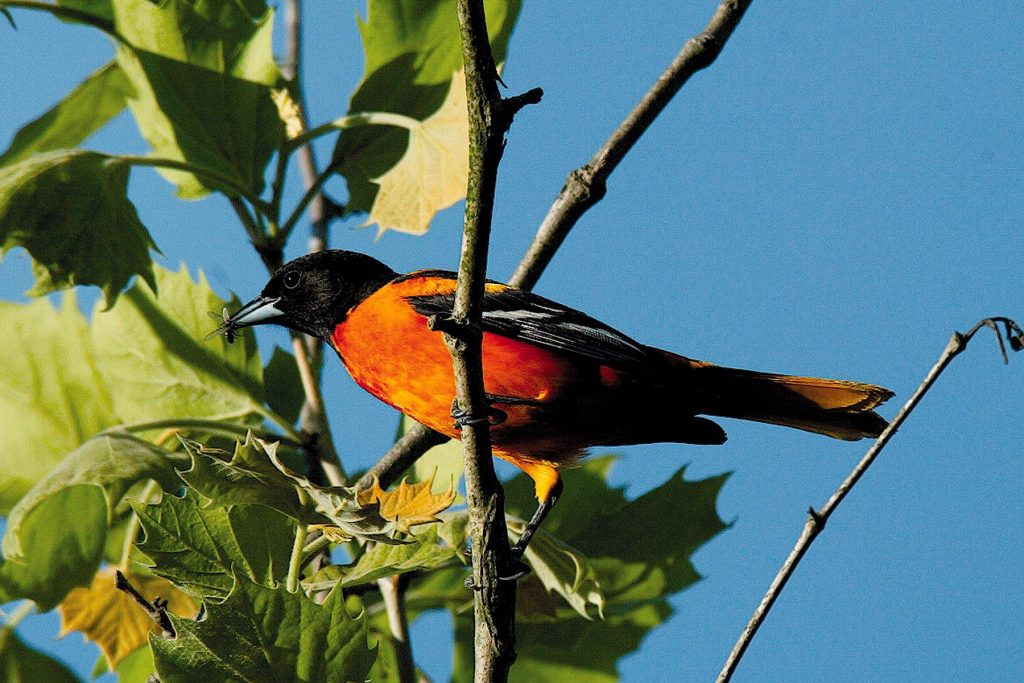
Because of Orioles’ habit of feeding at treetop level, consummate birder Pete Dunne nicknamed them The Eastern Arboreal Oriole. So why the nickname? This is a bird that is wedded to dense leaf canopy. Males sing from exposed perches to warn other males of proclaimed territory. Both the male and female land on the tallest point of a tree before slipping into the dense canopy to begin foraging for insects. These include caterpillars that emerge to eat unfurling new growth on trees.

Oak trees in particular offer more diversity of caterpillars than any other tree in Southeast Michigan. While an oak may not mature to full size during your lifetime, planting it for its food value to birds is an investment in the future of birds. Orioles eat many pest species, including tent caterpillars, gypsy moth caterpillars, fall webworms, spiny elm caterpillars, and the larvae within plant galls. Larger caterpillars are a challenge for some birds, but the Oriole has many strategies for eating them. The birds’ beak is quite pointed and is used to slice through the exterior of a caterpillar, allowing it to eat the nutritional insides. Orioles often have a feeding limb, a favored place to feed, as can be attested to by dried caterpillar skins accumulated on the branch. Orioles eat other insects as well including beetles, crickets, grasshoppers, moths, and flies and non-insects including spiders, snails, and other small invertebrates.
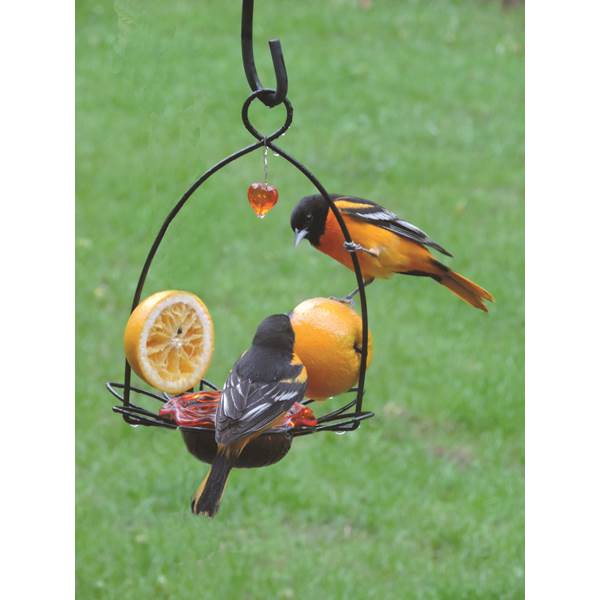
Baltimore Orioles sometimes use their slender beaks to feed in an unusual way, called “gaping”: they stab the closed bill into soft fruits, and then open their mouths to cut a juicy swath from which they drink with their brushy-tipped tongues. Fruits that are especially attractive to Orioles are those that are dark in color. A variety of these plants can offer the high lipid fat that the birds need for fall migration – dogwoods, chokeberry, elderberry, and viburnums. Native plants grow native caterpillars in abundance and therefore, are the perfect choice when planning your bird-friendly yard.

Orioles also have an early spring feeding strategy– they drink from the wells of Yellow-bellied Sapsuckers. These woodpeckers create purposeful holes to encourage sap to run, which in turn attracts insects, an additional food source for the birds.
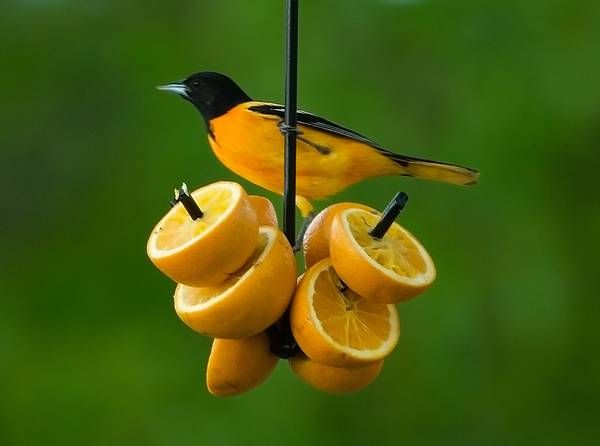
 

For a closer look at Orioles, you can place feeders in your yard that offer the same types of foods they find in the wild. Dark grape jelly can be offered in plastic and glass dishes, oranges can be placed on pronged feeders, and nectar feeders will round out the offerings.

Mealworms are another great food source to offer – the birds will take the worms back to their young as well as bring the young to the feeders once they are fledged. Your feeding station will be most successful if it is some distance away from other feeding stations. Your feeding station should be set up before the first week of May to attract the abundance of Orioles that migrate at that time. Once migration is over and the local birds have established their territory, you may find that the mated pair (or two if you are lucky) near your home can be very skittish at feeders. As a bonus, other birds will enjoy these offerings including House Finches, Cardinals and Rose-breasted Grosbeaks.
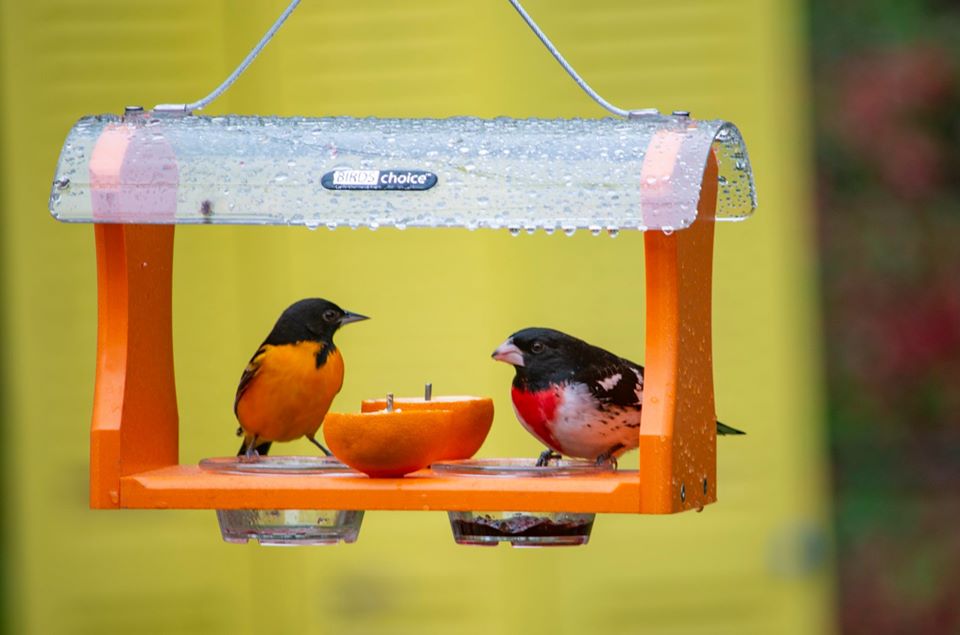
Female Orioles are responsible for the building of the nest that will hold their eggs and resultant young, usually four in number. Long strips of plant material are the backbone of their nest. Most frequently they use milkweed and dogbane, clipping the plant at the base just above where they are holding it firmly in their feet. Pulling up, they create strips that are then flown to the nest site and tied in place. Leave last years’ milkweed and dogbane standing into the spring so that these birds can utilize them, or clip it and add it to your nesting material basket. Elms were the favorite trees of Orioles for nest building before Dutch elm disease took its toll on them. Now, they favor maples, willows, poplars and oaks. Placed at the tip of branches, the sock-like structure has the advantage of being difficult for predators to reach.
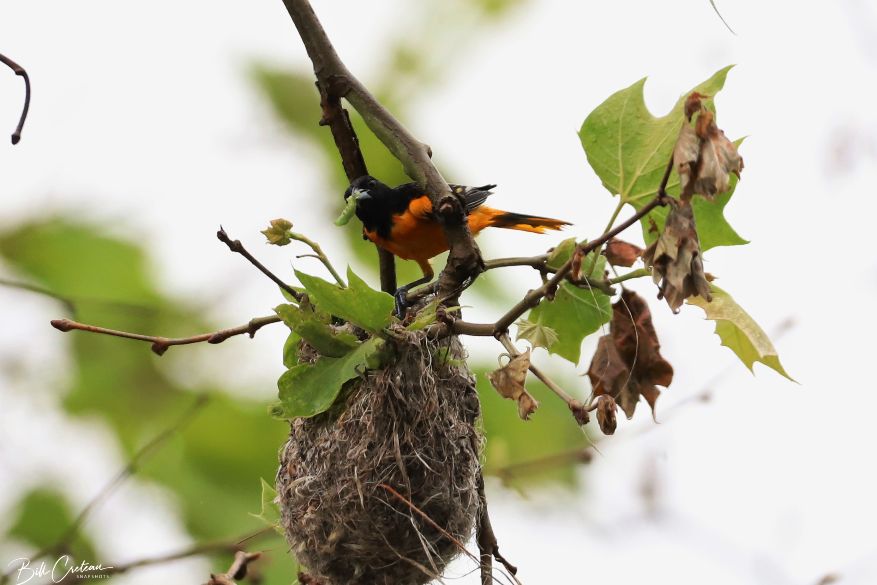
 

The nest is a work of art, a suspended pouch woven as two separate walls. The female uses a shuttling motion to create the walls and then stitches the two halves together. The inside plant material can consist of dandelion fluff, the downy material from willows and poplars and short strips of grape bark. Natural materials can be placed in a suet basket and placed where you can enjoy these beauties helping themselves. Short strips of natural fibers (avoid polyester), hair, and string may be used by Orioles in nest construction. Fishing line and dryer lint are two materials not to be used. The fishing line is too thin and can easily entangle the bird. Dryer lint has materials that will hold moisture and would cool eggs and babies instead of keeping them warm as natural materials would. The female builds the nest over a period of about eight days. Nests are not reused, although some of the nesting material might be used in the new structure.
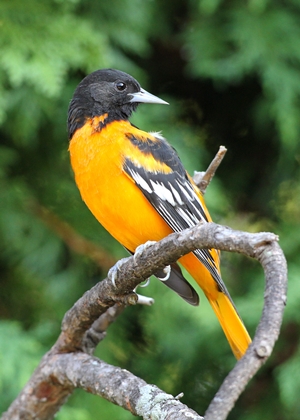
Graffius Oriole 2 small

Males keep a watchful eye on the female as she works, mating with her when she allows. Incubation is done by the female entirely, lasting a period of 12 to 14 days. Both parents feed the young for the next two weeks, during which time the naked hatchlings develop into fully feathered adult sized birds.

Now it is the male’s turn to take over as the young follow him for lessons on where to look for food. The female spends her time eating to regain the weight she lost and preparing herself for fall migration.
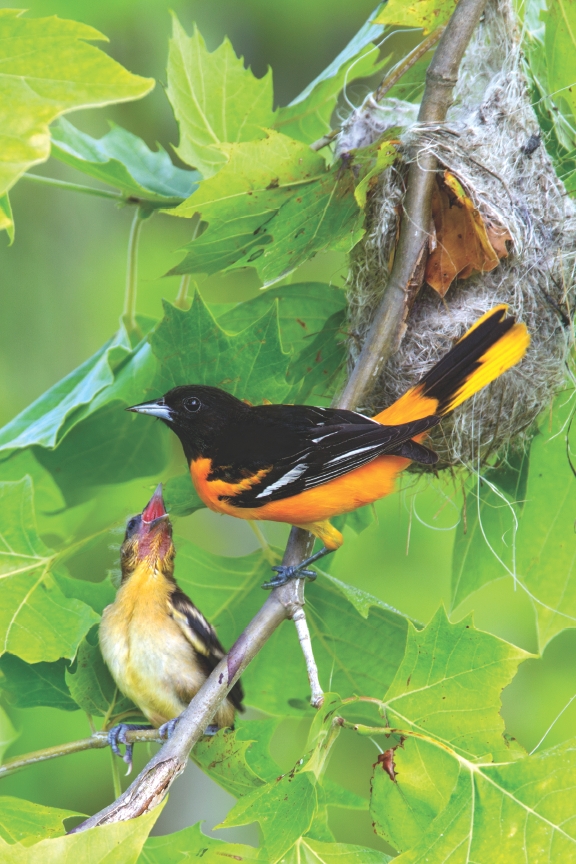
Orioles leave early back to their southerly home, our yards quieter without their songs as early as the end of August.

Oriole Father feeding baby

Well worth the effort to attract, Orioles make our time in the yard a special time indeed!

Thanks to Bill Creteau, John Graffius, Wayne Hoch and Randy Repicky for  sharing their photos

Have you joined our email list? Click here to sign up, it’s free and gives you access to sales, coupons, nature news, events, and more!
Posted in Bird Feeding Solutions, Spring, Summer, Wild Bird Facts | Tags: baltimore oriole, Bird Feeding, birds, fun facts, orange, orioles, Spring, summer, wild birds unlimited | Leave a comment |

Reconnecting with the Common – A Celebration of Mallards

Posted on February 6, 2020 by Rosann Kovalcik

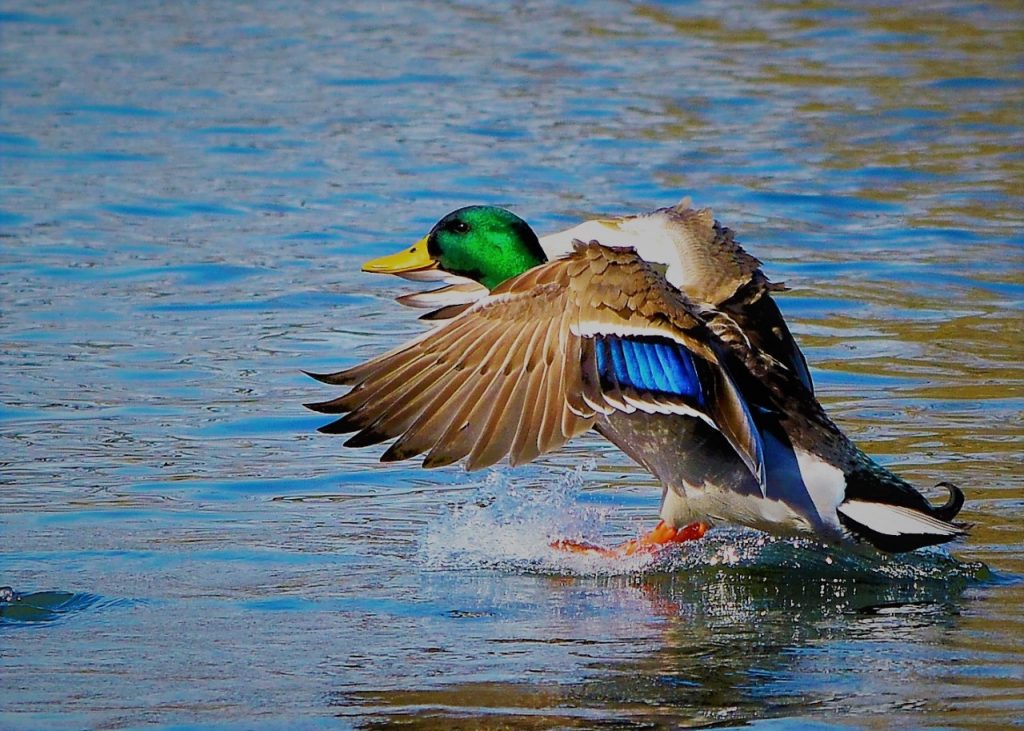
Mallard Duck by Tim Lintz

Mallards, A Reintroduction

Although common in our state, the Mallard Duck male is anything but common in appearance. He is eye-catching with his bold green head, bright yellow bill and equally bright orange legs. He also has a splash of iridescent blue in the wings (on the speculum). By comparison, the female is plain in coloration. This helps her stay concealed for safety during nesting.

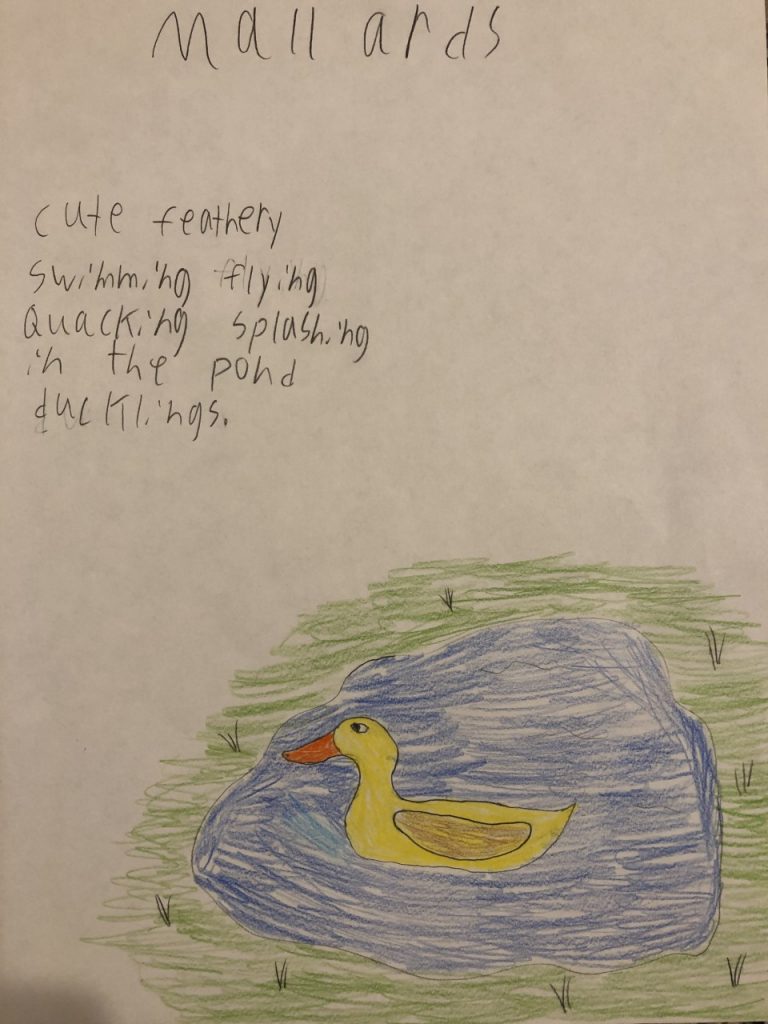
My granddaughter, Isabelle, has helped me see Mallards in a re-energized light. She’s so captivated, she’s drawn and written poetry about them. I am grateful these ducks are so common. This makes it easy for her to observe them in the fresh water ponds near her house.

A Poem & Drawing by Isabelle

The Mallard is a dabbling duck, meaning it does not typically dive for food. Instead, Mallards tip end-up and uses their beaks to grab plant food. They will also eat insects, mollusks and crustaceans. Mallards dive for food when needed, although their bodies are not built for this. Their legs are positioned in the middle of their body, which is not ideal for diving. Diving ducks, on the other hand, dive freely with legs near the back of their body.

Fun Facts About Mallards

Migrating Mallards can fly 55 miles per hour!

The “quack” you hear is from the female, as the male gives a quieter, raspy sound.

At the end of breeding season, Mallards lose their flight feathers and cannot fly for 3 to 4 weeks. During this time, they gather in groups in sheltered places as their feathers regenerate. Their body feathers molt during this time into a less striking plumage called “eclipse” plumage.

Many hunters target Mallards for sport. It was hunters who discovered the oldest known Mallard. The bird had been banded in Louisiana in 1981 and was shot in Arkansas in 2008, making it at least 27 years old.

A Place in the Ecosystem

Mallards play an important role in creating habitat. In a recent article published by Audubon, a scientist revealed his discovery of their eating habits after tracking their movements. As the article states, Mallards use the landscape as one big buffet. They will eat plants in one place and as they travel throughout the day, they excrete these seeds into areas sometimes as far away as five miles. This creates habitat, maintaining existing patches of healthy plant communities and creating new habitats. Read the full article here https://www.audubon.org/news/mallards-are-everywhere-and-thats-great-wetlands

Enjoy these ducks as much as Isabelle does, as they return to Michigan from their wintering grounds in the months to come.


Rosann Kovalcik, Owner

Wild Birds Unlimited, Grosse Pointe Woods

Have you joined our email list? Click here to sign up, it’s free and gives you access to sales, coupons, nature news, events, and more!
 

Posted in Wild Bird Facts | Tags: birds, duck, Grosse Pointe Woods, habitat, mallard, Michigan, nature, wild birds unlimited | Leave a comment |

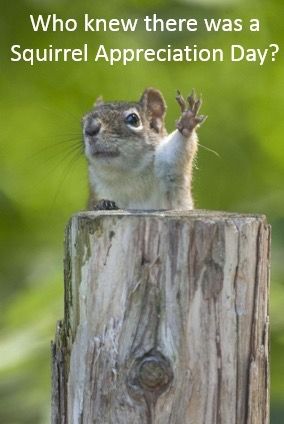
Squirrel Appreciation Day is January 21st

Posted on January 20, 2020 by Rosann Kovalcik

Squirrels: An Introduction

Soft, fluffy and entertaining – the definition of a squirrel. In our area we have both Fox Squirrels and Gray Squirrels. You may also see black squirrels, color variants of Gray Squirrels. Both species mate December through February. You may have noticed “chasing”, which is part of the mating ritual. Females give birth to naked, helpless young about 45 days after mating. They nurse the young until about three months of age. They will also mate again in May to June. Males do not help with the raising of the young. Squirrels build nests of twigs and leaves about 35 to 40 feet up, often in the sturdy crotch of a tree.

Food: Dining, Stashing, Chewing

Squirrels are omnivores and will eat all types of seeds including acorns, hickory, walnut, mulberry and hawthorn seeds. They will also consume bird eggs, birds, insects, arthropods and carrion.

Squirrels gather and stash seeds, an important job in the ecosystem. Some of the seeds are never refound, instead sprouting into new trees. These small mammals also serve as a food source for Red-tailed Hawks, Coopers Hawks, owls, coyotes and fox.

Another amazing aspect of squirrels is their teeth. They grow continuously and are very effective at chewing, as those of us who have them around well know.

Other Fun Facts

Those who feed the birds know of the squirrels’ leaping abilities. They can leap ten feet from a solid object such as the side of a tree as well as any man-made structure. It seems as if the only surface that they are unable to climb is glass.

Here is your word of the day – vibrissae. These thick hairs (whiskers) are found on the chin, nose, above and below the eyes, and forearms of squirrels. Squirrels rely on these hairs to enhance their sense of touch.

The Flip Side of Appreciation

However, many people are quick to exclaim about “those darned squirrels!” Who cannot relate to the success of squirrels at our bird feeders? Getting into the feeders is their full-time occupation and they are relentless in their efforts. Looking to keep them out of your feeders? We have answers for you at Wild Birds Unlimited in Grosse Pointe Woods!

Deterrents: Feeders

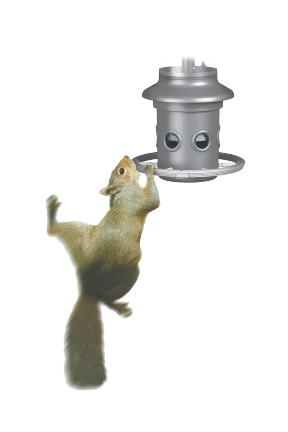
There are some very effective squirrel resistant feeders including the Eliminator. This feeder has a perch that closes with the weight of a squirrel. The length of the feeder prevents the squirrel from hanging from the top of the feeder or reaching the seed ports below.

Baffles

Placement of feeders that do not have a weight device is important if you do not intend to feed the squirrels. If using a pole system, there are steel baffles that are too wide for their paws to get a sufficient grip and too long for them to over reach the baffle. This type of baffle needs to have its top at five feet off of the ground with all feeders hanging so that the bottom of the feeders are above that five foot position. We do not recommend plastic baffles, as squirrels can easily chew through this material. This type of baffled pole system is only effective if placed ten feet from any object the squirrel can jump from. This includes trees, patio furniture, pots, grills and other feeding setups. When using a baffle above a feeder, the baffle needs to be quite wide or shaped to create a slide assisting the squirrels’ exit. Both types of baffles are carried at WBU GPW.

Seeds

Safflower seed used alone is another effective remedy against feeding squirrels as most do not prefer its’ taste. Hot pepper treated seed is also a good deterrent.

Whether you watch them and have names for the ones in your yard or are among those that wave your fist as you exclaim “Those Darned Squirrels”, let’s commend them on Squirrel Appreciation Day.


Posted in Bird Feeding Solutions, Squirrels | Tags: Bird Feeding, bird feeding solutions, Grosse Pointe Woods, solutions, squirrel, squirrel appreciation day, wild birds unlimited | Leave a comment |

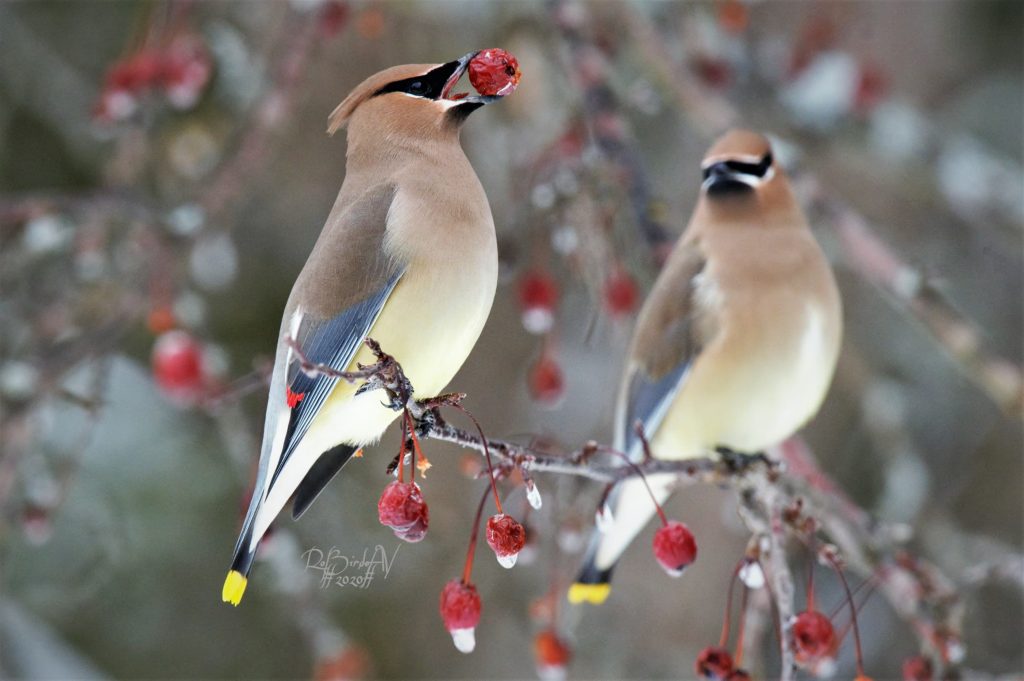
Cedar Waxwings

Posted on January 15, 2020 by Rosann Kovalcik

Cedar Waxwings – An Introduction

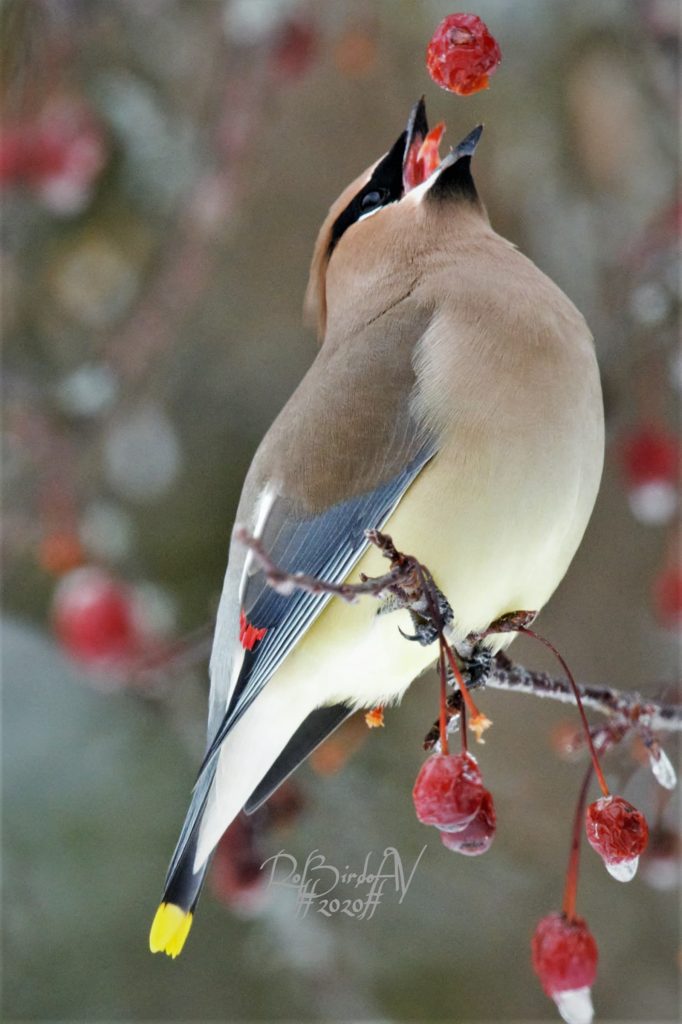
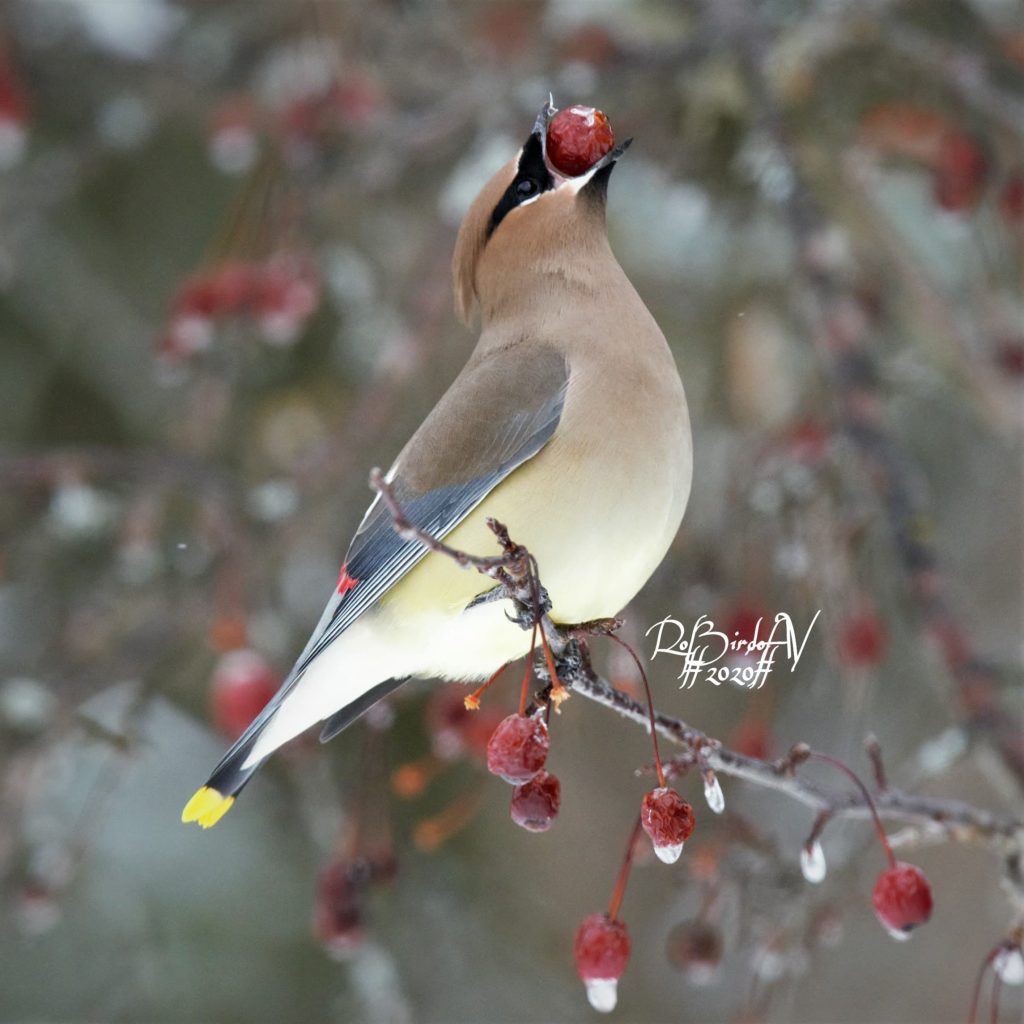
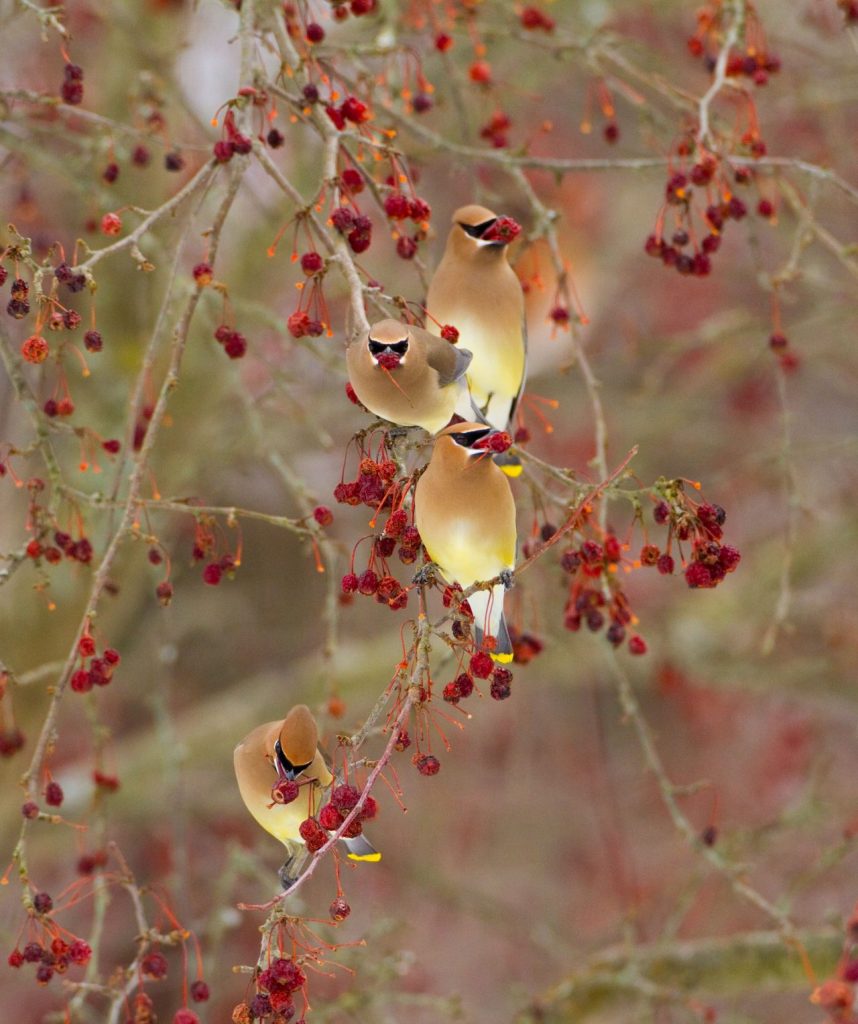
How fabulous-looking are Cedar Waxwings? The plumage appears soft and perfectly groomed. The facial mask is so striking. The wings have tips that appear as if they have been dipped in bright red wax. The bird has an elegant look, its tail edged in yellow, its head topped with a feathery crest. Winter is a great time to look for these birds as they eat fruit. You’ll find them travelling in flocks, often congregating near trees with berries.

My most recent experience with Cedar Waxwings was at Ira Township Park in New Baltimore. A group of 45 of them attracted my attention, sitting in the sunshine at the tops of trees. They flew down a few at a time to an area behind tangled vines where a creek could be accessed. Daintily dipping their beaks, some drank from the running stream while others stood sentinel above. Such a peaceful sight made the winter walk so rewarding.

Cedar Waxwings are known to pass fruit back and forth. This can be a courtship ritual or bonding between a mated pair. Many times it is not just one bird that passes the fruit. Rather, two birds may pass back and forth until one bird finally eats the berry, typically the female.

On a Personal Note…

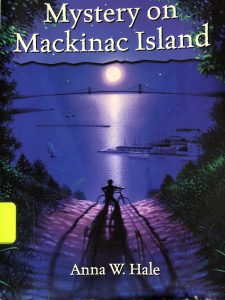
The Cedar Waxwing was a prominent bird in the book “Mystery on Mackinaw Island”. The librarian in this story had a stuffed Cedar Waxwing and used it as a signal to let the main character, a young boy, know she needed to see him. The dead bird had been found by him outside of the library when he was nine years old and he gave it to her. The book was a page turner for me – how couldn’t I love a book where the main character aspired to become “a real Bird Man”.

The book came to my attention when I spoke with Kathy Schmitz, a teacher at Kerby Elementary School in Grosse Pointe Farms. Her class was reading the book and she discovered the Cedar Waxwing was our bird of the month for our coloring contest! I look forward to seeing the masterpieces from these children. I hope they feel more deeply connected to the story and the main character as a result of this artistic enterprise.

Thinking Bigger

What can you do to become more engaged and attuned to Cedar Waxwings? Give serious consideration to planting fruiting trees for these beauties. They can subsist for months on a diet of fruit alone. Cornell Laboratory suggests juniper, mountain ash, crabapple and hawthorn as well as their namesake cedars for winter fruit. In summer, serviceberry, strawberry, mulberry, raspberries and dogwoods all provide a good food source. Envision your yard as a place to welcome these lovelies, as you make your planting plans. Get outside and search for berries, and you may be rewarded with some sights similar to these fabulous photographs, compliments of Roberto Viguilla and Marie Read.

Posted in Wild Bird Facts, Winter | Tags: bird watching, birds, cedar waxwing, mystery on mackinac island, native plants, nature, wild birds unlimited | Leave a comment |

Where are the Juncos?

Posted on January 9, 2020 by Rosann Kovalcik

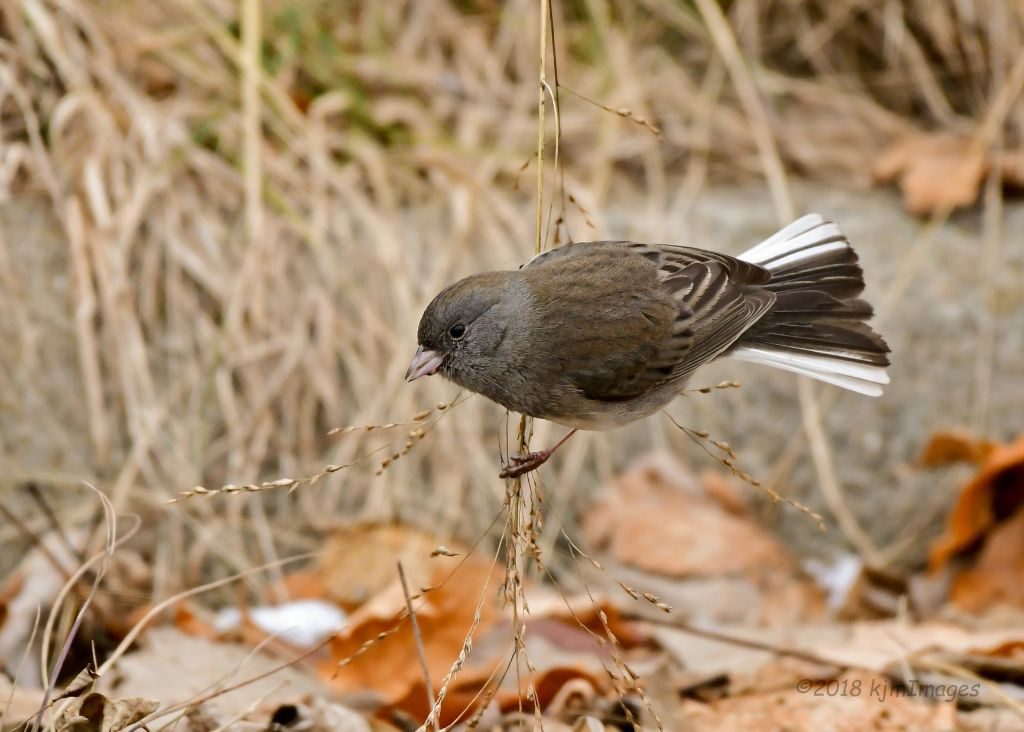
Dark-eyed Junco by Kevin Murphy, Eliza Howell Park, Detroit

Where are all the Juncos?

We have had a number of customers recently ask where the Dark-eyed Juncos have been. Many have not yet seen them at the feeders this winter. My best experience with Juncos this year has been when we had a recent small snowfall. They were perched on the stems of plants I leave up all winter to provide seeds for the birds.

Now that we are not experiencing snow cover, the seeds available to Juncos make their visits to our feeder less of a necessity. I have been missing their subtle gray coloration and their white “snowy” bellies. I also love that their two outer tail feathers are white on each side, looking like a cheerleader skirt as it flies or spreads its tail.

To attract them to your yard, offer White Proso Millet on a tray feeder. The feeder can be on legs and close to the ground, or on a pole system and higher off of the ground. Either way, this stable platform allows them to eat in a way that true sparrows prefer, simulating their groundfeeding preference.

Enjoy this winter visitor while you can!

Rosann Kovalcik, Owner

Wild Birds Unlimited, Grosse Pointe Woods

Have you joined our email list? Click here to sign up, it’s free and gives you access to sales, coupons, nature news, events, and more!


Posted in Bird Feeding Solutions, Winter | Tags: climate, dark-eyed junco, Grosse Pointe Woods, junco, millet, seasonal, snow, sparrow, weather, wild birds, wild birds unlimited, Winter | Leave a comment |

Christmas Tree – Artificial vs. Real

Posted on November 21, 2019 by Rosann Kovalcik

Tradition vs. Change

What a beautiful tradition it is to bring the outside within our homes at the holidays, featuring trees, wreaths and garlands. Who doesn’t have a photo with the family in front of the Christmas tree?

The choice we make as to whether we buy a real tree or an artificial one does have an impact on the world our birds call home. Manufacturing these trees requires fossil fuels. This means, when they are trashed within a landfill, they will not decay. Overseas manufacturing and shipping processes also leave a large carbon footprint.

Sounds like a real Christmas tree is the most environmentally friendly answer. Grown right here in our state of Michigan, the trees produce oxygen while they are growing as well as sequestering carbon. Tree farms will use the same spaces to plant again after harvest, a sustainable way to farm.

Things to Consider

If you are buying a real tree, there are some important factors to consider.

Photo by Lori Campbell

Ask your retailer these questions or research about their farm or shop – do they follow Integrated Pest Management practices and avoid the use of pesticides when possible, and do they practice water conservation?

Just as we have experienced with firewood, real trees used at the holiday can harbor non-native invasive pests. Trees that are grown in one area and then transported to be sold in another area may spread invasive pests such as gypsy moths, balsam woolly adelgid and Phytophthora ramorum, the fungus-like pathogen that causes sudden oak death.

The best way to minimize the chance of introducing a new pest to your neighborhood is by getting a locally sourced tree. Follow these tips:

  • Purchase locally grown trees or greens for wreaths and garland.
  • Cut down your own tree from a local cut-yourself farm or nursery.
  • Obtain a permit and cut your own tree from a local forest within 10 to 20 miles of your house.
  • Buy a pre-cut locally sourced tree from an established local business.
  • Don’t use invasive species such as Asian bittersweet in holiday decorations

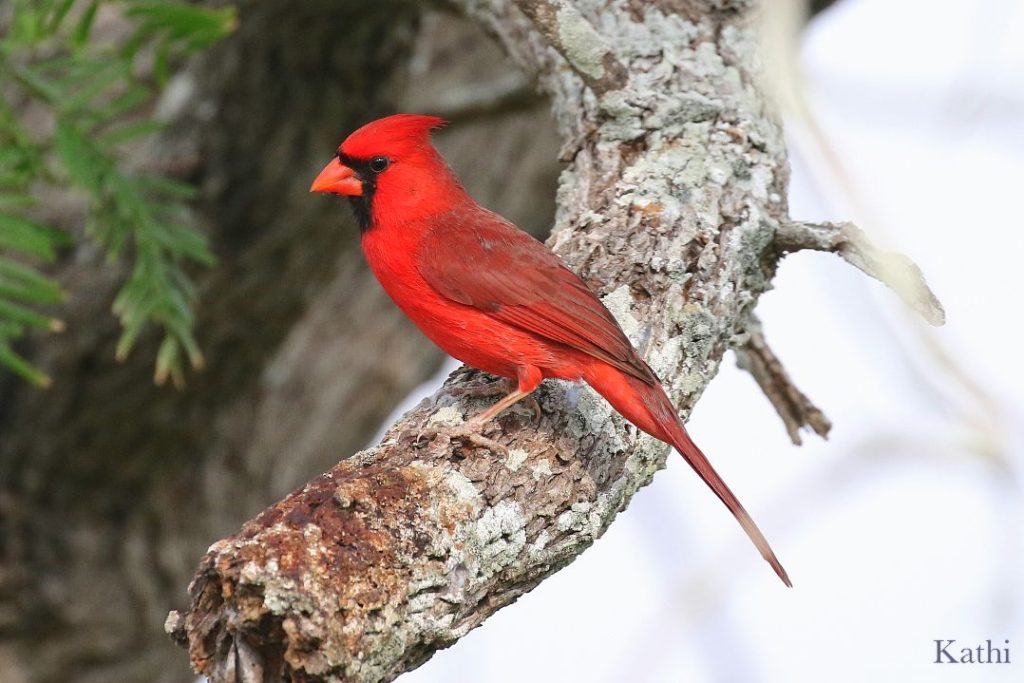
And once you are done with the tree, place it in the yard as shelter for your Cardinals. After all, nothing looks better on an evergreen than a Cardinal!

Northern Cardinal by Kathi Hince

Posted in Winter | Tags: Cardinal, christmas, christmas tree, december, Grosse Pointe Woods, holiday, locally sourced, november, wild birds unlimited | Leave a comment |

Fascinating Blue Jays

Posted on August 12, 2019 by Rosann Kovalcik

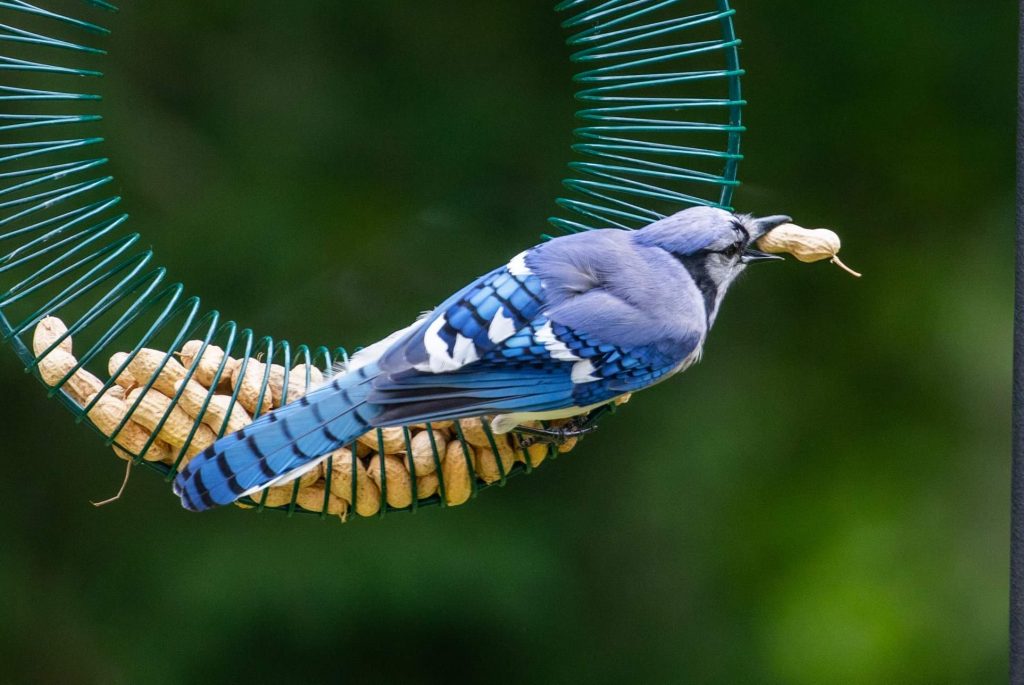
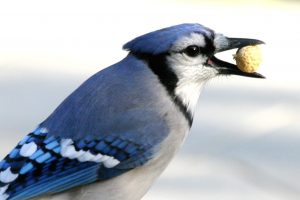
Blue Jay with Peanut by Emily Wolfe

Blue Jays – The Sights and Sounds

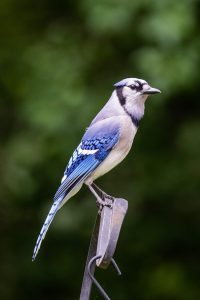
I find Blue Jays to be fascinating – I’m listening to them now as they sing out their “tootle-oot, tootle-oot” from the oak tree. They have such a rich complexity of vocal sounds. The same can be said about their plumage, a rich complexity of blues of every shade. Such a handsome bird with both males and females looking alike, their faces framed by a dark collar. Perhaps one of their finest features is their crest, raised and lowered at will depending upon their mental state – up when alert, feeling territorial, and down when there’s no reason, giving the back of the head a little “flair”.

The Brains

Blue Jay by Emily Wolfe

Jays play an important role among the birds in our yards. They will sound the “Jay! Jay!” alarm when a potential predator is nearby. This allows all of the birds to be on the lookout for the hawk, cat or human that caused the Jay to give the neighbors a warning. One of the most amazing vocalizations of the Blue Jay is their ability to vocally imitate hawks – they have turned my head with the calls of a Red-shouldered Hawk and a Broad-winged Hawk, only to spot them in my binoculars. And just a few short minutes after I wrote that, I heard a Cooper’s Hawk calling from the rooftop – except it was a Blue Jay. Perhaps he was using this as a scare tactic to keep the other birds away so he could swoop down and feed on the seed cylinder I had just put out. Smart move.

Blue Jays can be entertaining and unafraid in your yard. They will come quite close when any kind of a nut is involved as they naturally seek the mast of trees. Capable of storing a few acorns in their gular pouch, a holding area in the throat, they will transport the acorns to an area to stash away. Placing the acorns on the ground and covering them with leaves, or pushing them into the soil with their strong beaks, they hope to save them for future food. Many of those acorns will grow into trees and in this way, the Blue Jay plays forester for us.

Peanuts in the shell evoke the same mental response in Jays.  They simply cannot resist them when offered and will carry them away where they can hold them with their feet and use their beak to break away the shell and eat the protein-packed nut inside.

Blue Jay

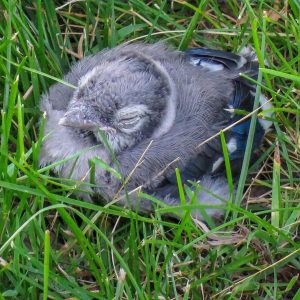
Baby Blue Jay by Samantha Mason

The Babes

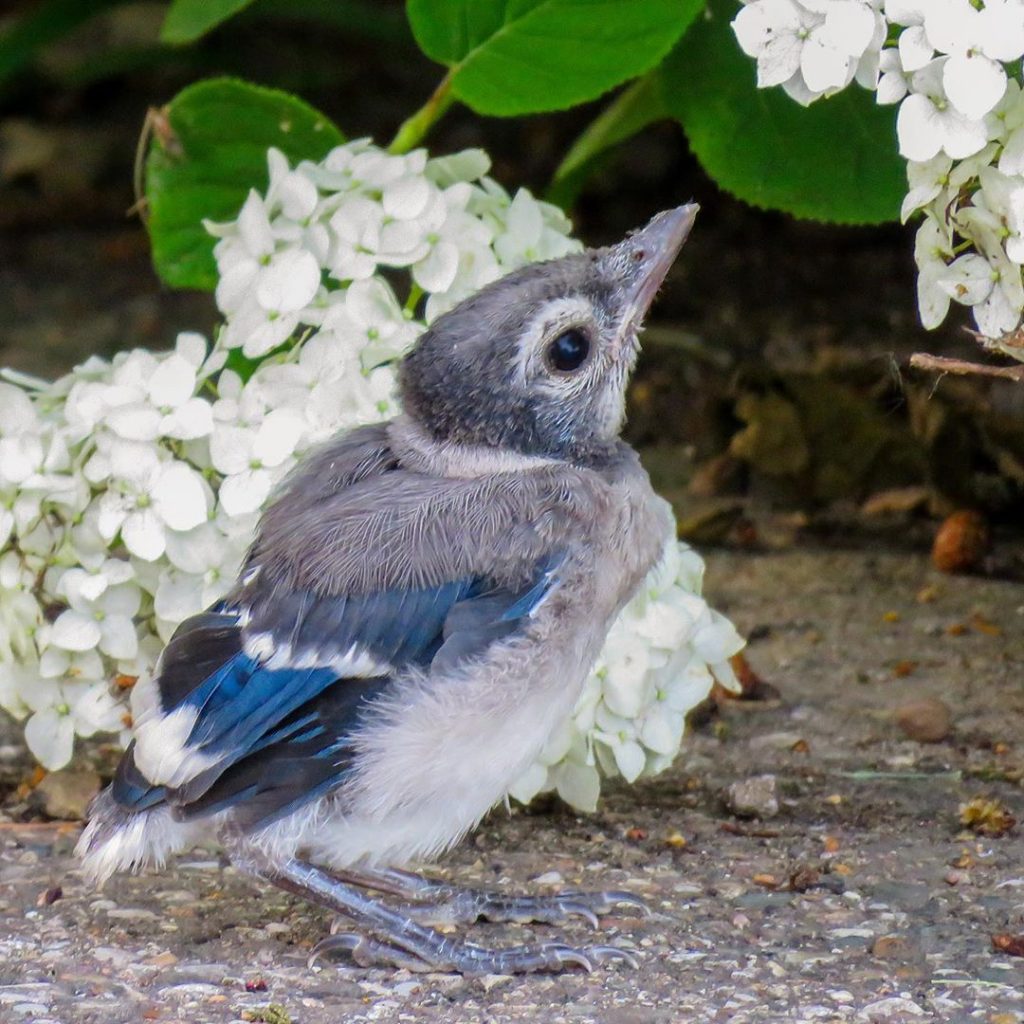
Both male and female Blue Jays take an active part in raising their brood of two to seven. They are quite secretive during nesting season as they find food for their young and deliver it to the nestlings. Jays are omnivorous and will eat a wide variety of plants and animals. Once the young fledge the nest, they will travel in family groups for feeding purposes. You can hear their contact calls to each other as they move about the trees.

Movement

Blue Jays take part in their spring and fall migration in very large numbers. They migrate in daytime flocks, unlike many of the small passerines that use the cover of night for migration. We have seen these flocks of hundreds of Blue Jays flying over us at the Ford House during our bird walks. The wing beats blink light and dark flashes as they travel along – a magnificent sight.

Enjoy this adaptable, gorgeous bird and all of the vocalizations that make Jays so unique.

Baby Blue Jay by Samantha Mason

Enjoy your birds!!

Rosann Kovalcik, Owner

Wild Birds Unlimited, Grosse Pointe Woods

Have you joined our email list? Click here to sign up, it’s free and gives you access to sales, coupons, nature news, events, and more!
Posted in Wild Bird Facts | Tags: Bird Feeding, birds, blue jays, Grosse Pointe Woods, jay, Michigan, summer, wild birds, wild birds unlimited | Leave a comment |

Where Have My Goldfinches Gone?

Posted on July 25, 2019 by Rosann Kovalcik

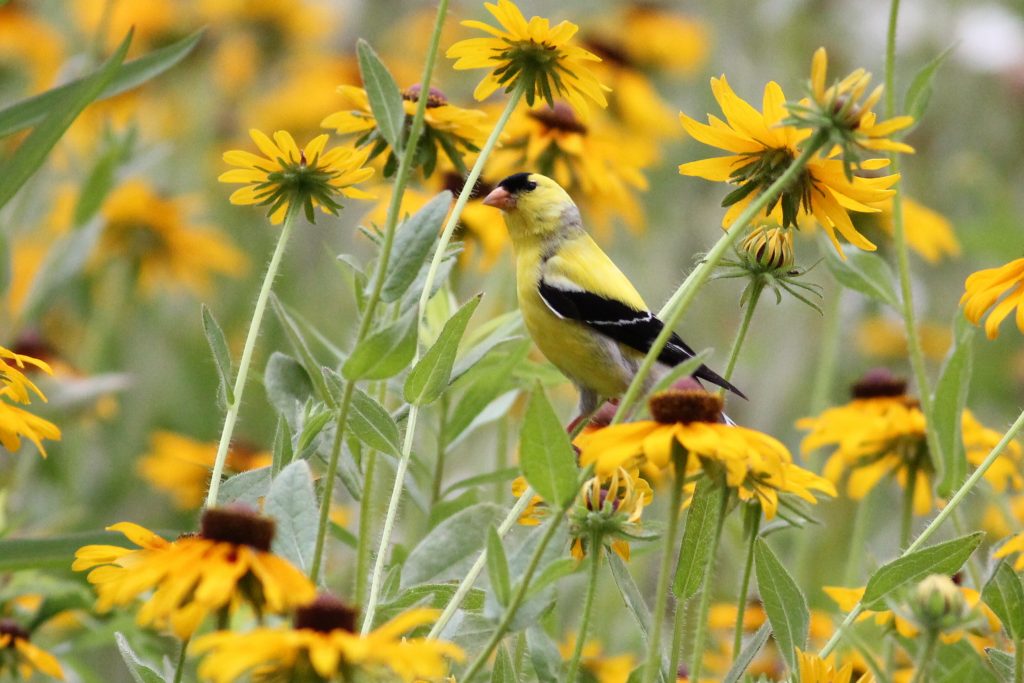
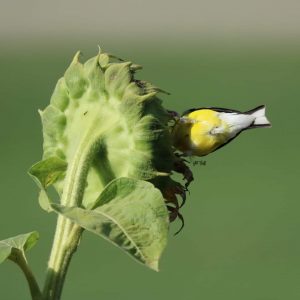
American Goldfinch male

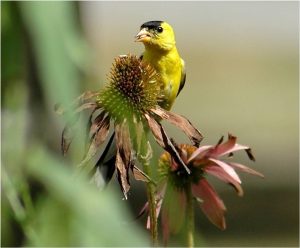
Where have my Goldfinches gone? This is a question that we hear often at the store this time of year. Goldfinches nest later than many other birds in our area. When they establish their territories, they don’t allow other pairs in that area. So, unlike the spring when they were migrating through in large numbers, you will have one pair that calls your yard part of their territory (if you are lucky)!

Nesting Prep

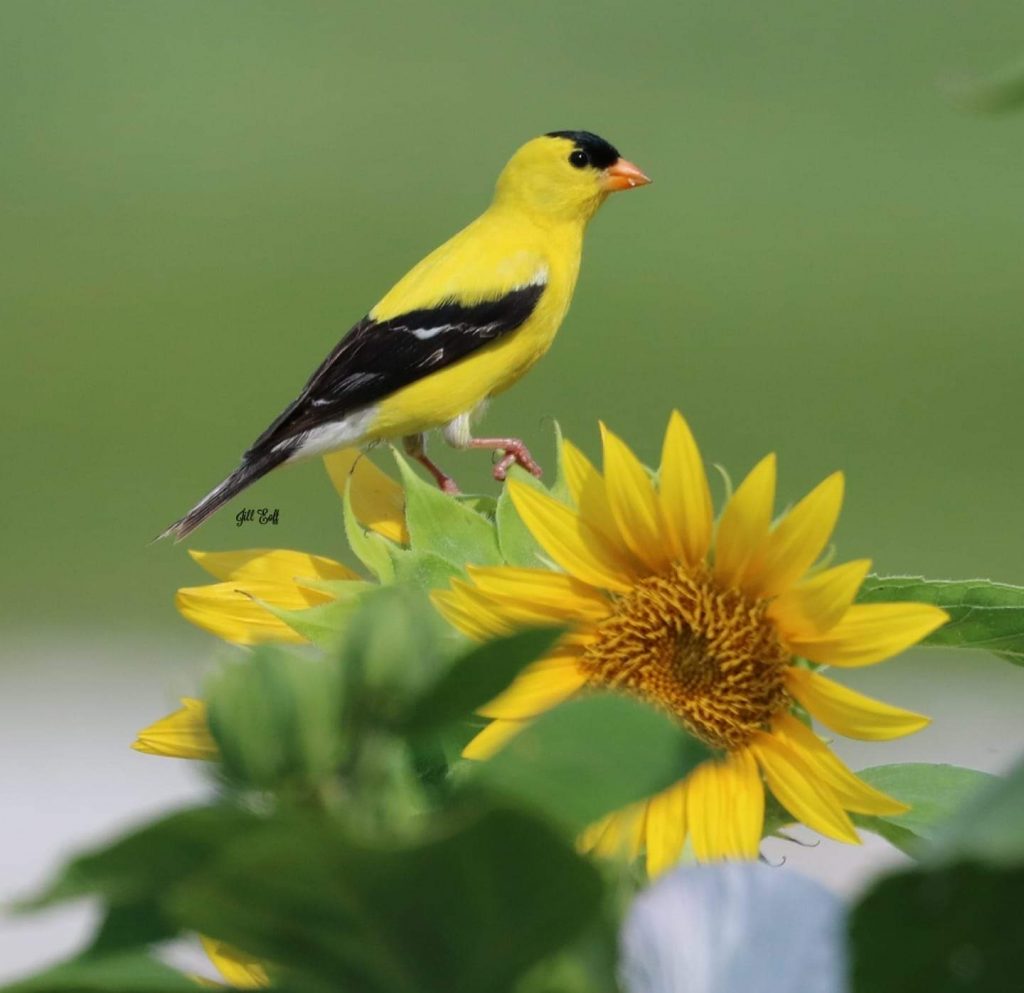
Goldfinch on Sunflower (Photo by Jill Eoff)

The male advertises his territory with a beautiful, long, sweet melodic song. Part of the territorial behavior consists of him flying in large circles around the area, singing as he flies, advertising that the area is his and available to one female to share with him. This behavior continues as she constructs the nest and she sits on their eggs.

Because she alone incubates those eggs, the male will bring her food as she continues to sit on the nest. How sweet is that? If you are seeing a single male at your feeders, this is the reason why. With natural food sources becoming abundant this time of year, these fresh resources are used by the finches in addition to quick stops at the feeder.

American Goldfinch male (Photo by Rosann Kovalcik)

Time to Hatch!

When the young hatch, the female will now come to the feeder for short periods, to feed herself and to carry seed back to the nestlings. When you see her at the feeder, you know the eggs have hatched. Both parents feed the young birds seeds, from feeders and natural sources.

Within a few weeks after they hatch, young goldfinches are following parents around, begging for food with a characteristic, high-pitched “chippee, chippee” call. Seeing them beg with open beaks and wings fluttering is a summer delight.

While there is less activity at your feeder, fill it only part way. The seed needs to be fresh if it is going to compete with the natural food sources that are available. Using a mix of nyjer and fine sunflower chips is a good strategy as the sunflower chips offer high protein and fat content, which the birds need this time of year. Using Feeder Fresh, a silicate additive, will help your seed stay fresh and moisture free. When filling the feeder, add the new seed and mix it about with the older seed to avoid clumping. Once finch activity picks up and those goldfinch families are coming to eat, you can start filling the feeder with a greater quantity of seed.

American Goldfinch male (Photo by Jill Eoff)

Enjoy your birds!!

Rosann Kovalcik, Owner

Wild Birds Unlimited, Grosse Pointe Woods

Have you joined our email list? Click here to sign up, it’s free and gives you access to sales, coupons, nature news, events, and more!
Posted in Summer, Wild Bird Facts | Tags: Bird Feeding, birds, finches, goldfinches, nyjer, summer, sunflower, wild birds unlimited | Leave a comment |

Decluttering Your Bird Feeders… Or Not

Posted on March 25, 2019 by Rosann Kovalcik

Much has been written about decluttering lately. And so, of course, my thoughts turn to bird feeders.

A common bit of wisdom regarding decluttering is to ask yourself if an item brings you Joy.

Cylinder Feeders

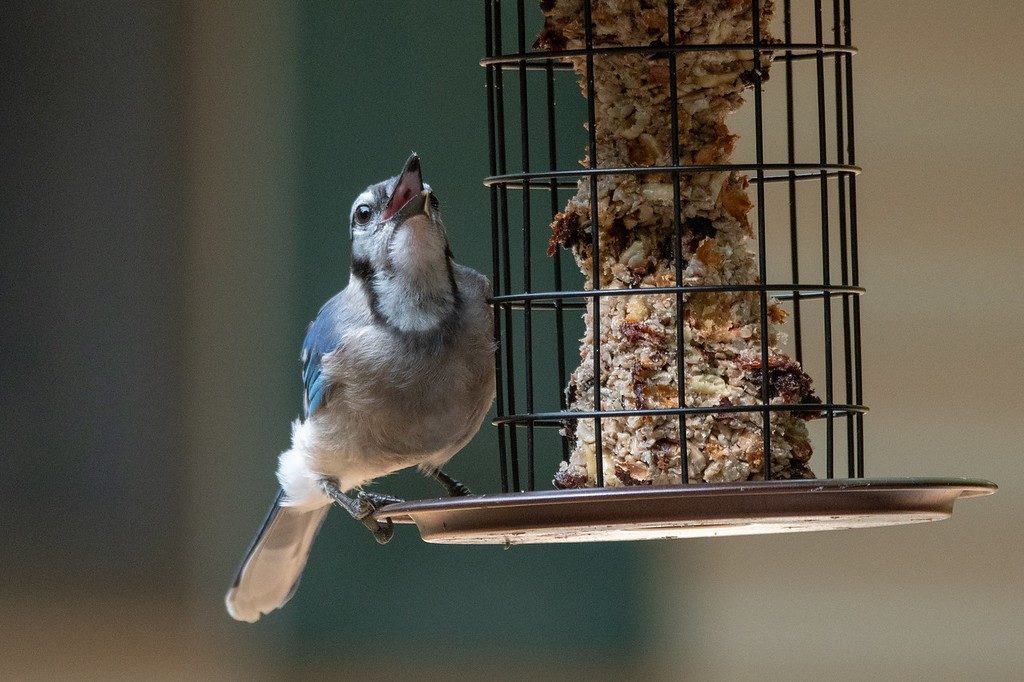
Blue Jay on Cylinder Feeder (Photo by Lisa Vreede)

When I fill my cylinder feeder with a new No-Mess seed cylinder, I notice Blue Jays coming in groups. Perhaps the first jay to discover the gleaming peanuts will stand atop the pole and give a little bounce up and down as he calls to the others in his tribe. Then the hammering begins; the birds’ feet holding on tightly, their heads moving back and forth, excavating each peanut with precision. Then off the Jay flies to a branch to eat its prize. Or maybe it plans to stash the peanuts. The flurry of blue from feeder to tree branches is so beautiful to watch.

Okay – Joy with the cylinder feeder… keep it!

Suet Feeders

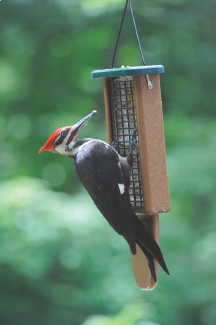
Pileated Woodpecker on Double Tail Prop Feeder

Then I consider my suet feeders. I have a lot of those. Tail prop feeders – I have two of the extra-large version. Last time I filled them with Nuts and Berries Suet I was in Boyne City, and when I was done, I called out to the woods ,“Hey Buddy (my male Pileated Woodpecker’s  given name), I just filled the feeders for you!” And I kid you not; within two minutes, he flew into the woods along the road and hammered away at one of his favorite trees, doing some serious excavation. Then, as I backed away from the feeders, he came in on his landing tree. By the time I was in the house, I had the Pileated Woodpecker on one of the double tail-prop suet feeders, and a Hairy Woodpecker on the other one.

Okay –  true Joy with the double tail-prop suet feeders – keep them. All of them.

Finch Feeders

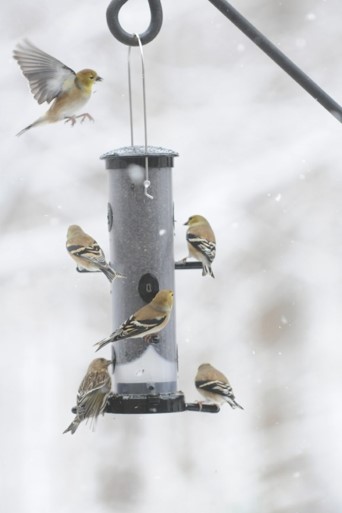
American Goldfinches

Next I reflect on my finch feeders. Yes, that’s plural as well. This past winter, it was so exciting to watch for finches of all varieties. The Winter Finch Forecast predicted we would have many irruptions into our area. This happens when seed crops are not optimal in Ontario, so irregularly occurring species move south in search of plentiful food sources. Pine Siskins can be identified at a distance by their very pointy beaks, looking like just-sharpened pencils. Careful observations need to be made to notice the potential Common Redpoll – such a dainty bird with the sweetest red cap. Of course, these winter visitors mix in well with American Goldfinches who visit the feeders all year long. As we move into spring, I watch my goldfinches carefully with binoculars to note when I see the first hint of yellow feathers as they molt into spring plumage.

Joy with the finch feeders – keep those too!

Hopper Feeders

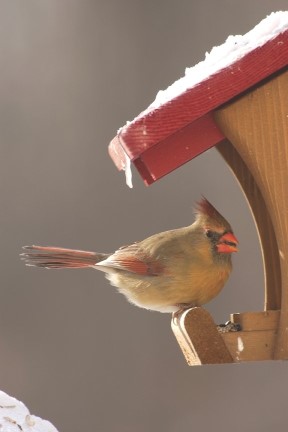
Female Northern Cardinal at Hopper Feeder

Time to evaluate the large hopper feeder, which holds an abundance of seed. I am relieved when the birds visit first thing in the morning, proof they made it through another challenging night. I feel so fortunate to be able to provide them with readily available food that has no shells, allowing for quick energy. If it’s cold enough, birds can go through all of their fat reserves in one night just to keep alive.

More Joy with the foundational hopper feeder – keep it.

Specialty Feeders

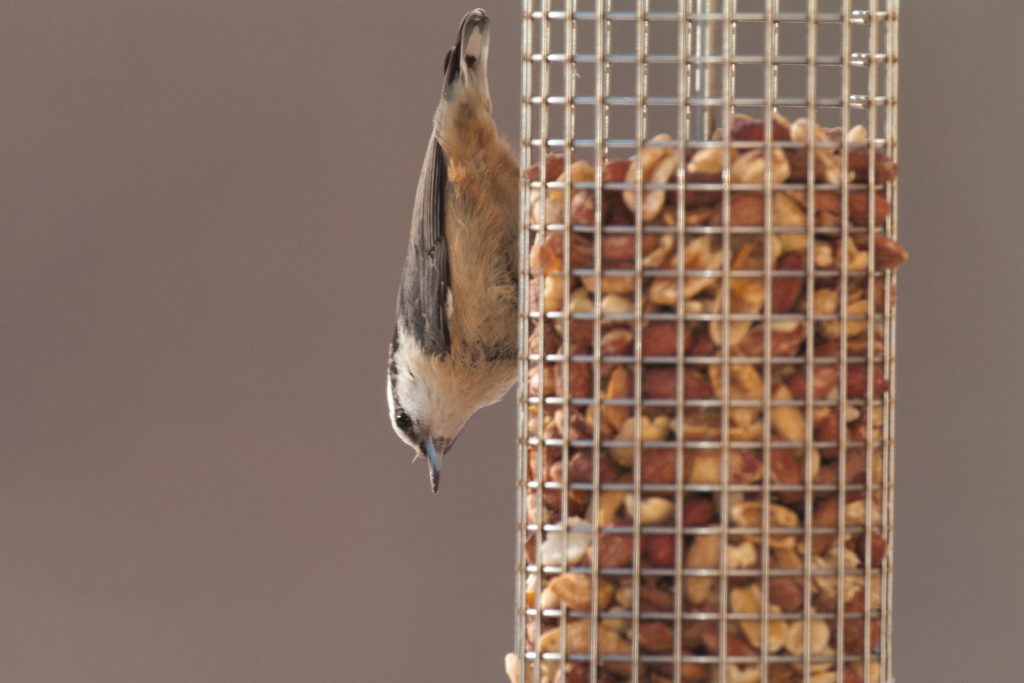
Red-breasted Nuthatch (Photo by Bill Rapai)

Then there is the peanut feeder, a draw for specific birds. It is certainly a favorite of Red-breasted Nuthatches that cling on upside-down.  I love to watch their bodies teeter back and forth like little sledge hammers as they pound away to extract a peanut. They make the dearest sounds, similar to small squeak toys. It has been an irruptive season for Red-breasted Nuthatches and I wouldn’t want to miss a moment of them.

Joy with my peanut feeder – keep it!

Tufted Titmouse on Dinner Bell Feeder

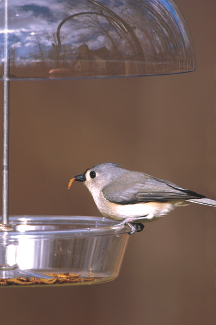
Finally, my thoughts turn to the variety of foods I offer the birds when I’m in a time crunch. For example, I can simply open a bag of Bark Butter Bits and pour them into my Dinner Bell feeder. This feeder is the most versatile and I dare say one of my absolute favorites. I can lower the weather dome so just the smaller birds fit between the tray and the dome, even excluding House Sparrows if low enough. It gives the Black-capped Chickadees a place they can dart to, picking up the beak-sized Bark Butter Bit and flying off to a branch. It is so fun to watch as they hold it in their feet and eat it with dainty bites. The Dinner Bell is also great for mealworm feeding. Mealworms give birds the protein they need for feather production when molting and for calcium when they are ready for egg-laying season.

Okay – Joy with my Dinner Bell Feeder – keep them.  Both of them.

So much for ridding myself of the “clutter” of bird feeders. Anything that bring me this much Joy is a keeper!

Posted in Bird Feeding Solutions, Spring, Wild Bird Facts | Tags: bird feeder, birds, blue jay, chickadee, declutter, finch, Spring, tidy, wild birds, wild birds unlimited, Winter, woodpecker | Leave a comment |

Winter Tree Birds

Posted on February 4, 2019 by Rosann Kovalcik

After spring and summer, the majority of birds in Michigan leave for the south. Their instincts pull them to return to wherever they have a full diet of insects and fruits. Those winter birds that stay for the colder months are marvels at finding food. What can they possibly eat? How do they find food?

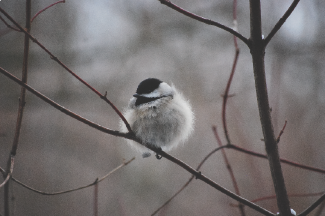
Black-capped Chickadee

Chickadees: The Flock Masters

Whenever I hear the calls of Chickadees in winter, their “dee dees” catching my attention, I know to look for them if I want to locate other winter birds. The Chickadees are what I call the “Flock Masters”. Very hardy and inquisitive, they are usually the first to locate a food source, whether natural foods or those found at feeders. Other birds are keen to the Chickadees’ ability to find food.

Downy Woodpeckers, Tufted Titmice, White-breasted Nuthatches and Brown Creepers make up the companion group that follow Black-capped Chickadees as they forage for food. Even those birds that come to our feeders for sunflower, suet and peanuts will continue to forage for natural foods. They eat what protein they can find, including insect eggs and cocoons, in addition to the insects hidden within the trees. They perform a great service as they keep our trees healthy and strong.

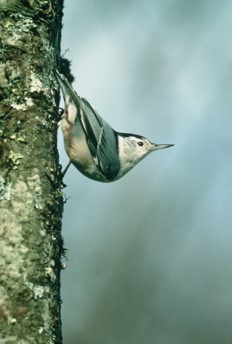
White-breasted Nuthatch

Working on the tiny twigs of the trees is the smallest of the team, the Black-capped Chickadee. The ability to hang upside down and investigate with their sharp eyesight and small, probing beaks enables them to find the eggs and hiding insects on the smallest of twigs.


Tufted Titmice: The Cousins

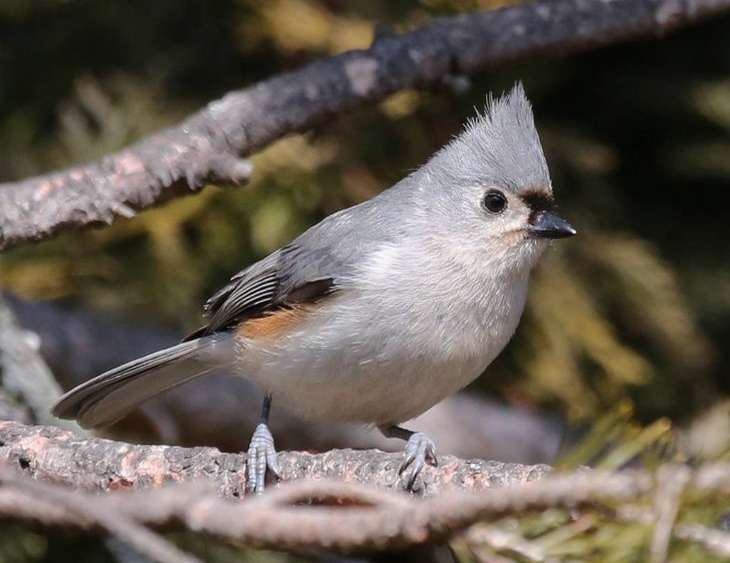
The Tufted Titmouse, a cousin to the Black-capped Chickadee, is a little larger and can focus its energy on the larger twigs. They work more slowly and usually move around in mated pairs. Their comparatively louder calls ring out clearly in the winter time, as “Peter, Peter” or “Cheer, Cheer, Cheer.” Titmice are also adept at hanging on to branches in an acrobatic manner. Sometimes when they are very intent on their food gathering, their head crest will remain down. At other times, the feathers of their crest become erect as a warning. Perhaps they feel a hawk is in the area or a squirrel is getting too close to their food source and they do not want to share.

Tufted Titmouse (Photo by John Graffius)

Downy Woodpeckers: The Listeners

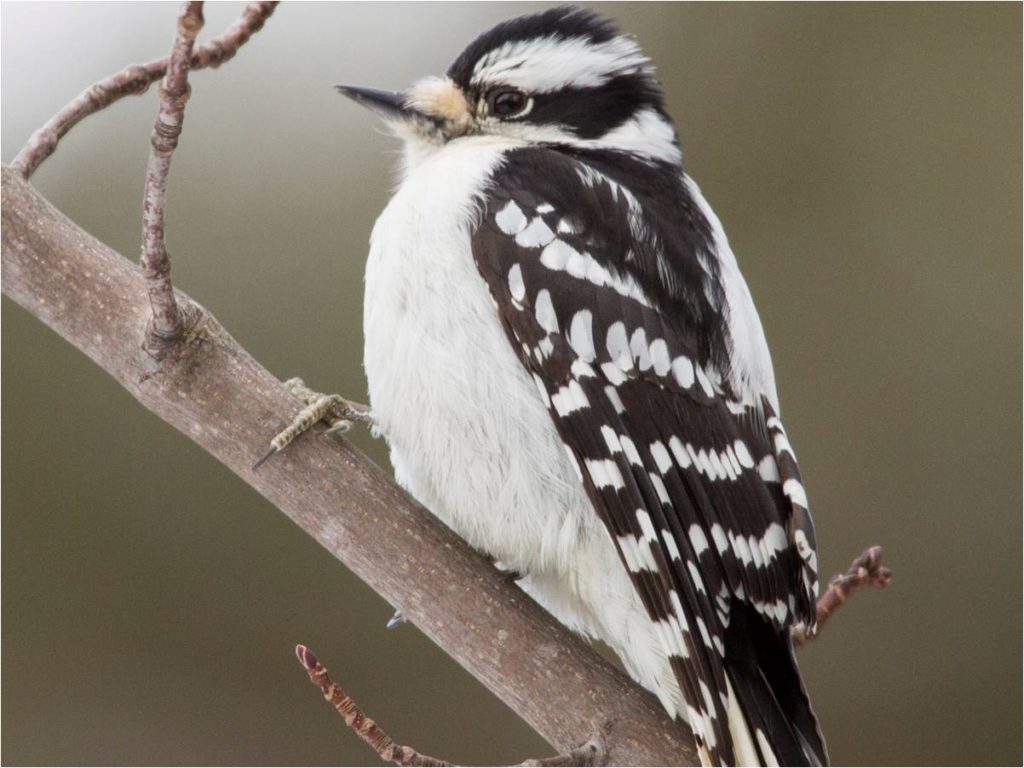
The Downy Woodpecker is an even larger bird in the team of Winter Tree Birds. They work on the limbs and larger branches of the tree. Not only do they look for insects, eggs and cocoons on the branches of the trees, they listen for the sound of insects moving inside the trees. This is why you may watch a Downy Woodpecker clinging to the side of the tree, moving its head from side to side – it is listening for the insects. Once it locates them, it uses its small beak to chisel a hole and extract the insects inside. A woodpecker has special tools for this function, a barbed tongue with sticky saliva that is excellent for extracting the insects it finds.

Downy Woodpecker

Nuthatches & Creepers: The Bark Bandits

The deep cracks in the bark of some trees are a perfect place to find cocoons, insects, and eggs, sheltered from rain and snow. This is where the White-breasted Nuthatch and Brown Creeper are very adept – their beaks well-suited to the job. White-breasted Nuthatches have a thin dagger-like bill that is slightly upturned on the bottom edge to create an angle, perfect for the type of feeding it does. When seeking food, the Nuthatch travels upside down and from top to bottom on the tree trunks. This allows them to find the food the right-side-up birds do not see.

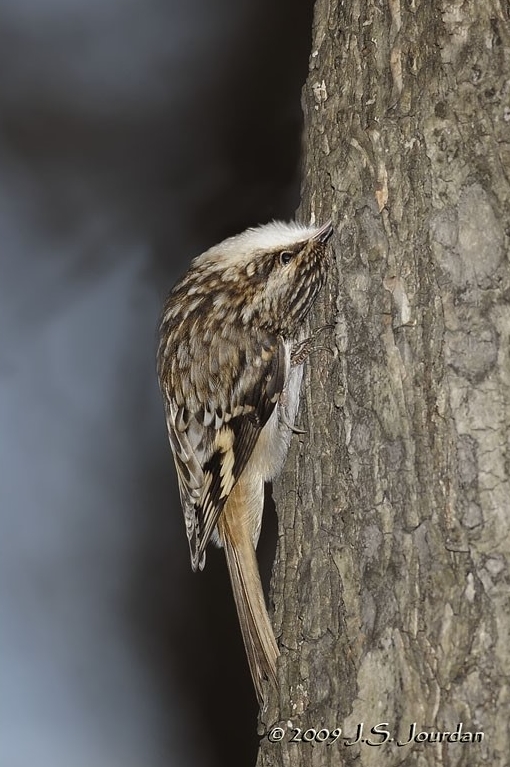
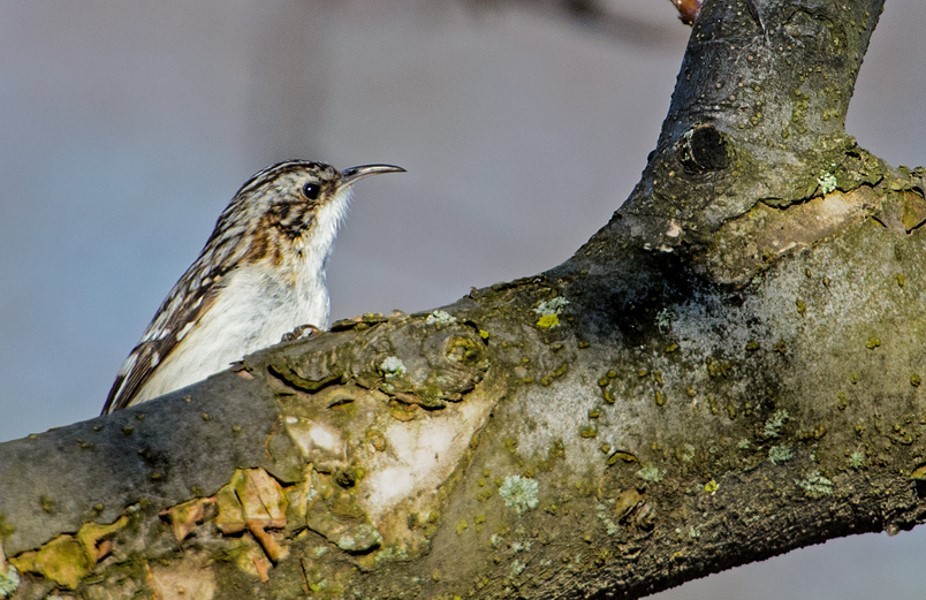
On the other end of the spectrum is the Brown Creeper, who can be identified by its behaviors. Flying from one tree to another, the Brown Creeper lands at the base of the tree and work its way up, searching along the bark for food, and circling the tree as it climbs. Its long, needle-like bill allows for deep probing within the nooks and crannies of trees. This bird eats only insects in the winter – an admirable accomplishment.

Brown Creeper (Photo by Jerry Jourdan)

Brown Creeper

The Black-capped Chickadee takes care of the tiny twigs, the Tufted Titmouse gleans from the larger twigs, the Downy Woodpecker from limbs and branches and the White-breasted Nuthatch and Brown Creeper take from the trunks and larger branches of the trees, travelling in opposite directions. By working as a team, these five species of birds help to keep our trees healthy and strong.

Enjoy your birds!!

Rosann Kovalcik, Owner

Wild Birds Unlimited, Grosse Pointe Woods


Have you joined our email list? Click here to sign up, it’s free and gives you access to sales, coupons, nature news, events, and more!
Posted in Wild Bird Facts, Winter | Tags: birds, brown creeper, chickadee, Grosse Pointe Woods, nature, nuthatch, trees, wild birds unlimited, Winter, woodpecker | Leave a comment |

Recent Posts

  • Welcome the Wood Duck as our State Duck
  • Killdeer – our most common Plover returns
  • Red-tailed Hawks, the Common Buteo
  • Bald Eagles –
  • What other owls can you find ?

Archives

  • March 2026
  • March 2023
  • February 2023
  • January 2023
  • April 2022
  • March 2022
  • December 2021
  • September 2021
  • April 2021
  • March 2021
  • May 2020
  • April 2020
  • February 2020
  • January 2020
  • November 2019
  • August 2019
  • July 2019
  • March 2019
  • February 2019
  • December 2018
  • October 2018
  • August 2018
  • July 2018
  • May 2018
  • April 2018
  • March 2018
  • January 2018
  • December 2017
  • November 2017
  • October 2017
  • September 2017
  • August 2017
  • July 2017
  • May 2017
  • April 2017
  • February 2017
  • January 2017
  • December 2016
  • October 2016
  • September 2016
  • August 2016
  • July 2016
  • May 2016
  • February 2016
  • October 2015
  • August 2015
  • July 2015
  • June 2015
  • March 2015
  • October 2014

Categories

  • Bird Feeding Solutions
  • Bird Songs
  • Events & Outings
  • Fall
  • Native Plants
  • Nesting
  • Spring
  • Squirrels
  • Summer
  • Uncategorized
  • Wild Bird Facts
  • Winter

Enter your email address:

Delivered by FeedBurner

  • 1
  • 2
  • Next
© Wild Birds Unlimited of GPW - Website by TBD Web Services