
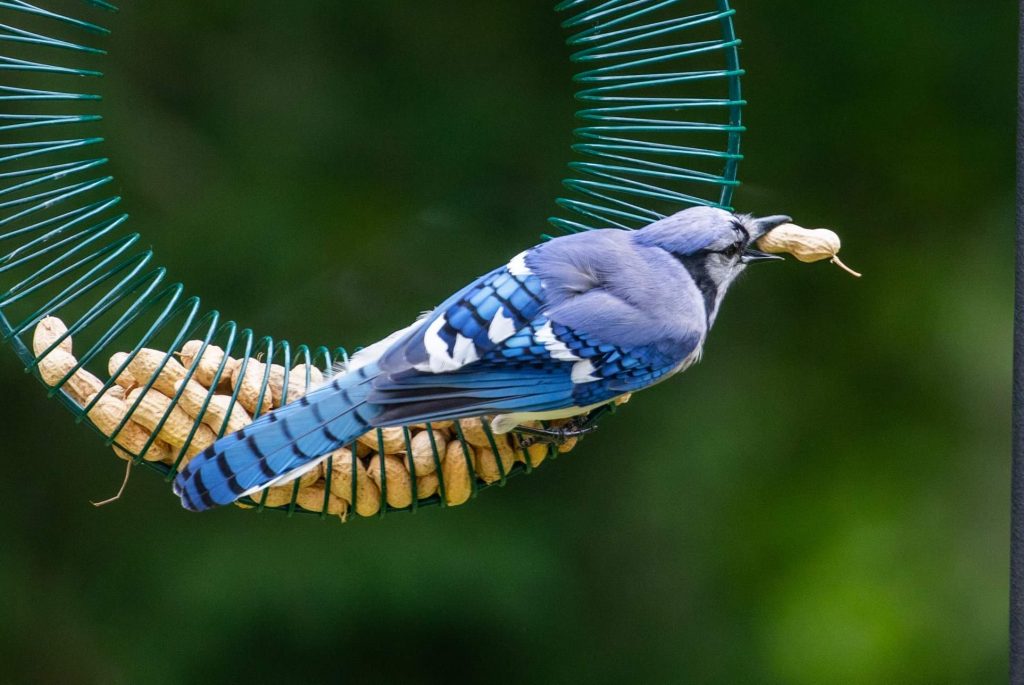
Blue Jay with Peanut by Emily Wolfe
Blue Jays – The Sights and Sounds
I find Blue Jays to be fascinating – I’m listening to them now as they sing out their “tootle-oot, tootle-oot” from the oak tree. They have such a rich complexity of vocal sounds. The same can be said about their plumage, a rich complexity of blues of every shade. Such a handsome bird with both males and females looking alike, their faces framed by a dark collar. Perhaps one of their finest features is their crest, raised and lowered at will depending upon their mental state – up when alert, feeling territorial, and down when there’s no reason, giving the back of the head a little “flair”.
The Brains
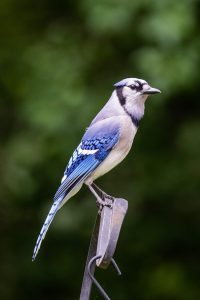
Blue Jay by Emily Wolfe
Jays play an important role among the birds in our yards. They will sound the “Jay! Jay!” alarm when a potential predator is nearby. This allows all of the birds to be on the lookout for the hawk, cat or human that caused the Jay to give the neighbors a warning. One of the most amazing vocalizations of the Blue Jay is their ability to vocally imitate hawks – they have turned my head with the calls of a Red-shouldered Hawk and a Broad-winged Hawk, only to spot them in my binoculars. And just a few short minutes after I wrote that, I heard a Cooper’s Hawk calling from the rooftop – except it was a Blue Jay. Perhaps he was using this as a scare tactic to keep the other birds away so he could swoop down and feed on the seed cylinder I had just put out. Smart move.
Blue Jays can be entertaining and unafraid in your yard. They will come quite close when any kind of a nut is involved as they naturally seek the mast of trees. Capable of storing a few acorns in their gular pouch, a holding area in the throat, they will transport the acorns to an area to stash away. Placing the acorns on the ground and covering them with leaves, or pushing them into the soil with their strong beaks, they hope to save them for future food. Many of those acorns will grow into trees and in this way, the Blue Jay plays forester for us.
Peanuts in the shell evoke the same mental response in Jays. They simply cannot resist them when offered and will carry them away where they can hold them with their feet and use their beak to break away the shell and eat the protein-packed nut inside.
Blue Jay
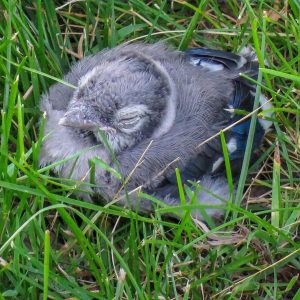
Baby Blue Jay by Samantha Mason
The Babes
Both male and female Blue Jays take an active part in raising their brood of two to seven. They are quite secretive during nesting season as they find food for their young and deliver it to the nestlings. Jays are omnivorous and will eat a wide variety of plants and animals. Once the young fledge the nest, they will travel in family groups for feeding purposes. You can hear their contact calls to each other as they move about the trees.
Movement
Blue Jays take part in their spring and fall migration in very large numbers. They migrate in daytime flocks, unlike many of the small passerines that use the cover of night for migration. We have seen these flocks of hundreds of Blue Jays flying over us at the Ford House during our bird walks. The wing beats blink light and dark flashes as they travel along – a magnificent sight.
Enjoy this adaptable, gorgeous bird and all of the vocalizations that make Jays so unique.
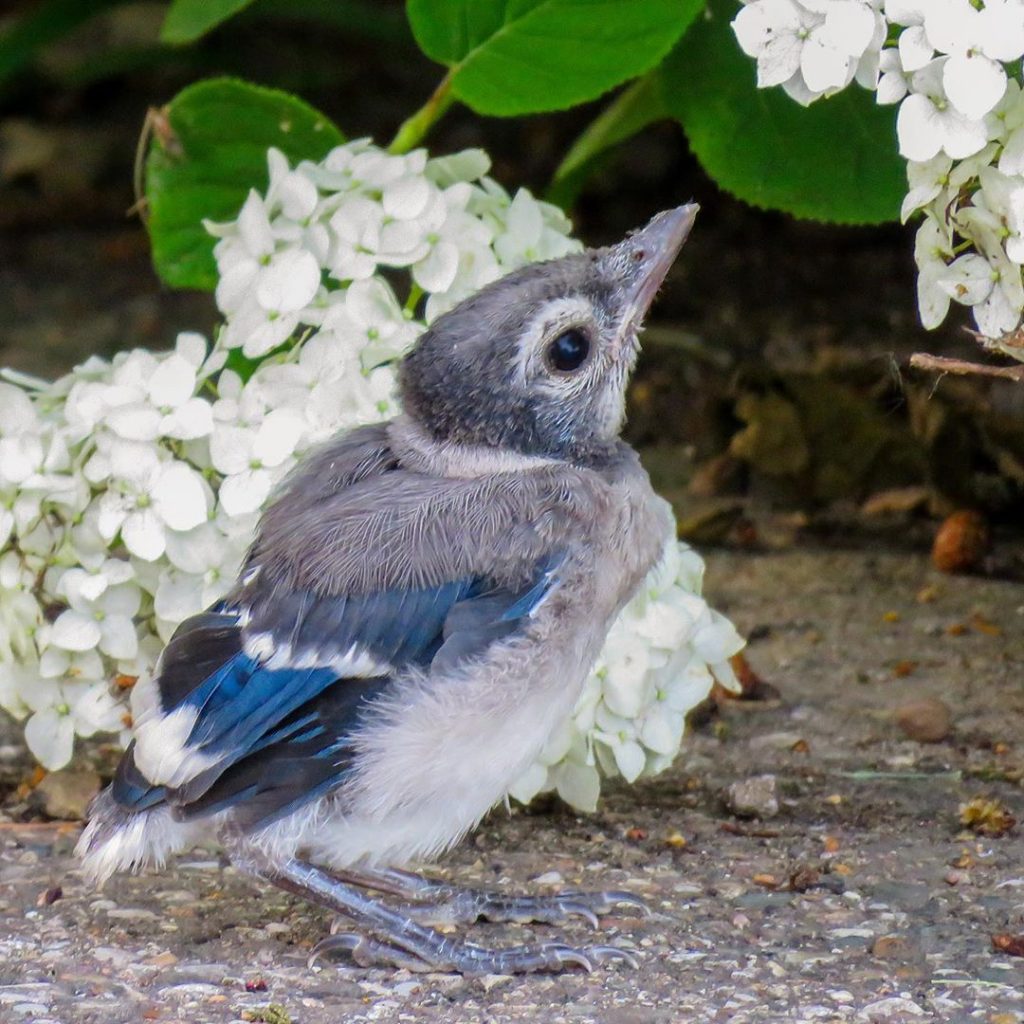
Baby Blue Jay by Samantha Mason
Enjoy your birds!!
Rosann Kovalcik, Owner
Wild Birds Unlimited, Grosse Pointe Woods
Have you joined our email list? Click here to sign up, it’s free and gives you access to sales, coupons, nature news, events, and more!