• Home
  • About Us
  • Blog

Category Archives: Winter

Cedar Waxwings

Posted on January 15, 2020 by Rosann Kovalcik

Cedar Waxwings – An Introduction

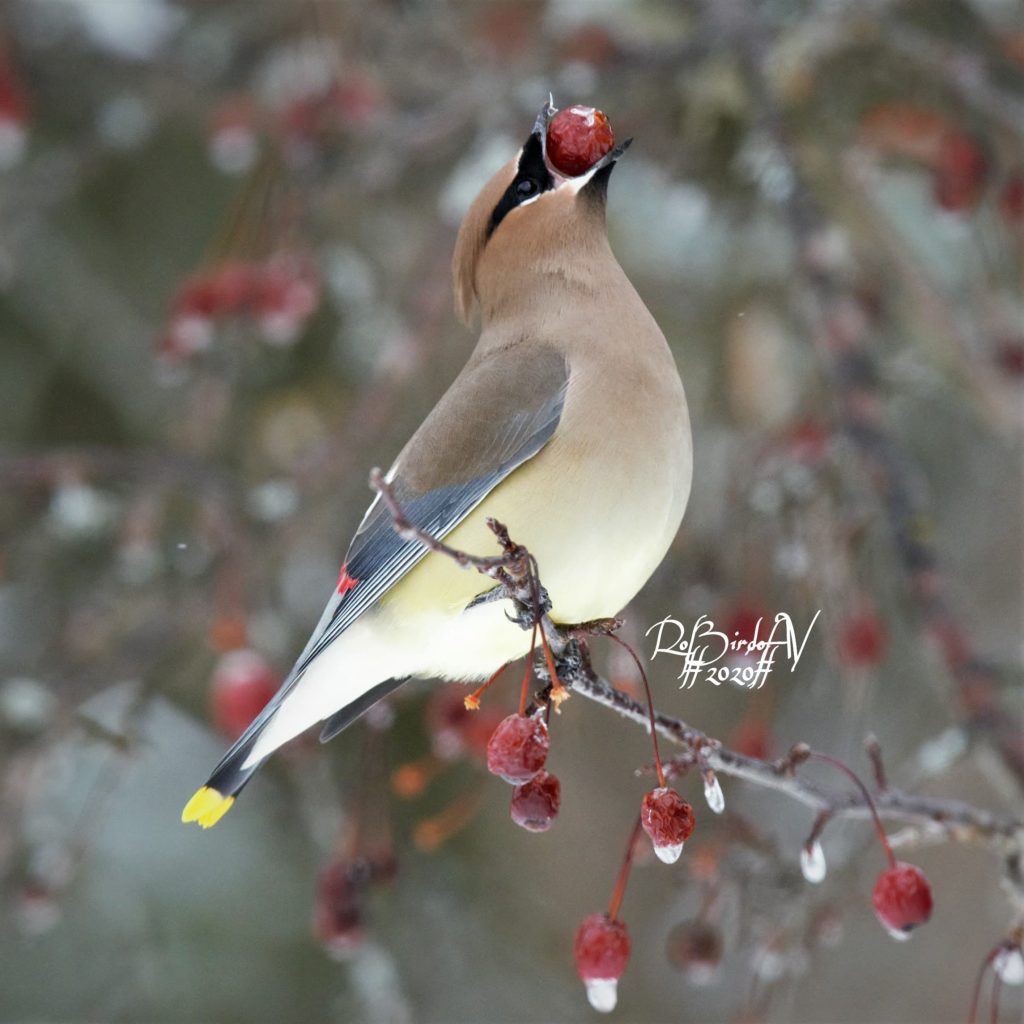
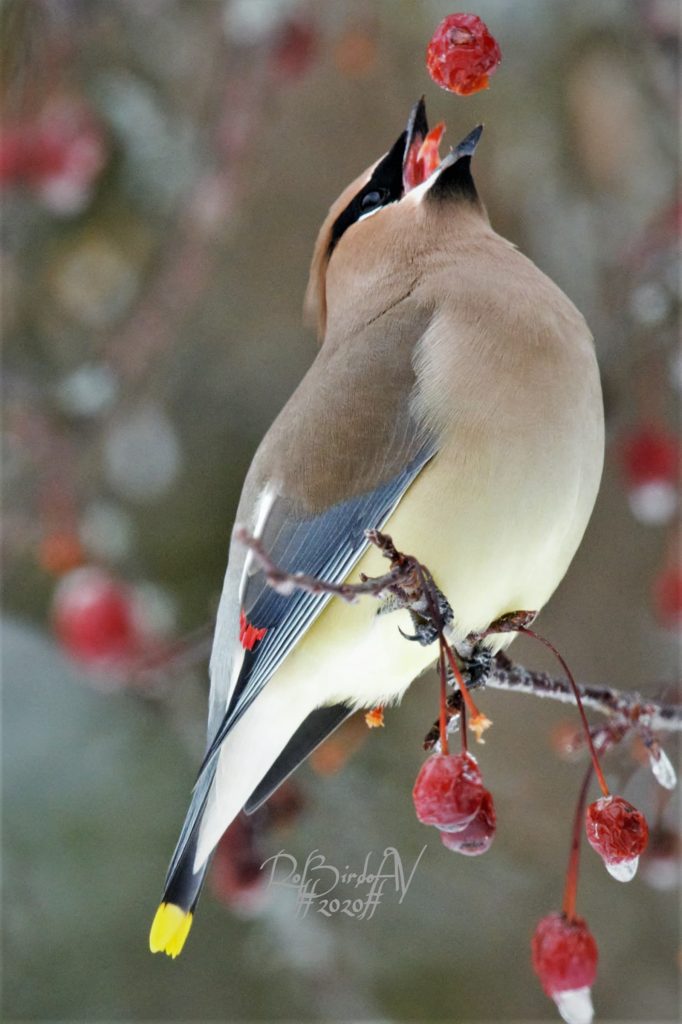
How fabulous-looking are Cedar Waxwings? The plumage appears soft and perfectly groomed. The facial mask is so striking. The wings have tips that appear as if they have been dipped in bright red wax. The bird has an elegant look, its tail edged in yellow, its head topped with a feathery crest. Winter is a great time to look for these birds as they eat fruit. You’ll find them travelling in flocks, often congregating near trees with berries.
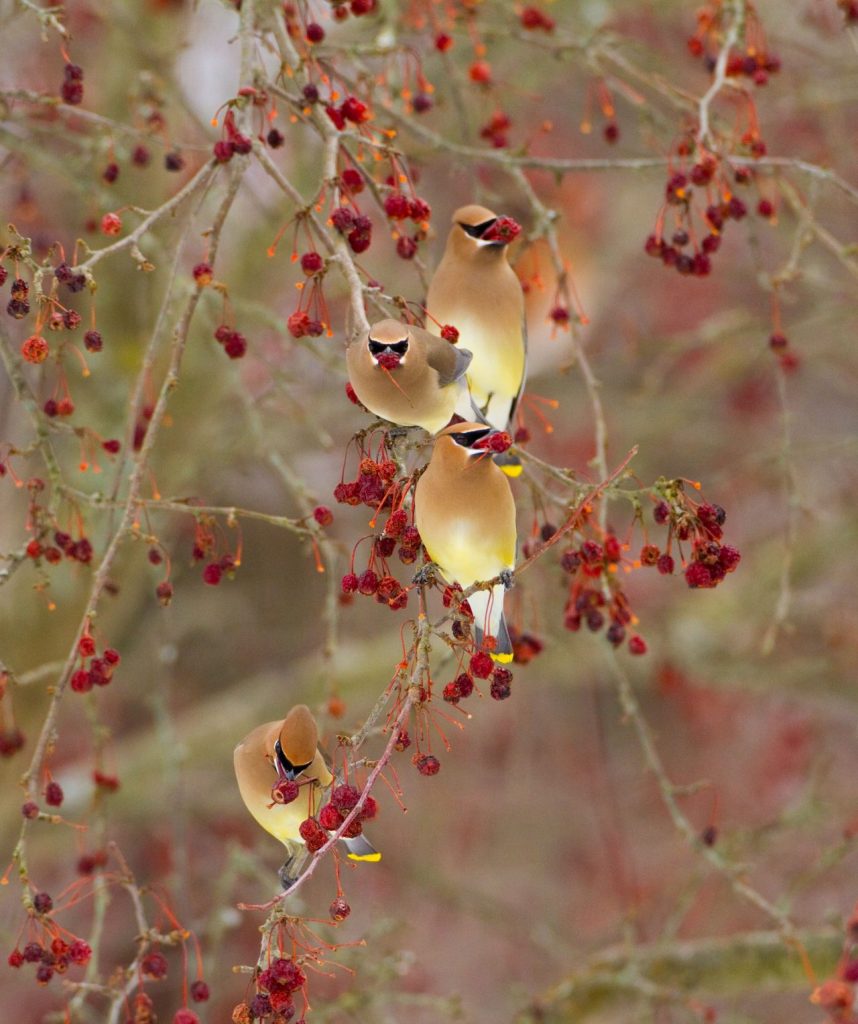
My most recent experience with Cedar Waxwings was at Ira Township Park in New Baltimore. A group of 45 of them attracted my attention, sitting in the sunshine at the tops of trees. They flew down a few at a time to an area behind tangled vines where a creek could be accessed. Daintily dipping their beaks, some drank from the running stream while others stood sentinel above. Such a peaceful sight made the winter walk so rewarding.

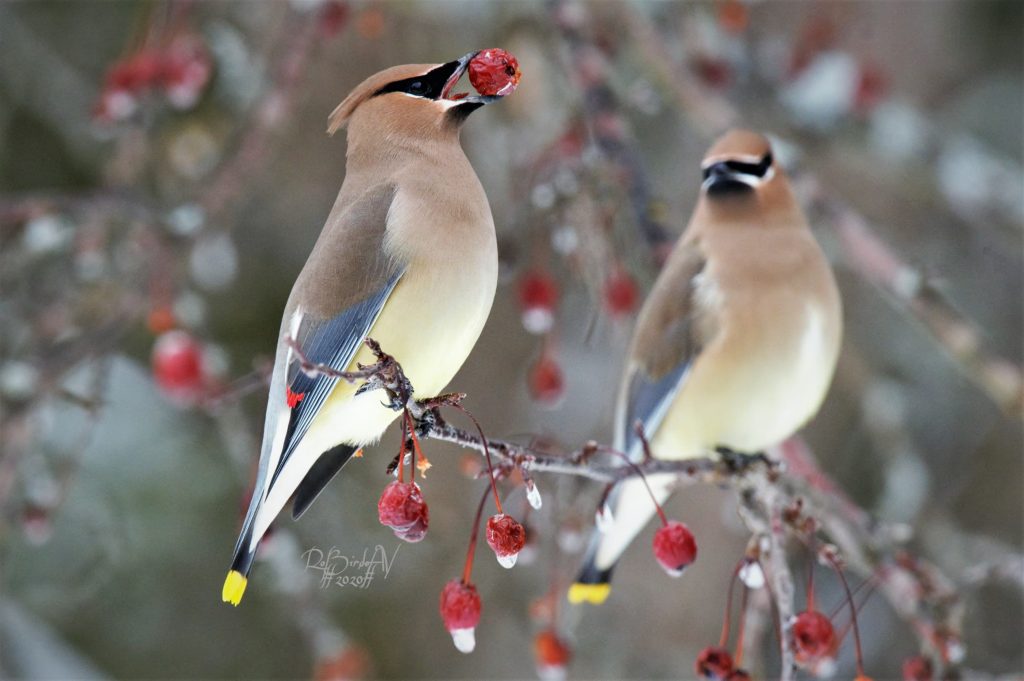
Cedar Waxwings are known to pass fruit back and forth. This can be a courtship ritual or bonding between a mated pair. Many times it is not just one bird that passes the fruit. Rather, two birds may pass back and forth until one bird finally eats the berry, typically the female.

On a Personal Note…

The Cedar Waxwing was a prominent bird in the book “Mystery on Mackinaw Island”. The librarian in this story had a stuffed Cedar Waxwing and used it as a signal to let the main character, a young boy, know she needed to see him. The dead bird had been found by him outside of the library when he was nine years old and he gave it to her. The book was a page turner for me – how couldn’t I love a book where the main character aspired to become “a real Bird Man”.

The book came to my attention when I spoke with Kathy Schmitz, a teacher at Kerby Elementary School in Grosse Pointe Farms. Her class was reading the book and she discovered the Cedar Waxwing was our bird of the month for our coloring contest! I look forward to seeing the masterpieces from these children. I hope they feel more deeply connected to the story and the main character as a result of this artistic enterprise.

Thinking Bigger

What can you do to become more engaged and attuned to Cedar Waxwings? Give serious consideration to planting fruiting trees for these beauties. They can subsist for months on a diet of fruit alone. Cornell Laboratory suggests juniper, mountain ash, crabapple and hawthorn as well as their namesake cedars for winter fruit. In summer, serviceberry, strawberry, mulberry, raspberries and dogwoods all provide a good food source. Envision your yard as a place to welcome these lovelies, as you make your planting plans. Get outside and search for berries, and you may be rewarded with some sights similar to these fabulous photographs, compliments of Roberto Viguilla and Marie Read.
Posted in Wild Bird Facts, Winter | Tags: bird watching, birds, cedar waxwing, mystery on mackinac island, native plants, nature, wild birds unlimited | Leave a comment |

Where are the Juncos?

Posted on January 9, 2020 by Rosann Kovalcik

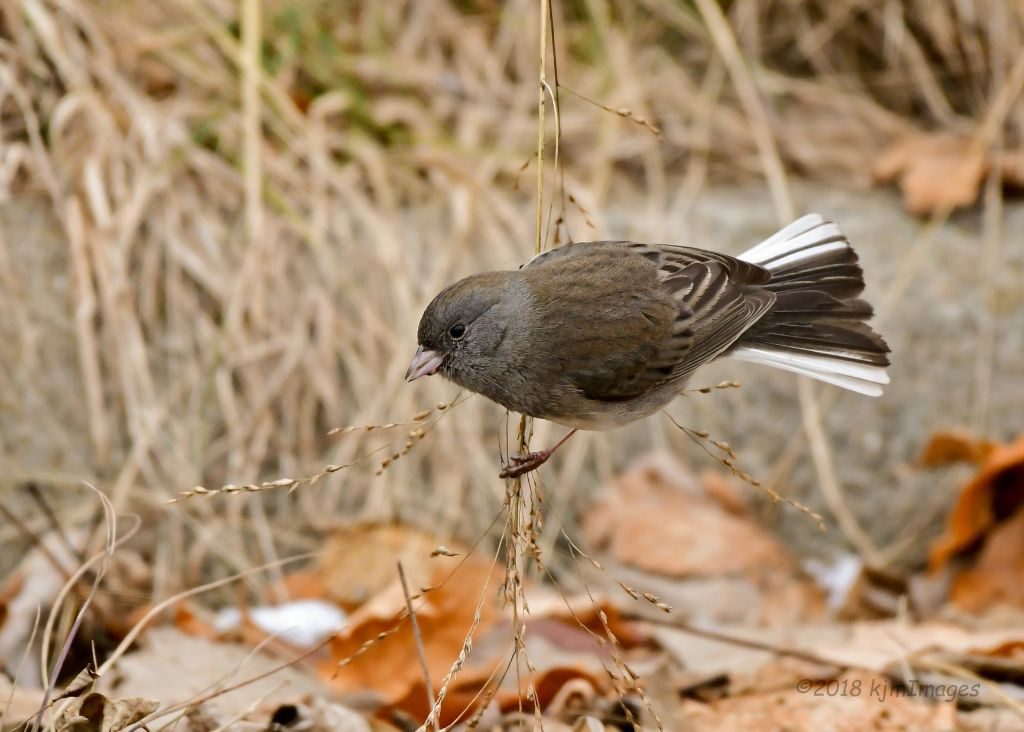
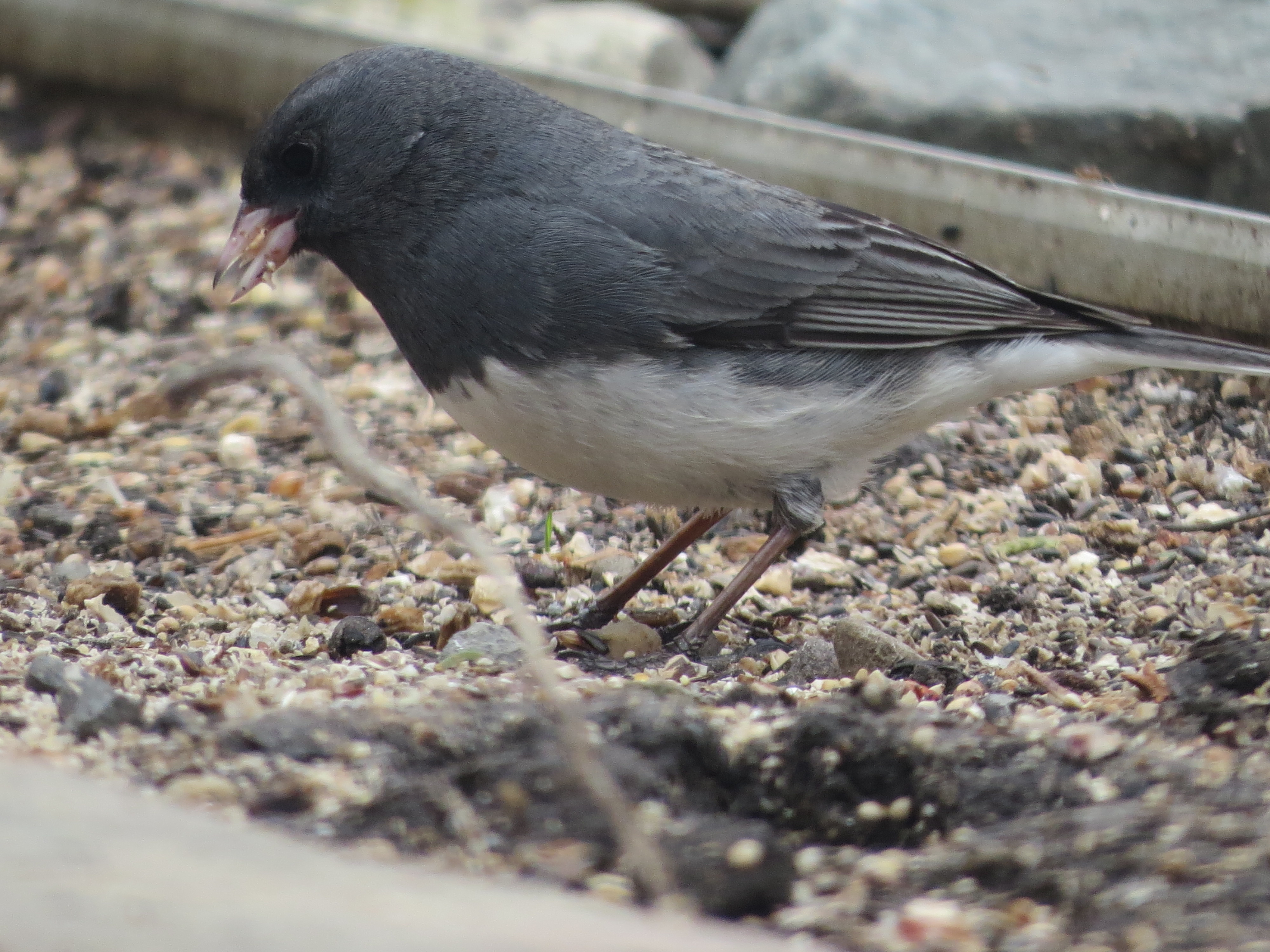
Dark-eyed Junco by Kevin Murphy, Eliza Howell Park, Detroit

Where are all the Juncos?

We have had a number of customers recently ask where the Dark-eyed Juncos have been. Many have not yet seen them at the feeders this winter. My best experience with Juncos this year has been when we had a recent small snowfall. They were perched on the stems of plants I leave up all winter to provide seeds for the birds.

Now that we are not experiencing snow cover, the seeds available to Juncos make their visits to our feeder less of a necessity. I have been missing their subtle gray coloration and their white “snowy” bellies. I also love that their two outer tail feathers are white on each side, looking like a cheerleader skirt as it flies or spreads its tail.

To attract them to your yard, offer White Proso Millet on a tray feeder. The feeder can be on legs and close to the ground, or on a pole system and higher off of the ground. Either way, this stable platform allows them to eat in a way that true sparrows prefer, simulating their groundfeeding preference.

Enjoy this winter visitor while you can!

Rosann Kovalcik, Owner

Wild Birds Unlimited, Grosse Pointe Woods

Have you joined our email list? Click here to sign up, it’s free and gives you access to sales, coupons, nature news, events, and more!


Posted in Bird Feeding Solutions, Winter | Tags: climate, dark-eyed junco, Grosse Pointe Woods, junco, millet, seasonal, snow, sparrow, weather, wild birds, wild birds unlimited, Winter | Leave a comment |

Christmas Tree – Artificial vs. Real

Posted on November 21, 2019 by Rosann Kovalcik

Tradition vs. Change

What a beautiful tradition it is to bring the outside within our homes at the holidays, featuring trees, wreaths and garlands. Who doesn’t have a photo with the family in front of the Christmas tree?

The choice we make as to whether we buy a real tree or an artificial one does have an impact on the world our birds call home. Manufacturing these trees requires fossil fuels. This means, when they are trashed within a landfill, they will not decay. Overseas manufacturing and shipping processes also leave a large carbon footprint.

Sounds like a real Christmas tree is the most environmentally friendly answer. Grown right here in our state of Michigan, the trees produce oxygen while they are growing as well as sequestering carbon. Tree farms will use the same spaces to plant again after harvest, a sustainable way to farm.

Things to Consider

If you are buying a real tree, there are some important factors to consider.

Photo by Lori Campbell

Ask your retailer these questions or research about their farm or shop – do they follow Integrated Pest Management practices and avoid the use of pesticides when possible, and do they practice water conservation?

Just as we have experienced with firewood, real trees used at the holiday can harbor non-native invasive pests. Trees that are grown in one area and then transported to be sold in another area may spread invasive pests such as gypsy moths, balsam woolly adelgid and Phytophthora ramorum, the fungus-like pathogen that causes sudden oak death.

The best way to minimize the chance of introducing a new pest to your neighborhood is by getting a locally sourced tree. Follow these tips:

  • Purchase locally grown trees or greens for wreaths and garland.
  • Cut down your own tree from a local cut-yourself farm or nursery.
  • Obtain a permit and cut your own tree from a local forest within 10 to 20 miles of your house.
  • Buy a pre-cut locally sourced tree from an established local business.
  • Don’t use invasive species such as Asian bittersweet in holiday decorations

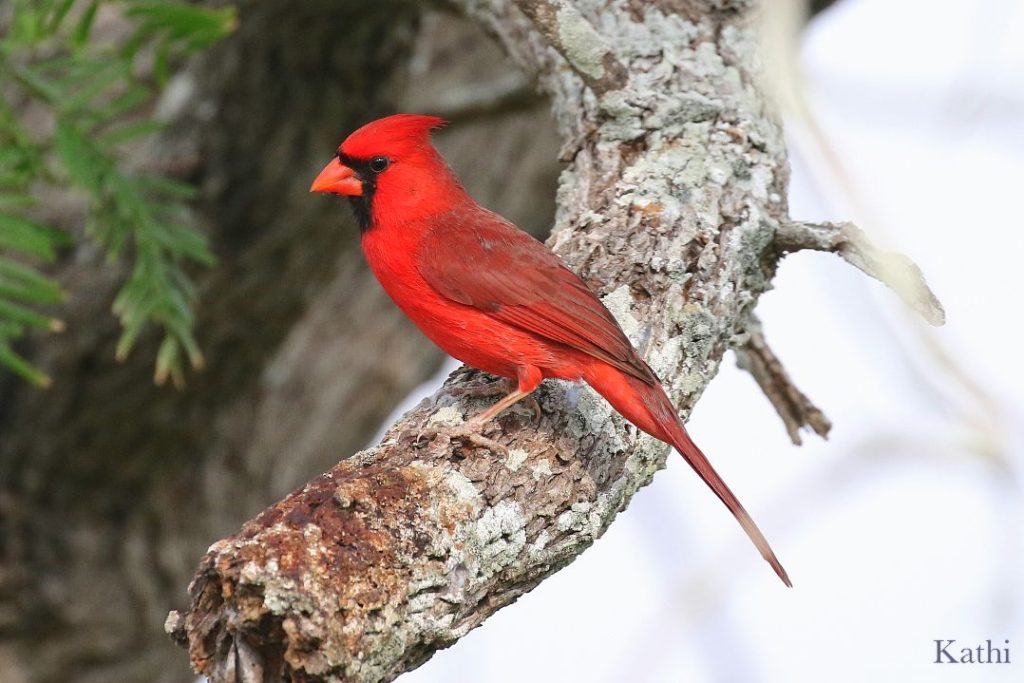
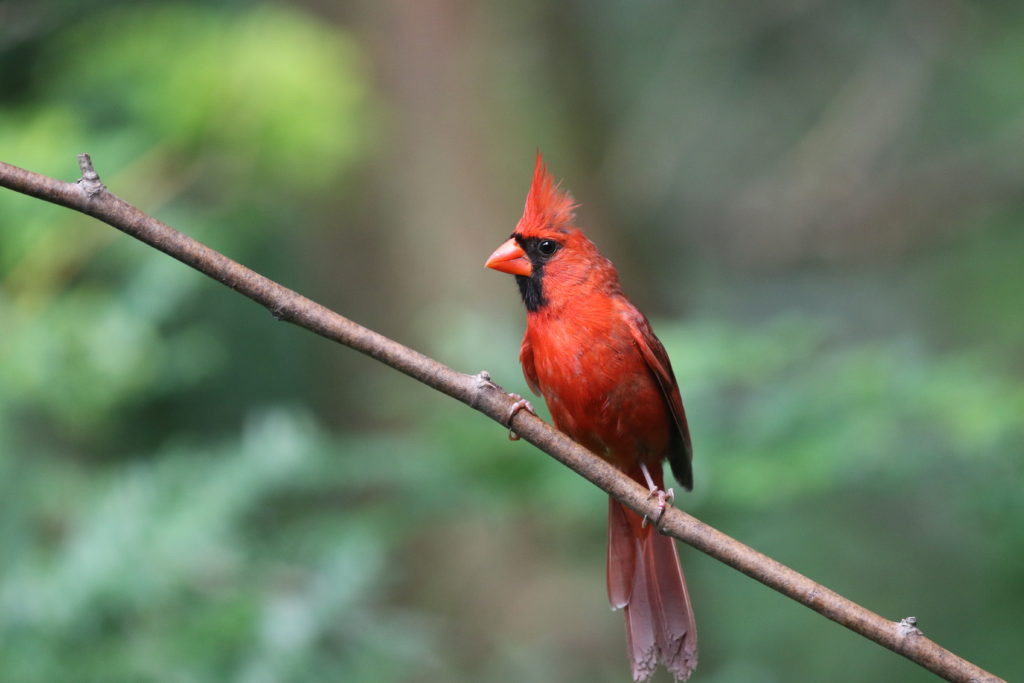
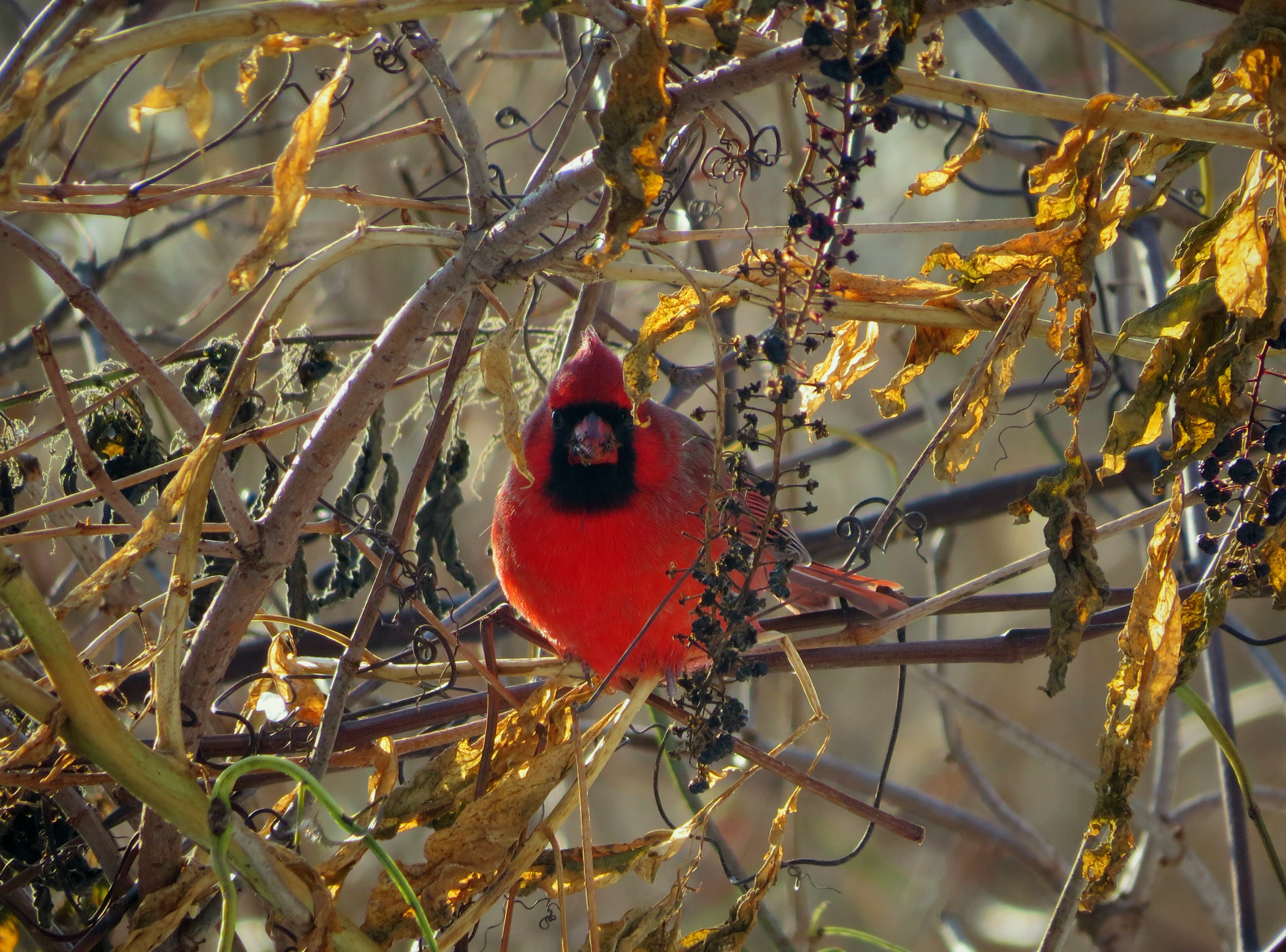
And once you are done with the tree, place it in the yard as shelter for your Cardinals. After all, nothing looks better on an evergreen than a Cardinal!

Northern Cardinal by Kathi Hince

Posted in Winter | Tags: Cardinal, christmas, christmas tree, december, Grosse Pointe Woods, holiday, locally sourced, november, wild birds unlimited | Leave a comment |

Winter Tree Birds

Posted on February 4, 2019 by Rosann Kovalcik

After spring and summer, the majority of birds in Michigan leave for the south. Their instincts pull them to return to wherever they have a full diet of insects and fruits. Those winter birds that stay for the colder months are marvels at finding food. What can they possibly eat? How do they find food?

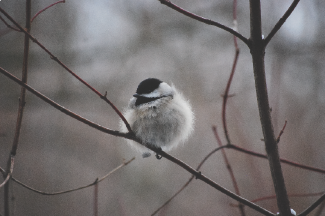
Black-capped Chickadee

Chickadees: The Flock Masters

Whenever I hear the calls of Chickadees in winter, their “dee dees” catching my attention, I know to look for them if I want to locate other winter birds. The Chickadees are what I call the “Flock Masters”. Very hardy and inquisitive, they are usually the first to locate a food source, whether natural foods or those found at feeders. Other birds are keen to the Chickadees’ ability to find food.

Downy Woodpeckers, Tufted Titmice, White-breasted Nuthatches and Brown Creepers make up the companion group that follow Black-capped Chickadees as they forage for food. Even those birds that come to our feeders for sunflower, suet and peanuts will continue to forage for natural foods. They eat what protein they can find, including insect eggs and cocoons, in addition to the insects hidden within the trees. They perform a great service as they keep our trees healthy and strong.

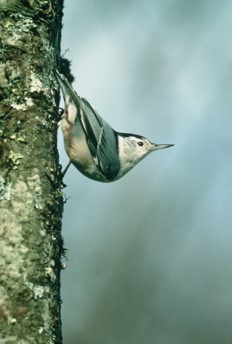
White-breasted Nuthatch

Working on the tiny twigs of the trees is the smallest of the team, the Black-capped Chickadee. The ability to hang upside down and investigate with their sharp eyesight and small, probing beaks enables them to find the eggs and hiding insects on the smallest of twigs.


Tufted Titmice: The Cousins

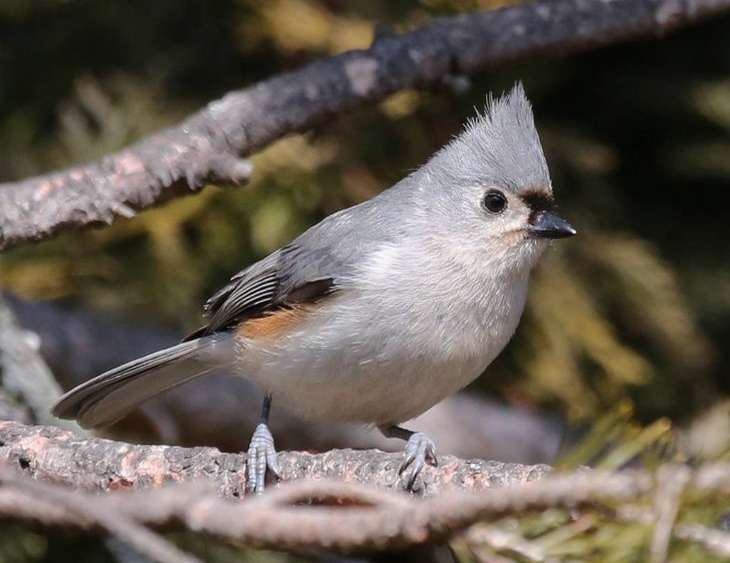
The Tufted Titmouse, a cousin to the Black-capped Chickadee, is a little larger and can focus its energy on the larger twigs. They work more slowly and usually move around in mated pairs. Their comparatively louder calls ring out clearly in the winter time, as “Peter, Peter” or “Cheer, Cheer, Cheer.” Titmice are also adept at hanging on to branches in an acrobatic manner. Sometimes when they are very intent on their food gathering, their head crest will remain down. At other times, the feathers of their crest become erect as a warning. Perhaps they feel a hawk is in the area or a squirrel is getting too close to their food source and they do not want to share.

Tufted Titmouse (Photo by John Graffius)

Downy Woodpeckers: The Listeners

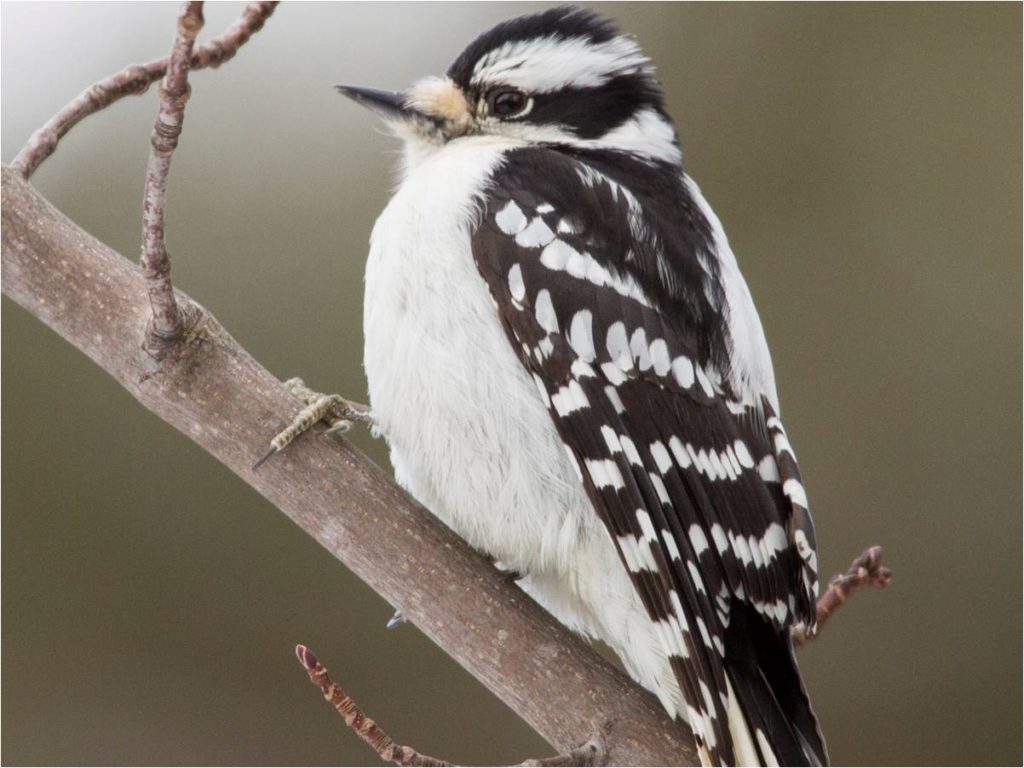
The Downy Woodpecker is an even larger bird in the team of Winter Tree Birds. They work on the limbs and larger branches of the tree. Not only do they look for insects, eggs and cocoons on the branches of the trees, they listen for the sound of insects moving inside the trees. This is why you may watch a Downy Woodpecker clinging to the side of the tree, moving its head from side to side – it is listening for the insects. Once it locates them, it uses its small beak to chisel a hole and extract the insects inside. A woodpecker has special tools for this function, a barbed tongue with sticky saliva that is excellent for extracting the insects it finds.

Downy Woodpecker

Nuthatches & Creepers: The Bark Bandits

The deep cracks in the bark of some trees are a perfect place to find cocoons, insects, and eggs, sheltered from rain and snow. This is where the White-breasted Nuthatch and Brown Creeper are very adept – their beaks well-suited to the job. White-breasted Nuthatches have a thin dagger-like bill that is slightly upturned on the bottom edge to create an angle, perfect for the type of feeding it does. When seeking food, the Nuthatch travels upside down and from top to bottom on the tree trunks. This allows them to find the food the right-side-up birds do not see.

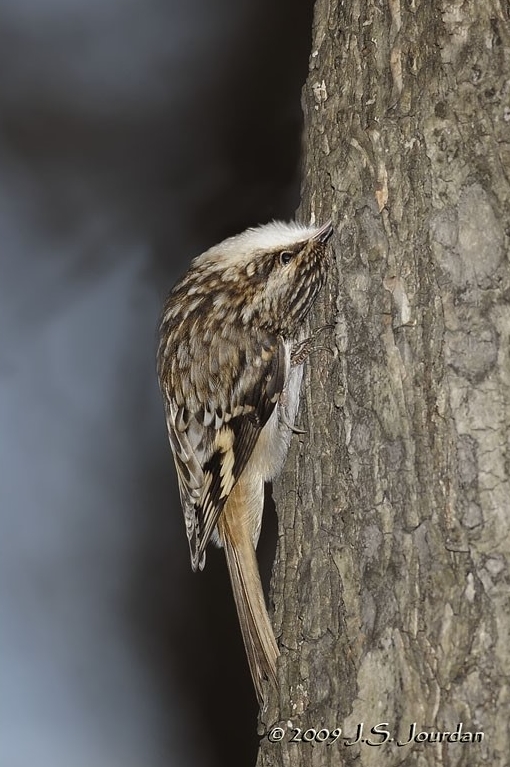
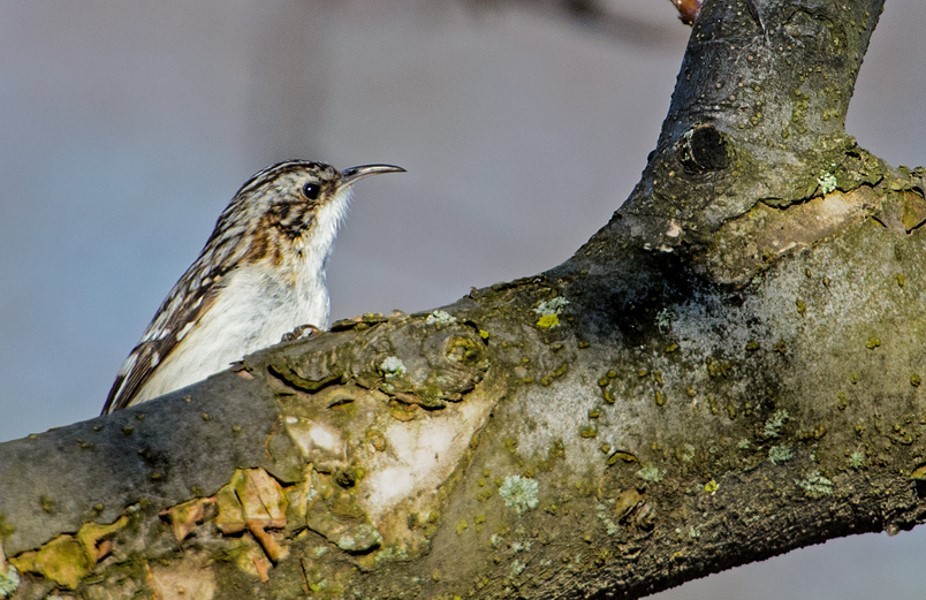
On the other end of the spectrum is the Brown Creeper, who can be identified by its behaviors. Flying from one tree to another, the Brown Creeper lands at the base of the tree and work its way up, searching along the bark for food, and circling the tree as it climbs. Its long, needle-like bill allows for deep probing within the nooks and crannies of trees. This bird eats only insects in the winter – an admirable accomplishment.

Brown Creeper (Photo by Jerry Jourdan)

Brown Creeper

The Black-capped Chickadee takes care of the tiny twigs, the Tufted Titmouse gleans from the larger twigs, the Downy Woodpecker from limbs and branches and the White-breasted Nuthatch and Brown Creeper take from the trunks and larger branches of the trees, travelling in opposite directions. By working as a team, these five species of birds help to keep our trees healthy and strong.

Enjoy your birds!!

Rosann Kovalcik, Owner

Wild Birds Unlimited, Grosse Pointe Woods


Have you joined our email list? Click here to sign up, it’s free and gives you access to sales, coupons, nature news, events, and more!

Posted in Wild Bird Facts, Winter | Tags: birds, brown creeper, chickadee, Grosse Pointe Woods, nature, nuthatch, trees, wild birds unlimited, Winter, woodpecker | Leave a comment |

Northern Cardinal – A Crimson Jewel in the Garden

Posted on March 5, 2018 by Rosann Kovalcik

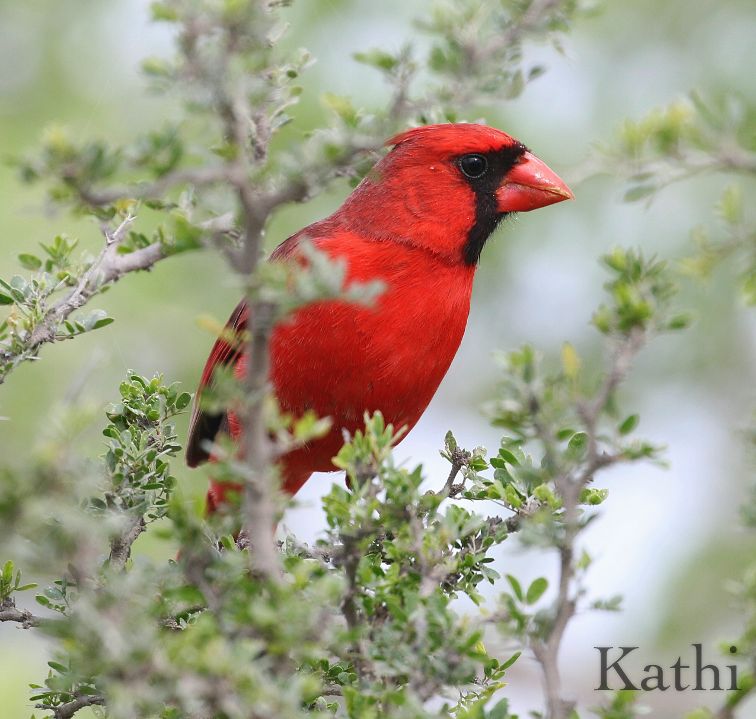
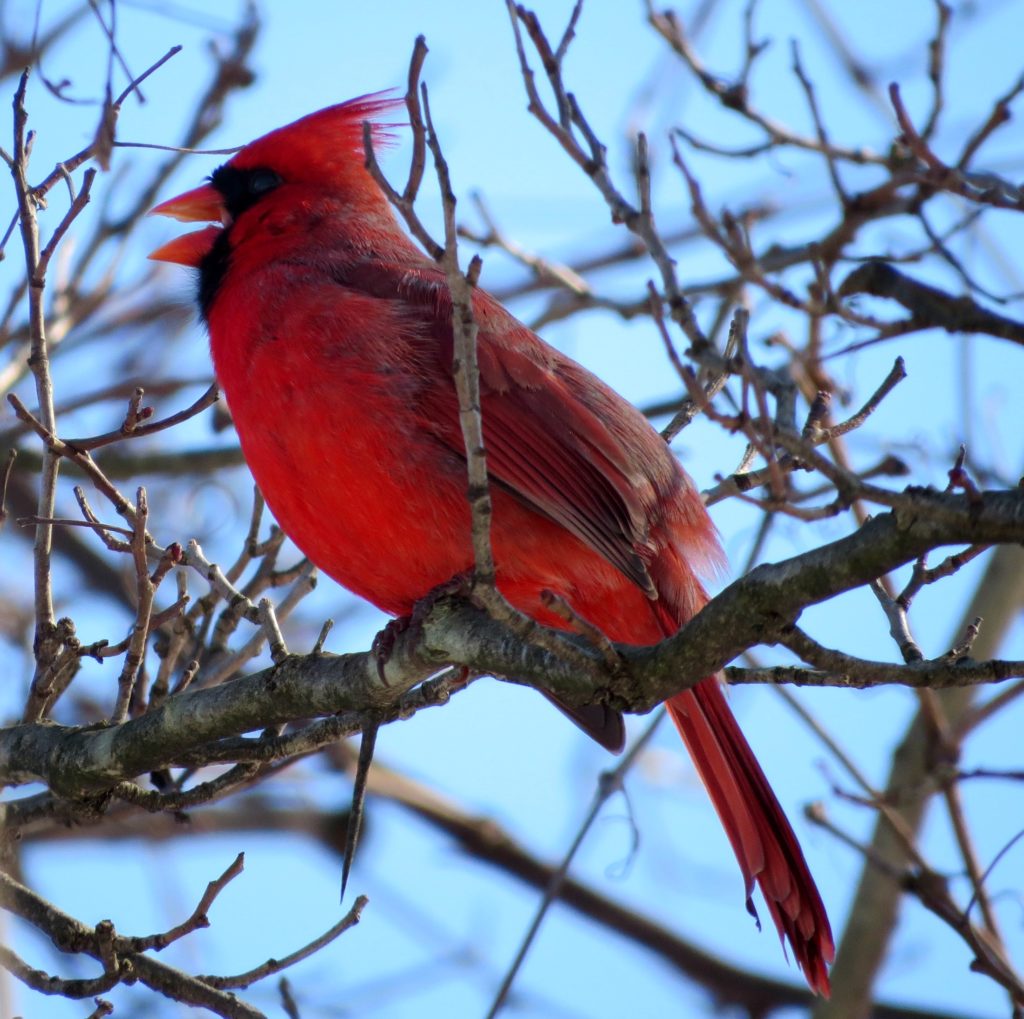
male Northern Cardinal by Kathi Hince

One of the moments I like most about late winter is hearing the Northern Cardinal beginning to sing. Prompted by the length of day, the Northern Cardinal sings to mark its territory.

If we’re lucky, we can hear two male Cardinals calling in tandem in a hormonal duel. Unlike many other songbirds, the females also sing. Often in response to the song the male initiates, the female will sing from the nest. Many times, her song is longer and more complex than the male’s! During nesting season, this is her way of asking her mate for food, as she is the sole incubator and does not leave the nest. Cardinals have an amazing physiology within their syrinx which allows for their complex song. Click here for a link to recordings and explanations.

Northern Cardinals appeared in Michigan in the late 1800’s, expanding their range due to deforestation. Cardinals prefer the opening of forest edges as well as low shrubs, so our yards make great habitat for these birds!

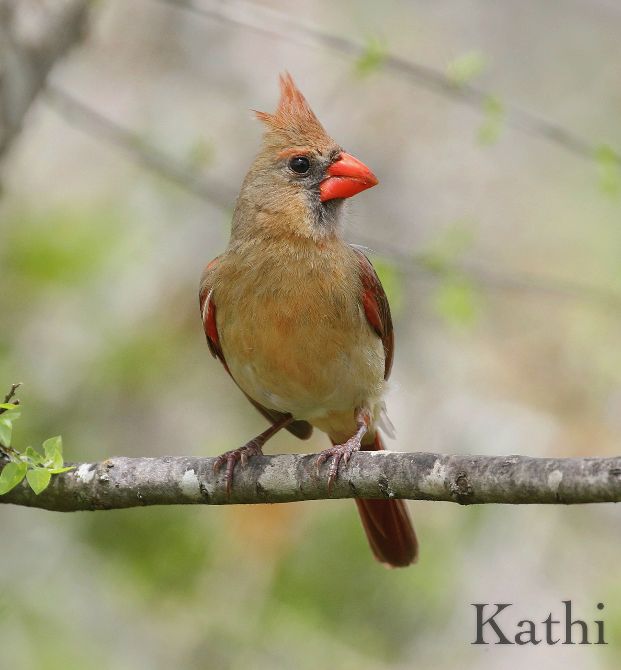
female Northern Cardinal by Kathi Hince

Nesting

The female Cardinal is responsible for nest building. She bends twigs around her body and uses her feet to push them into a cup shape. There are four layers to the nest including: coarse twigs, a mat of leaves, thin bark, and a soft top layer of grasses, rootlets and pine needles.

In Michigan, Northern Cardinals start to nest in mid-April, laying 2 to 4 eggs. Incubation takes up to two weeks. After hatching, the young stay in the nest another few weeks fledging. The young are fed protein in the form of caterpillars and other soft-bodied insects. Adults are omnivorous, adding seeds and fruits to their diet of insects.

male Northern Cardinal by Kathi Hince

More Fun Facts

These birds are named for their bright red plumage thought to be reminiscent of the cleric by that name. The have the distinctive honor of being the State Bird of no fewer than seven states, which is more than any other bird.

Another endearing aspect of Cardinals is how the male feeds the female as part of courtship display. This is a change from their behavior in the winter, when it is every bird for itself.

Juvenile Cardinals look like the females, a warm brown with golden overtones, and a lighter belly color, sporting red in their tail feathers,  wings and crest. The difference between female Cardinals and the young is the females have a bright red beak, whereas young birds have a gray/black beak.

The males have a prominent black facial mask larger and more striking than the females’. The beak is a distinctive characteristic in Northern Cardinals. It is very short and robust – a true seed cracking tool. The cardinal holds a seed in the beak, with a crunch down to crack the shell, then a roll of the tongue to rotate the seed until the shell falls away. This leaves the nut “meat” for the bird to consume. This method of eating allows the Cardinals to stay at feeders and eat. Other birds like Chickadees must instead fly off to a perch where they can hold the seed in their feet in order to extricate the edible portion of the seed.

Window Strikes

Northern Cardinals are one of the species of birds that are known to attack their reflection in a window or car mirror, repeatedly striking the surface, much to our frustration and dismay. This behavior takes place because the bird believes it is attacking another bird, an intruder in the nesting territory. In order to stop this behavior, block the birds’ reflection on the outside of the window. A product aptly named Stop Bird Attack is sprayed on the outside of the window, easily removed when no longer needed (this product sold at Wild Birds Unlimited in Grosse Pointe Woods).

male Northern Cardinal by Kathi Hince

Attracting Northern Cardinals

To attract Northern Cardinals, offer black oil sunflower either in or out of the shell, safflower and shelled peanuts. All of these seeds can be place in a hopper feeder with a larger ledge or a tube feeder with an added tray, essential for their body size if they are to reach the feeding ports.

Take a listen for this beautiful songster, filling the days with sound that will lift your spirit.

Enjoy your birds!

-Rosann Kovalcik

Owner, Wild Birds Unlimited, Grosse Pointe Woods

Have you joined our email list? Click here to sign up, it’s free and gives you access to sales, coupons, nature news, events, and more!

Posted in Spring, Wild Bird Facts, Winter | Tags: Backyard birds, Bird Feeding, birds, Cardinal, Northern Cardinal, Spring, Winter | Leave a comment |

It’s Going to be a Snowy (Owl) Winter

Posted on December 14, 2017 by Rosann Kovalcik

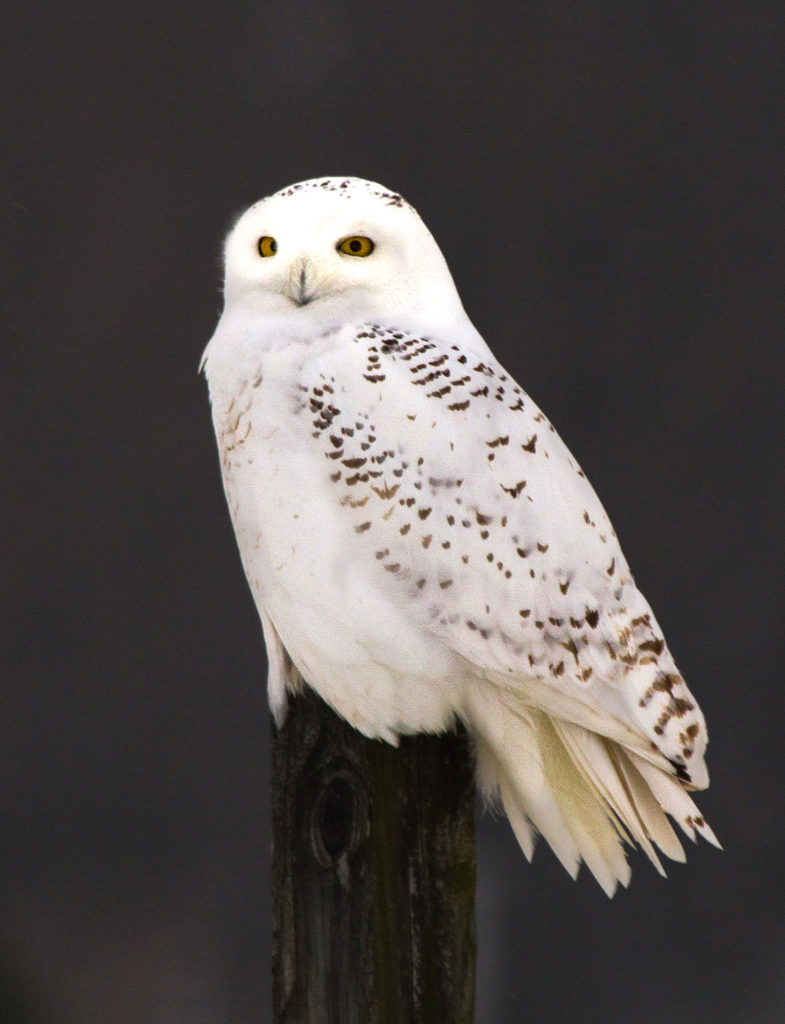
Who could not be amazed at a large, white owl with penetrating yellow eyes, prevalent during daylight hours for all to see?

Prepare to be amazed.

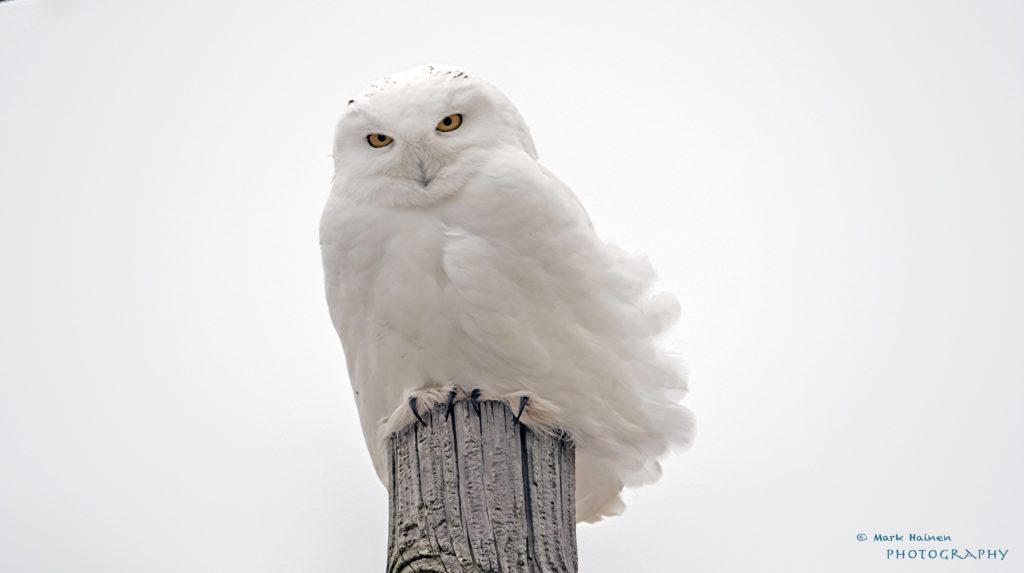
Snowy Owl by Mark Hainen


We have an exciting winter already in Michigan, with the appearance of so many Snowy Owls in our state. According to eBird reports (click here to learn more), the Great Lakes region has a higher influx of Snowy Owls than anywhere in the United States so far this winter.

Locally, there has been a consistent sighting of this yellow-eyed marvel at the Grosse Pointe Yacht Club. The bird is usually seen at the farthest point of the property closest to the lake, surveying for potential prey.

Snowy at Grosse Pointe Yacht Club

A Snowy Owl has also been seen at The Ford House a few times, and on a boat house near Jefferson and Ten Mile. The DNR boat launch site in Harrison Township has also been a fairly reliable spot to see these Arctic nomads sitting on the break wall.

Many parts of our State resemble the Arctic tundra with wide open spaces that Snowy Owls are accustomed to occupying. They may be found along the shorelines, in airport fields, farm fields, and our protected natural areas. A true testament that these birds think nothing of our winter weather! The hunting must be pretty good out there with the abundance of waterfowl to feed on.

This abundant influx of Snowy Owls is referred to as an irruption. As explained by the Department of Natural Resources in Wisconsin,

“Most experts agree these periodic mass movements are associated in some way with their primary northern prey source, a small rodent known as a lemming. Traditional thought suggested that a temporary ‘crash’, or shortage, of lemmings pushes owls southward in search of food. However, more recent evidence suggests nearly the opposite, that a temporary abundance of lemmings allows the owls to successfully raise large families, and then these young owls disperse southward by the hundreds to avoid competition with older birds for winter territories. It’s even possible, perhaps likely, that not all irruptions are created equal and both mechanisms play out in some years. Unfortunately, the population dynamics of lemmings are complex and poorly understood. The same can be said for snowy owls, in large part because of the remote northern haunts they occupy most of the year. This no doubt elevates their intrigue but serves as a barrier to understanding and ultimately conserving the species.”

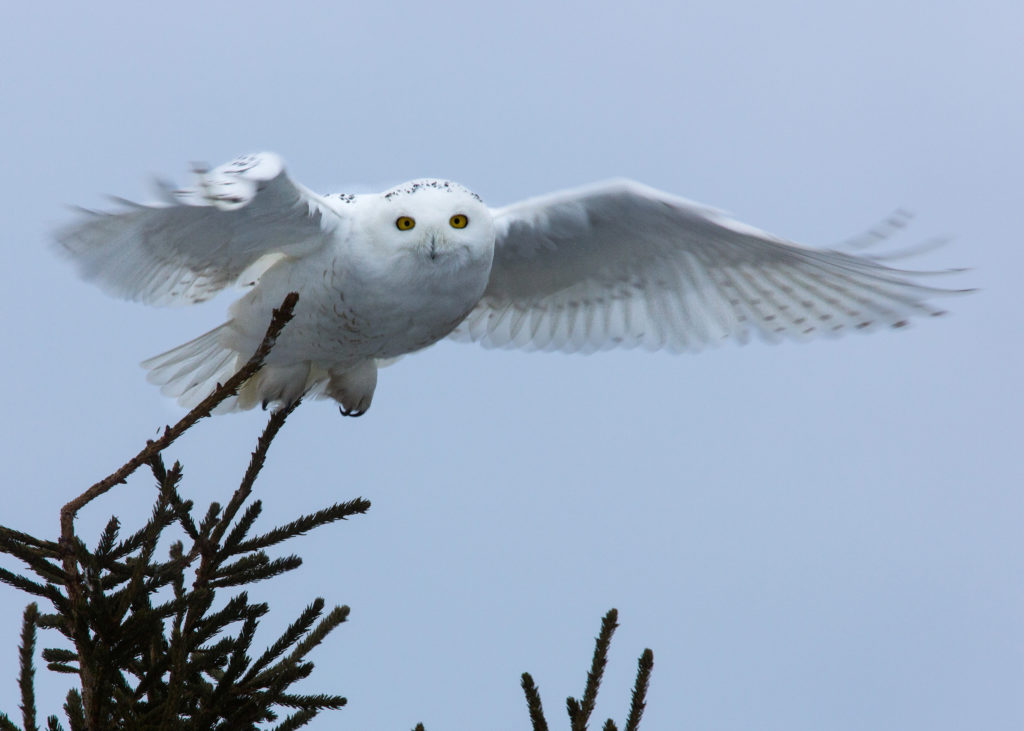
Photo by John Graffius

Therefore, what we are seeing now most likely indicates that Snowy Owls had an extremely successful breeding season this past summer, coinciding with an abundance of lemmings, their predominant prey. Interesting fact – one Snowy Owl can eat 1,600 lemmings in a year.

When there is more food available for feeding young, the females will lay more eggs. When food is scarce, female Snowy Owls may lay as little as three eggs; in years of abundant prey, they have been known to lay up to eleven eggs. Nests are simple scrapes on the ground. The Snowy Owl female is the one who builds the nest, scraping out a shallow hollow on the bare ground. She shapes it by pressing her body into the depression, taking a few days to complete the scrape. The owls may reuse the nest site for many years. Eggs are laid every other day with a 32 day incubation period. Males may have bred with two females, keeping them a kilometer apart and assisting with the rearing of both broods of young.

The Cornell Lab of Ornithology describes the male displaying for the female in this way –

On their breeding grounds, male Snowy Owls execute a fascinating mating display. First the male rises into the air with exaggerated wing beats in an undulating flight, holding a lemming in his bill or talons. Then he descends to the ground with wings flapping or held in a “V.” He drops the prey on the ground, stands erect, then lowers his head and fans his tail as the female approaches. To defend his territory from another Snowy Owl, a male lowers his head and sticks it forward, extending his wings and raising the feathers on his neck and back to seem bigger.

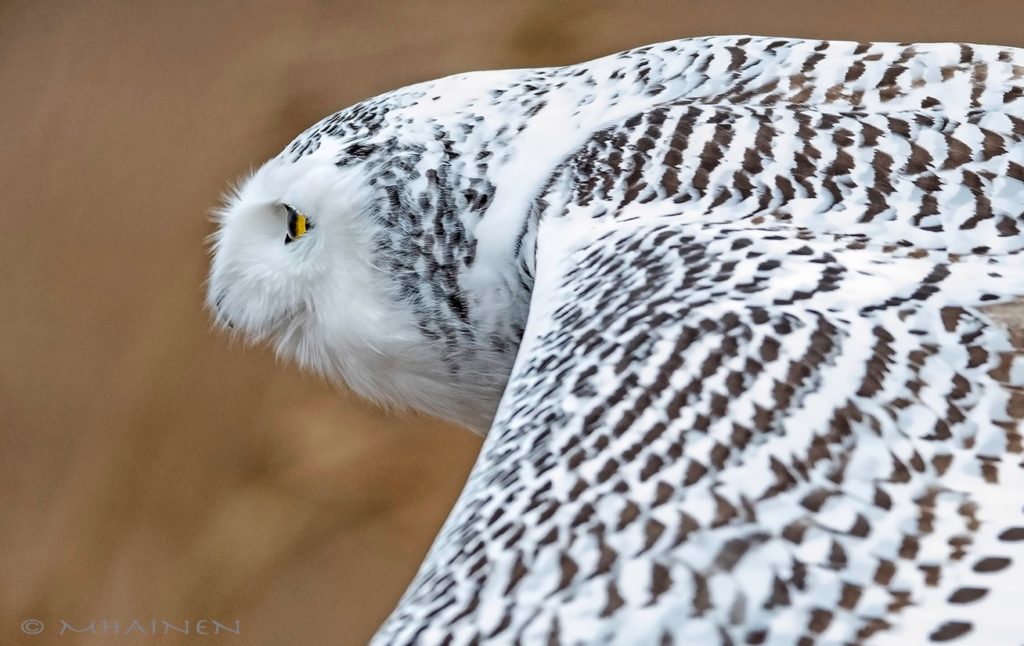
Photo by Mark Hainen

Since lemmings aren’t breeding in the winter, there is less food available for the Snowy Owls right now. As well, Snowy Owls are territorial in their wintering areas, defending their winter territories fiercely, even engaging in combat with other Snowy Owls. All of these factors cause them to roam into southern areas in search of better food sources. Our Great Lakes provide an abundance of ducks, just as our farm fields provide an abundance of voles and mice. Small prey is eaten whole, with the bones, teeth and fur of their prey being regurgitated as pellets. Snowy Owls have a tendency to frequent the same spot to perch – I wonder how many pellets are sitting in a pile at the Yacht Club?

Snowy Owls are the heaviest owls in the United States, weighing between 3.5 and 6.5 pounds with a wingspan of 49 to 59 inches. Their average life span is ten years. The oldest-known Snowy Owl was a female, at least 23 years, 10 months old when she was recaptured in 2015 during banding operations in Montana, having been originally banded in Massachusetts in 1992.

Photo by John Graffius

Keep your binoculars ready and scan along the shoreline. Unlike other owls in our area, Snowy Owls are diurnal, hunting during the daytime. Your potential for seeing one is not as unusual as you might think!

Enjoy your Birds !

-Rosann Kovalcik

Owner, Wild Birds Unlimited, Grosse Pointe Woods

Have you joined our email list? Click here to sign up, it’s free and gives you access to sales, coupons, nature news, events, and more!

Posted in Wild Bird Facts, Winter | 3 Comments |

More Cardinals and Cooper’s – Project Feederwatch Results

Posted on February 6, 2017 by Rosann Kovalcik

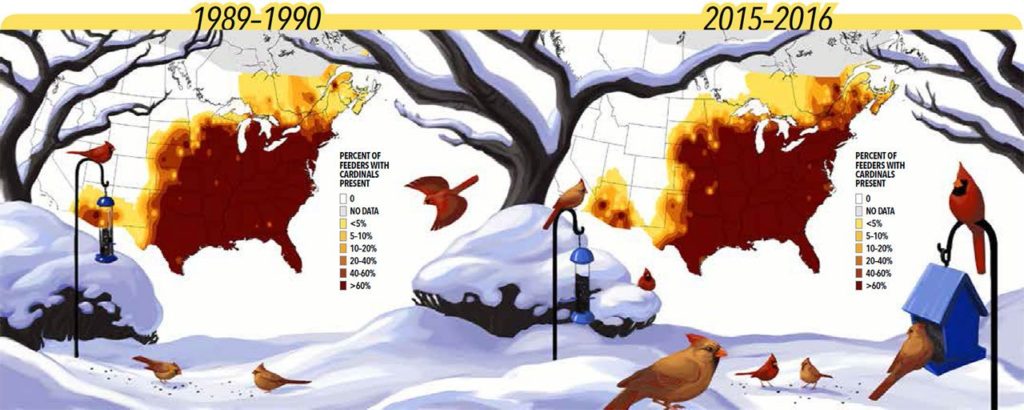
This year marks the 30th Anniversary of Project Feeder Watch, a partnership between Cornell Lab of Ornithology and Bird Studies Canada, sponsored by Wild Birds Unlimited. Through the efforts of those citizen scientists who report the number of birds at their feeders, a comprehensive look at continental wintertime populations of feeder birds has been compiled.

There were two noteworthy conclusions that I felt people in this area might be interested to know more about.

The first is the data for Northern Cardinals, which shows their range has expanded since 1989. This has been supported by the number of Feeder Watchers who are reporting Cardinals in Minnesota, Michigan, Maine and southeastern Canada. The citizen Science Director of Cornell’s Lab stated that “Cardinals, like people, like a free lunch. The abundance of food provided by people has helped the species to colonize new areas.” It was also noted that the addition of shrubbery in landscaping, a somewhat new trend, provides food in the way of fruit, and shelter for nesting habitat as well as cover in winter.
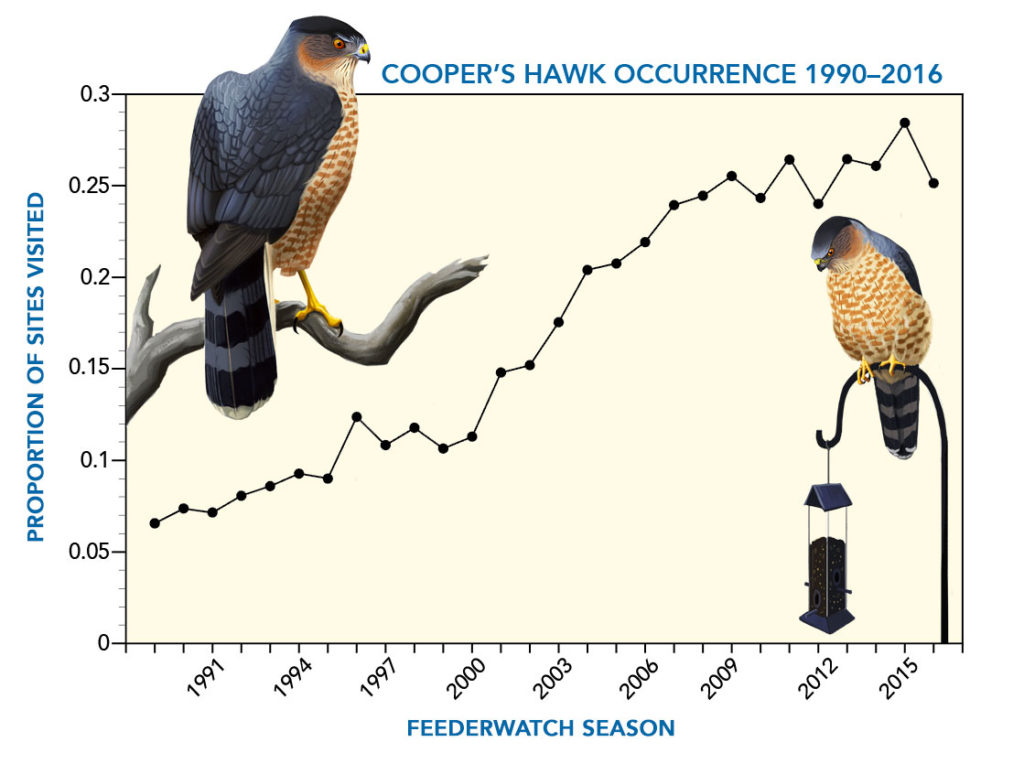
It comes as no surprise to us, here at Wild Birds Unlimited in Grosse Pointe Woods, that the prevalence of Cooper’s Hawks is on the rise. We hear about this trend on a daily basis and have witnessed the number of verified nests for this raptor species.


As stated in the report, the Feeder Watch data shows a clear and consistent increase in the proportions of backyards hosting Cooper’s Hawks in the winter. The current hypothesis is that the wintering strategy has changed from migrating to Mexico to overwintering where there are large groups of prey species at bird feeders. The data does not suggest that prey species numbers are stable.
Through Project Feeder Watch, your data can be added to the growing base of important information. The fee to participate is $18.00 ($15.00 for Cornell members), and includes your count kit tally sheet and calendar, access to online data, and a Common Feeder Birds poster. Counting concludes on April 7, 2017. Visit feederwatch.org to learn more.

You may also consider signing up with eBird, a free online program which helps record bird populations on a daily basis, year-round. Click here to learn more about Cornell & Audubon’s Great Backyard Bird Count, a bird-based citizen science project which uses eBird data inputs.

Have you joined our email list? Click here to sign up, it’s free and gives you access to sales, coupons, nature news, events, and more!

Posted in Events & Outings, Wild Bird Facts, Winter | Leave a comment |

What does Bird Song Mean? Spring?

Posted on January 23, 2017 by Rosann Kovalcik

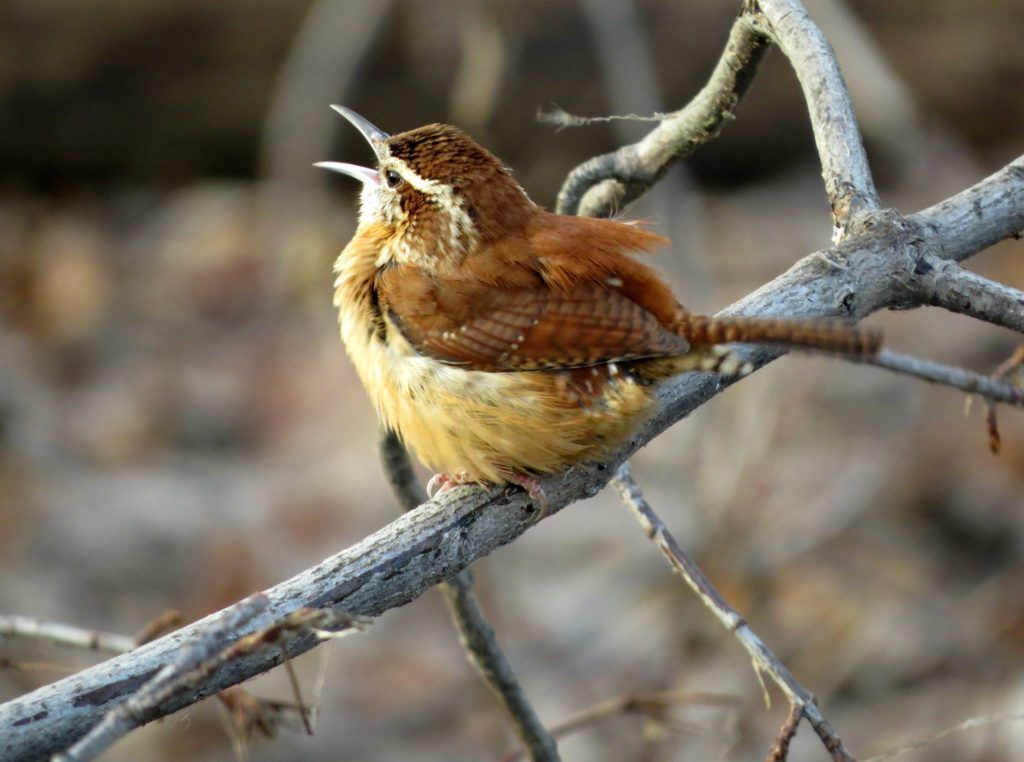
Carolina Wren by Andrea Rose

For us humans, bird song is often associated with the coming of spring. With it being a mild winter so far, many are wondering if an increase in bird song is an indication that birds are confused about what season it is. As a matter of fact, this is not the case. In reality, birds are more in-tuned with the cycle of the seasons than many of us are. Their tendency to sing more frequently is a result of incrementally lengthening daylight hours. After December 21st (the winter solstice), the shortest day of the year, daylight begins to stretch out longer. The increased light affects the pineal gland of a bird’s brain.

Located in the center of the brain, the pineal gland produces melatonin, which helps maintain circadian rhythm and regulate reproductive hormones. Melatonin is a simple hormone which is special because its secretion is dictated by light. Its two primary functions are to help control circadian rhythm and regulate certain reproductive hormones. We too produce this hormone, but our modern-day lifestyles often interfere with our response to it. After all, many of us rise before the sun and fall asleep in the midst of the artificial glow of TVs and cell phones, long after the sun has set. Birds, on the other hand, are very much in-tuned with their natural rhythms, and their behaviors change accordingly and responsively.

Simply put, it is longer daylight, not increasing temperature, that prompts the reproductive hormones in your resident birds, causing them to sing.

My earliest record of a Northern Cardinal singing is January 19th. This year is no different, as witnessed by many customers who have reported hearing bird song already.

Northern Cardinal by Andrea Rose


Sending a message loud and clear to his mate from last year, the Cardinal is letting her know he is proclaiming a territory fit to breed in this year. He is also marking his territory with the boundary of song, letting other males in the area know where his space begins, and that they need to heed these markers.

Take a moment to listen to this harbinger of our lengthening days. Bird song is one of the best ways to keep our spirits lifted!

Have you joined our email list? Click here to sign up, it’s free and gives you access to sales, coupons, nature news, events, and more!

Posted in Wild Bird Facts, Winter | Leave a comment |

Bird Feeding in the Winter

Posted on December 16, 2016 by Rosann Kovalcik
Northern Cardinal

Northern Cardinal

As the seasons change and the weather gets colder, some bird species are getting ready to remain through the winter. Cardinals, Black-capped Chickadees, White-breasted Nuthatches, Tufted Titmice, House Finches, Downy Woodpeckers, Hairy Woodpeckers and Red-bellied Woodpeckers are all resident birds that remain in Michigan, expanding their feeding territories in order to find adequate food sources. All of these birds are well-loved by those who engage in the hobby of birdwatching. Their colors and antics add a dimension of joy to our lives as we view them at the feeding stations we provide.

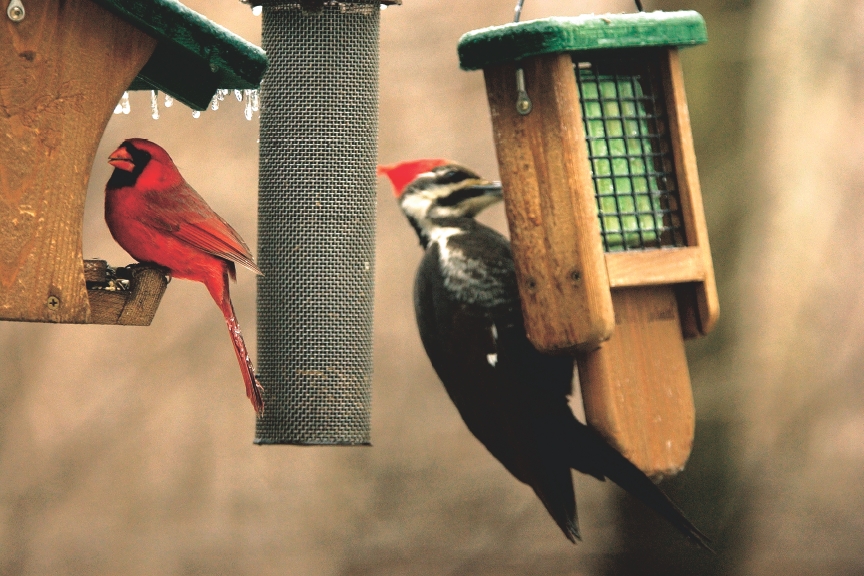
All of these bird species can be attracted to your yard with the addition of bird feeders stocked with appropriate foods that they need. A blend of seeds high in fat and protein including sunflower (either in or out of the shell), peanuts and millet is a great place to start. If you want to attract larger bodied birds including Cardinals, a hopper feeder with a ledge or a tube feeder with a tray is necessary for them to be able to fit and reach the seed. Suet is the perfect substitute for the insects that are normally part of the diet of the Chickadees, Nuthatches and Woodpeckers. Suet is derived from the fat that surrounds the kidney of cattle. It is rendered, a process that removes impurities and adds shelf life. Extra ingredients may be added including peanuts and insects for protein. Fruit in suet is especially attractive to Red-bellied Woodpeckers. Placed in a suet cage, these birds are adept at clinging in order to feed.

Cardinal on Hopper Feeder and Pileated Woodpecker on suet.

Cardinal on Hopper Feeder and Pileated Woodpecker on Suet

Other bird species shift their locations within the United States, those farther north relocating to winter territories in the south. This includes Goldfinch, which move from Canada and the mid-states down to reach the lower states where they can be seen in the winter only. Blue Jays will migrate for the most part, with a small number of the entire population remaining behind in select territories. The same is true of Mourning Doves. Most of the blackbird species including Red-winged Blackbirds, Cowbirds and Grackles will migrate south. While many associate American Robins as a sure sign of spring, many have become accustomed to plentiful food sources in the way of fruit and remain here through winter, hedging their bets that they can make it through the cold. This strategy works for them if they can survive, as they will have the first choice of prime breeding territories to offer to the females, who leave the area altogether.

While some birds leave, a completely different set of birds arrive for the winter, leaving northern climes for this comparatively milder wintering ground. Most notably, Dark-eyed Juncos tell of the arrival of fall. The white proso millet in a seed blend is the favorite of the Juncos, which are a true sparrow and feed primarily on the ground. Other arriving sparrows include the American Tree Sparrow. This year has been a banner year for Red-breasted Nuthatches appearing at feeding stations as they settle into a winter territory. The prediction for the arrival of Winter Finches includes Pine Siskins, Purple Finches and Common Redpolls, based upon the lack of poorly available seed crops in Ontario.

Dark-eyed Junco

Dark-eyed Junco

Attracting finches can be accomplished by offering nyjer (thistle), a crop that is grown in Nigeria and Ethiopia and sterilized before it can be sold within the United States. A tube feeder designed with small holes to dispense the seed is the best way to offer this food. A blend of nyjer with small chips of sunflower is even more attractive to the Finches and to Chickadees.

Water is as essential to birds in the winter months as it is in the warmer ones. In fact, some birds visit the yard specifically for this reason alone, notably the American Robin. Using a plastic dish with the heating element built into it is the most convenient way to provide a water source. These bird baths are thermostatically controlled and will cycle on and off to keep the water at a temperature just above freezing. Another option is the addition of a heating element that can be added to a plastic or metal bird bath. Manufacturers of cement and ceramic bird baths warn against the use of heaters as those types of baths can break if a small crack succumbs to the effect of water freezing within.

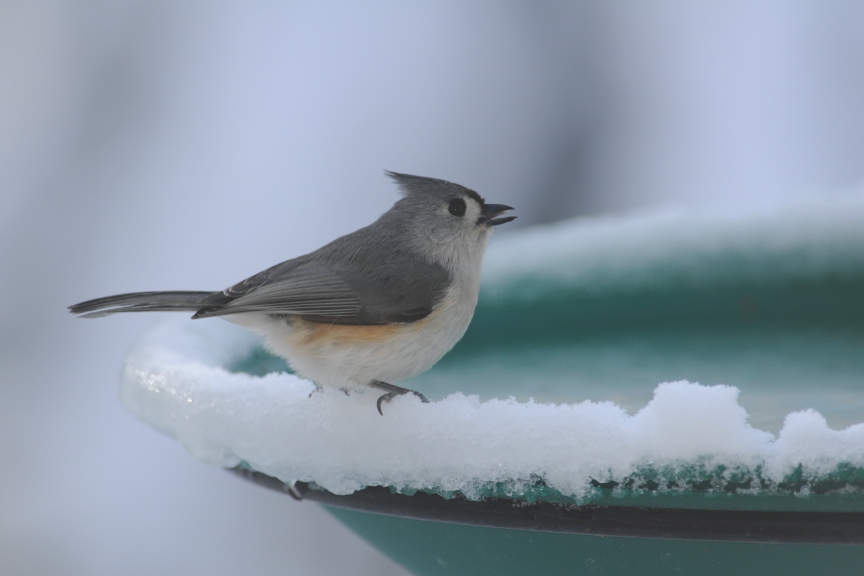
Tufted Titmouse on Bird Bath

Tufted Titmouse on Bird Bath

One of the major challenges for those who want to feed the birds is the fact that squirrels don’t understand the term “bird feeder”. If the feeder has seeds or suet, they will help themselves. There are some very effective squirrel-proof feeders on the market that are made entirely of metal and close with the weight of mammals. If you prefer to use seed in a window feeder or another place that mammals can access, safflower seed has a bitter taste to mammals and can be used in those situations. Feeding stations on a pole system with a baffle mounted on the pole to prevent mammals from climbing is another answer. Placement of feeders is key, as the setup needs to be far enough so that sideways leaps cannot be accomplished. The baffle top needs to be five feet from the ground and all feeders in the zone above that five feet limit. Another alternative is to offer seed and suet that are treated with hot pepper as the mammals have more taste buds than birds and are adversely affected, whereas the birds are not.

Planning your habitat for birds in the winter would include an area in your yard or neighboring yard that includes evergreens for shelter. In poor weather conditions and during the night, birds must have these areas for roosting. Some birds use cavities for shelter, both excavated by themselves or provided in the form of a nest box. If you see the entrance to a cavity, leaving the branch is the best option for the bird. Providing a winter roost box or keeping a functional nest box outside can make the all the difference in winter survival for birds.

Many plants bear fruit that persists during the winter and provides natural food sources for birds. Holly berries need to freeze and thaw a number of times before they become palatable to birds. Insects can be found by birds in many types of plant material. The galls in Goldenrods contain an insect that will be chiseled out by Chickadees or Woodpeckers. Sumac seed heads also contain insects that the birds will find nourishing. Many of our flowers can be left as a food source for winter birds including coneflowers and all other flowers with a composite seed head. Goldenrod is the favorite food of our native sparrows that spend the winter including the Juncos and White-throated Sparrows that may call our yard home.

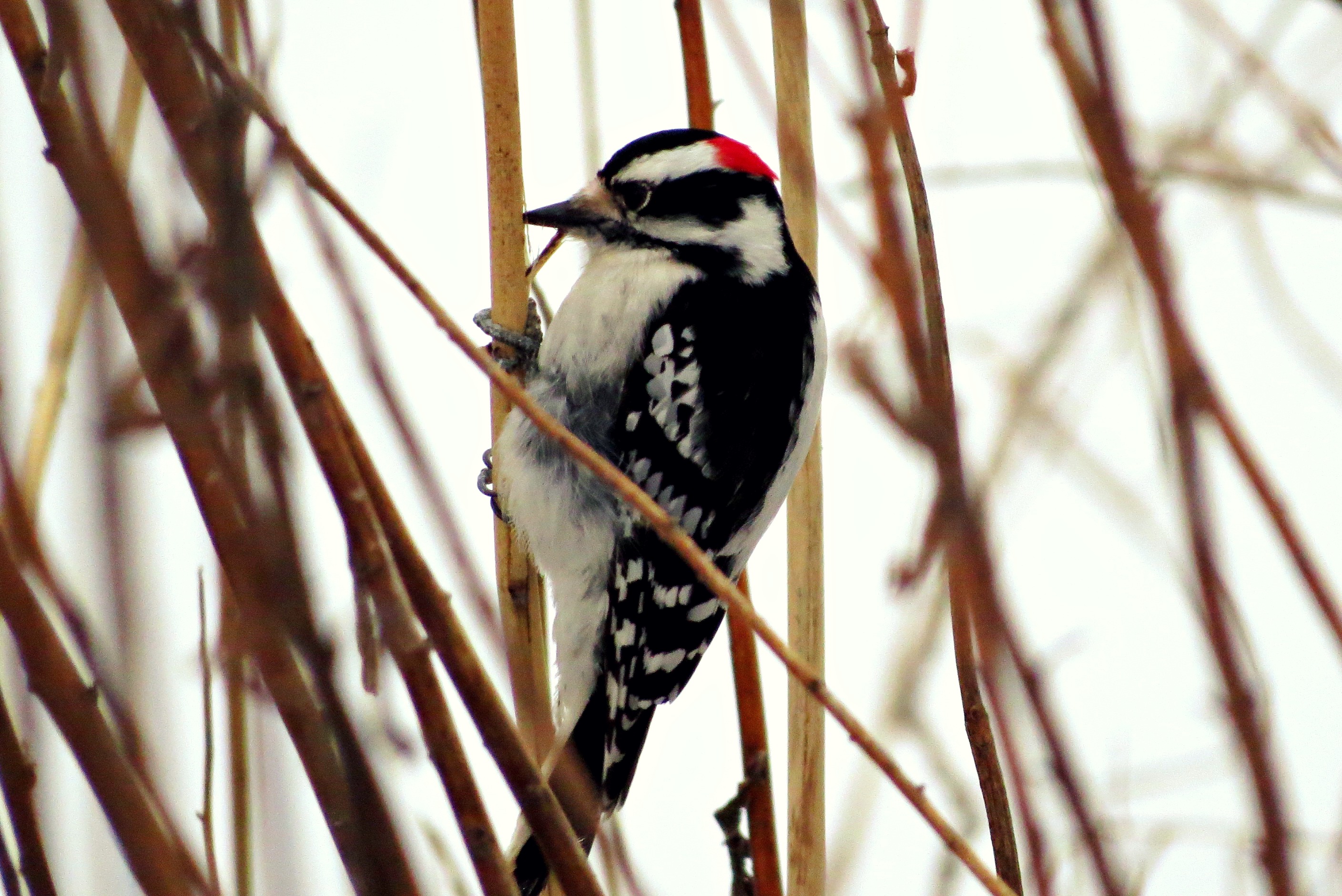
Downy Woodpecker

Downy Woodpecker

Whatever you choose to do in your yard, the hobby of bird feeding can be a joyful one for you. The added bonus is that the resident birds will be healthy at the onset of spring, ready to claim your yard as part of their territory. With that, a new generation of birds can be a welcome addition to look forward to.

Enjoy your Birds!

Have you joined our email list? Click here to sign up, it’s free and gives you access to sales, coupons, nature news, events, and more!

Posted in Bird Feeding Solutions, Wild Bird Facts, Winter | Leave a comment |

How Birds Survive the Winter Cold

Posted on October 6, 2014 by admin

Wild Birds that do not migrate have interesting strategies for survival in the cold winter, both natural and some that are provided by our caring customers at Wild Birds Unlimited in Grosse Pointe Woods, Michigan. Those customers often ask what they can do to help winter resident birds survive, such as Cardinals, Black-capped Chickadees, and White-breasted Nuthatches that they see in their yards.

Birds survive winter in part by using layers of feathers that they fluff out, trapping air which then insulates them. Fall molt is when birds increase the number of feathers that they have, growing as much as 30% more feathers than in warmer months, adding to their ability to keep out the cold. Smaller birds have more feathers per unit of body weight than larger birds.

The lower legs and feet of birds are tendinous as opposed to having fleshy parts exposed as in mammals. Therefore, there is no heat loss from that area. A birds’ bill is made of horn similar to our fingernails and does not suffer heat loss either.

Birds use their metabolism to produce heat and run a hotter engine in the winter than in the summer months. They produce this additional heat by consuming more food – up to twenty times more on a winter day than during warmer months. Their choice is energy rich foods, which results in a high concentration of glucose in the blood, creating a higher metabolism.

During the cold winter nights, cavity-nesting birds such as chickadees and nuthatches will pile into a tree hollow or a roost box that you provide, sometimes in groups to keep each other warm. In addition, some birds are able to lower their metabolism and body temperature at night, which saves energy. For example, a chickadees’ heart rate slows from 2,000 down to 500 beats per minute and body temperature goes from 108 degrees to twenty degrees lower during the night.

During the daytime, a bird may shiver, with this muscular energy producing heat. Another adaptation to cold is some birds’ ability to store seeds in a crop, an enlargement of the esophagus. This food is used during the night to maintain higher metabolism, especially in finches.

But how does any of this explain the ducks and geese on Michigan’s, Lake St. Clair ice? They have a special adaptation where the arteries and veins in their feet lie next to each other, with the cold returning blood of the veins being warmed by the arterial blood, resulting in no loss of heat.

Mother Nature does a great job of giving birds the tools they can use to survive winter as long as they can find sufficient food. Stock up those bird feeders and utilize your strategy for warmth – a hot drink and a fire!

Enjoy your birds!
Rosann

Wild Birds Unlimited of Grosse Pointe Woods, MI

Posted in Wild Bird Facts, Winter | Tags: bird feeders, fall bird feeding, Grosse Pointe Woods, Michigan, winter bird feeding | Leave a comment |

Recent Posts

  • Killdeer – our most common Plover returns
  • Red-tailed Hawks, the Common Buteo
  • Bald Eagles –
  • What other owls can you find ?
  • Eastern Screech Owl

Archives

  • March 2023
  • February 2023
  • January 2023
  • April 2022
  • March 2022
  • December 2021
  • September 2021
  • April 2021
  • March 2021
  • May 2020
  • April 2020
  • February 2020
  • January 2020
  • November 2019
  • August 2019
  • July 2019
  • March 2019
  • February 2019
  • December 2018
  • October 2018
  • August 2018
  • July 2018
  • May 2018
  • April 2018
  • March 2018
  • January 2018
  • December 2017
  • November 2017
  • October 2017
  • September 2017
  • August 2017
  • July 2017
  • May 2017
  • April 2017
  • February 2017
  • January 2017
  • December 2016
  • October 2016
  • September 2016
  • August 2016
  • July 2016
  • May 2016
  • February 2016
  • October 2015
  • August 2015
  • July 2015
  • June 2015
  • March 2015
  • October 2014

Categories

  • Bird Feeding Solutions
  • Bird Songs
  • Events & Outings
  • Fall
  • Native Plants
  • Nesting
  • Spring
  • Squirrels
  • Summer
  • Uncategorized
  • Wild Bird Facts
  • Winter

Enter your email address:

Delivered by FeedBurner

  • 1
  • 2
  • Next
© Wild Birds Unlimited of GPW - Website by TBD Web Services