• Home
  • About Us
  • Blog

Tag Archives: wild birds unlimited

Bird Spotlight: Long-eared Owl

Posted on December 2, 2018 by Rosann Kovalcik

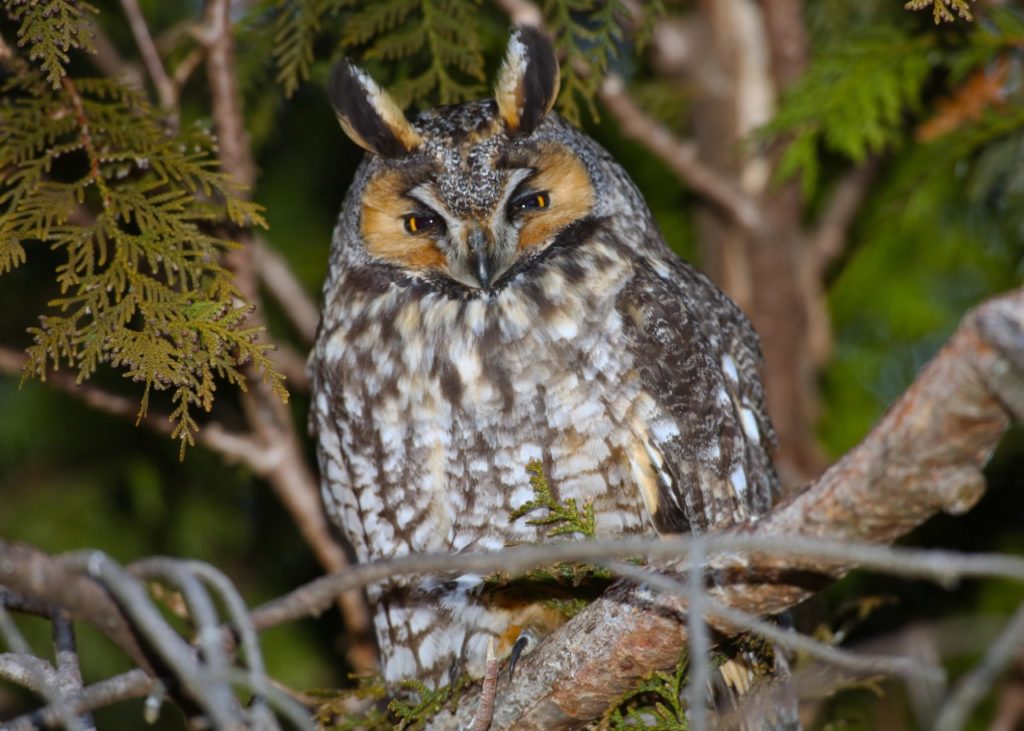
Long-eared Owl (Photo by John Graffius)

An Owl Appears

I can still hear the excitement in my friend Debbie Graffius’ voice as she explained what she was seeing. She was looking in her yard at a large owl with ear tufts. She knew enough to know it was not a Great-horned Owl.

At this point, I grabbed my binoculars, as there was only one answer. I quickly headed to her house in the north part of Grosse Pointe Woods (not far from Lake Shore). Sure enough, perched on a limb open to the sun, yet protected by surrounding evergreens, was a Long-eared Owl. When Debbie’s husband John returned home, his photography skills came into play. Some excellent shots of this comfortably roosting owl resulted.

A Little Bit of Background…

We spotted this bird on March 29th of 2013. We don’t often see Long-eared Owls in our area. The only other time I am aware of was in April 2004, when Tufted Titmice in my yard began to scold. This led to an investigation on my part. Sure enough, a Long-eared Owl was in the evergreens in my 75 x 150 Grosse Pointe Woods yard. This is a great testimony to the need for evergreens as shelter. The bird did not budge during the daylight. Mike Florian, my good buddy and President of the Grosse Pointe Camera Club, was able to get some great photo opportunities that day.

This behavior is typical of Long-eared Owls do. They roost during the day in dense evergreens, typically near field edges. When trying to conceal themselves, Long-eared Owls sit erect, tightening their body feathers,“ear” tufts sticking straight up. One of the most interesting facts I have read about these owls is how they use the same distraction technique as that of Killdeer. When luring predators away from the nest, both the owl and the killdeer often feign a broken wing as they drag themselves along the ground.
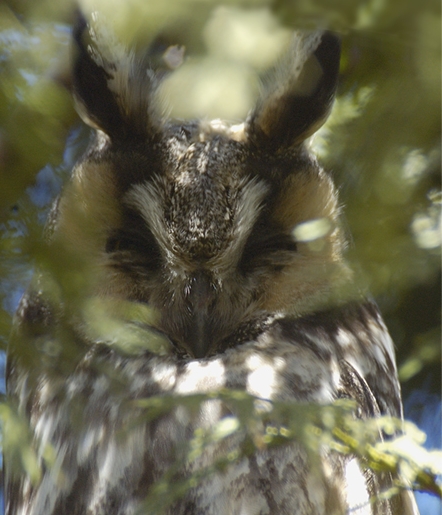
Long-eared Owl (Photo by Mike Florian)

Bird Stats

The wingspan-to-body-length ratio of this bird is quite amazing; head to toe it is only 13 – 16 inches tall, with a wingspan tripling that at 39 inches! For a bird this size, it is amazing they weigh only 8 ounces to 1 pound.

To raise their young, Long-eared Owls use the abandoned nests of hawks and crows. These are usually 20 feet or more above ground. They lay between 2 – 10 eggs, with an incubation period of 35 – 40 days. The young are fed the same diet as the adults, torn into bite-sized pieces. This diet consists of mammals including: mice, shrews, voles, rats, rabbits and less commonly, birds. The adults kill the prey with a bite to the back of the neck of the mammal, and eat their prey whole.
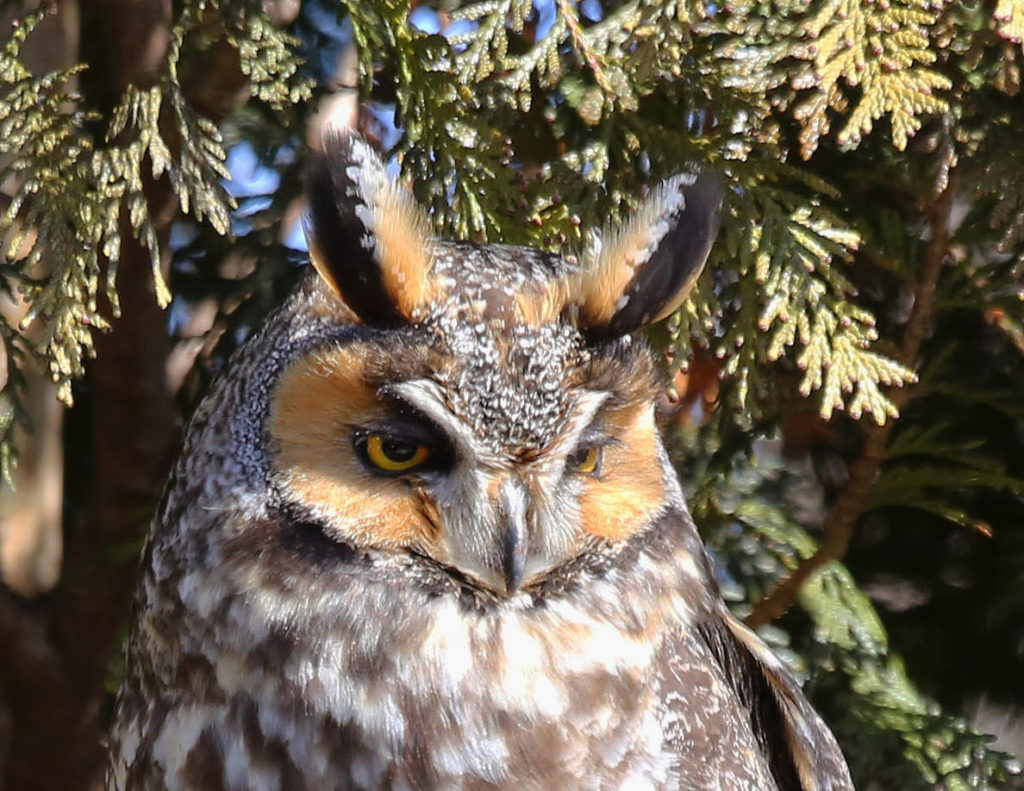
Long-eared Owl (Photo by John Graffius)

Owl sounds are always magical to me, and the sounds of a Long-eared Owl are no exception. The male gives a low hoot call, similar to the sound of blowing across the top of an empty bottle. The owls repeat this call sometimes up to 200 times, between 2 -4 seconds apart. The sound carries more than a half mile away. When disturbed during nesting season, the owls clack their mandibles together and also give a call that sounds like the bark of a small dog.

As set forth on the Cornell web-site, Long-eared Owls are rated as a 13 out of 20 on the Continental Concern Score and they are listed on the 2016 State of North America’s Birds Watch List. This list was compiled to bring attention to those species that are at risk of extinction unless conservation measures are taken to reverse the challenges that they face. For Long-eared Owls, this includes loss of habitat including wooded areas and grasslands. Continued protection of our small wetlands is a step in the right direction for this species’ survival, since many of these wetland areas are adjacent to wooded areas.

Final Reflections
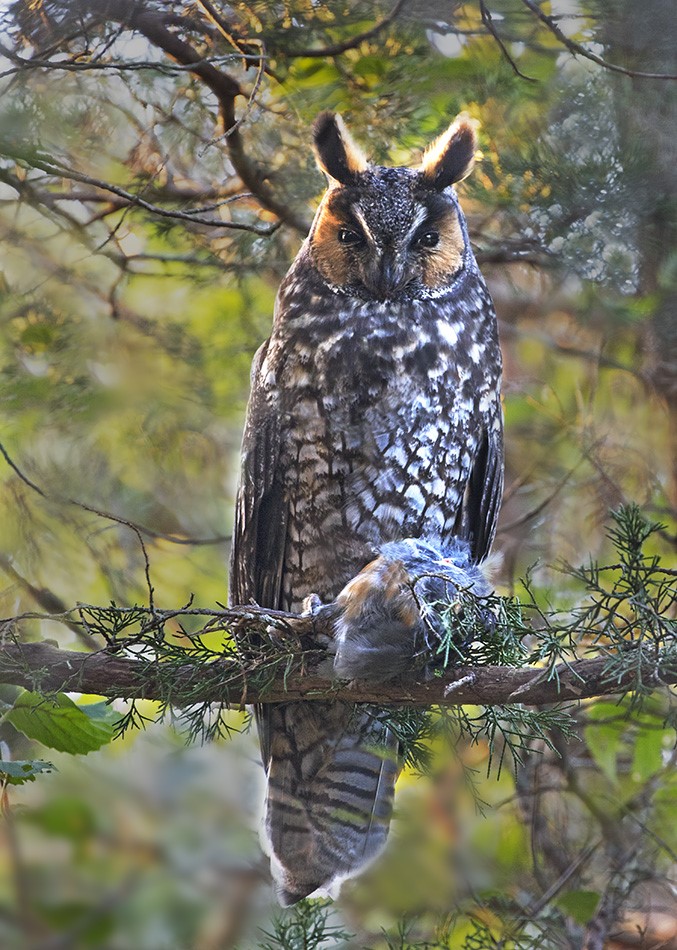
Long-eared Owl (Photo by Kevin Karlson)

Some of my best memories of this bird is watching their moth-like flight as they lift from the trees at dusk at Whitefish Point, on their way to migrate further north. This is when their wingspan can truly be appreciated. Knowing this is their behavior, I advised Deb and John if we sat and patiently watched the Long-eared Owl in their yard, it would become active at dusk. And as if on cue, when the sun began to set, the bird sat more erect and stretched its wings. Looking about, it then flew to the top of the nearest phone pole and after another stretch, lifted itself and headed north.

Do you want to see this owl? Mark your calendar for the Michigan Audubon Spring Fling on April 28th and 29th at Whitefish Point in Paradise, Michigan. Stand on the hawk watch platform at dusk and wait for the magic to begin.

Enjoy your birds!

Rosann Kovalcik, Owner

Wild Birds Unlimited, Grosse Pointe Woods


Have you joined our email list? Click here to sign up, it’s free and gives you access to sales, coupons, nature news, events, and more!
 

Posted in Wild Bird Facts | Tags: audubon, birding, birds, cornell, Grosse Pointe Woods, long-eared owl, Michigan, nature, owl, whitefish point, wild birds, wild birds unlimited | Leave a comment |

Red-breasted Nuthatch, A Predicted Winter Visitor

Posted on October 4, 2018 by Rosann Kovalcik


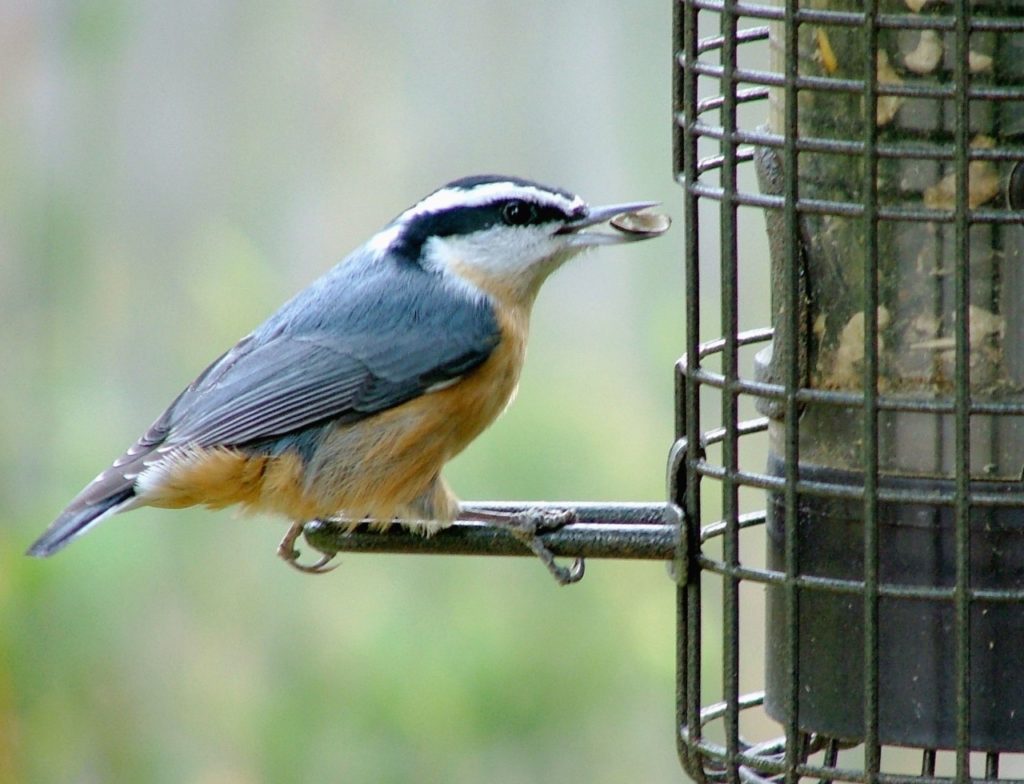
Red-breasted Nuthatch on Squirrel-proof Feeder (photo by  Glen Noyer)

Have you noticed Red-breasted Nuthatches in your yard or at your feeders this year?  I have a pair that have been visiting since the fall and they are such a Joy to watch and to listen to, sounding like little squeak toys.

Irruption

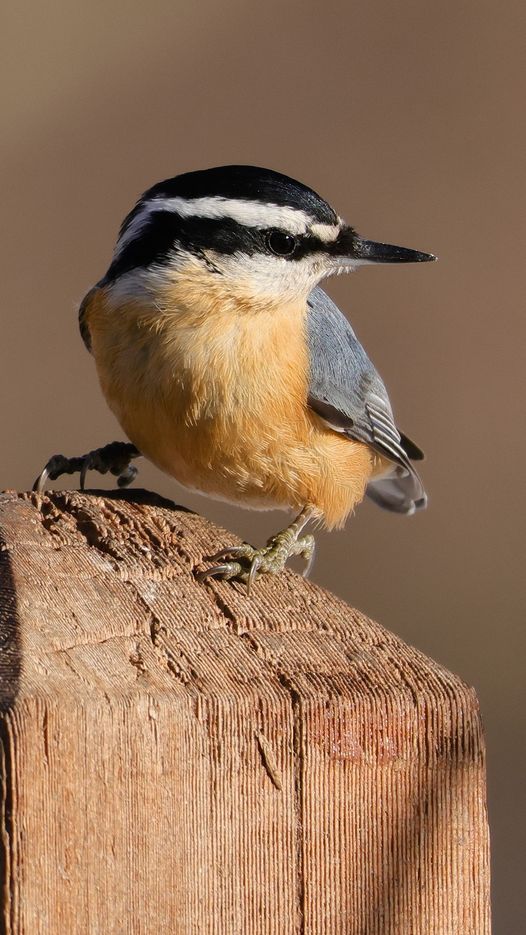
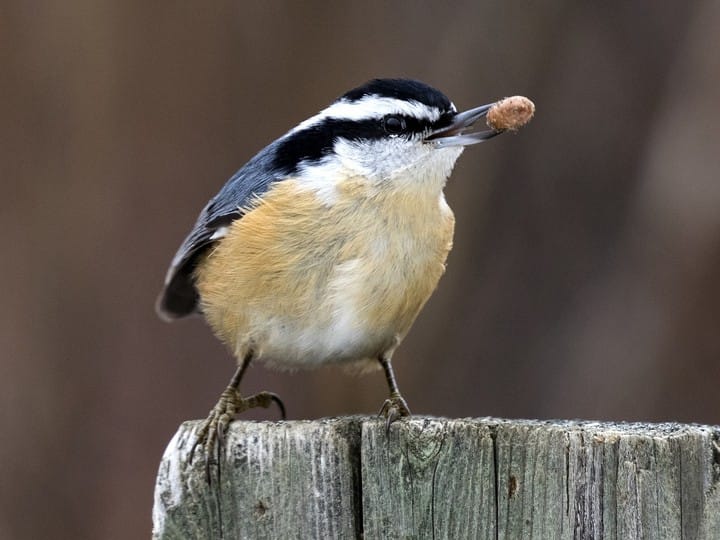
This movement of Red-breasted Nuthatches to our area is called an irruption, a movement of a bird species from their usual wintering grounds, predicted based upon lack of food supply in Ontario forests.  Listen for their nasal “toot, toot, toot” and check out the cones of evergreens.   You may be rewarded with a look at these 4.5” birds, their striking eye line running from their beak to their nape, with a distinct white supercilium (“eye brow”) above that.  Red-breasted Nuthatches have slaty blue-gray backs and wings and, true to their name, a wash of brick red color on their breast. Check out the tail length – it is only slightly longer than their wings.

Red-breasted Nuthatches have a distinctive flight pattern, with an undulating movement as a result of quick bursts of the wings, followed by a glide. Watch them in flight and notice the shortness of the tail.

                 Red-breasted Nuthatch with a Bark Butter Bit (photo by Bob Martinka)

Feeding

These birds are fairly tame and can be watched very closely as they forage for food. In fact, I have had them land on my feeder pole, waiting patiently for me to fill the feeder. Offer them sunflower in or out of the shell, suet loaded with peanuts, and peanuts out of the shell to keep them coming back for the fats and protein they will need this winter. Now is the perfect time to try Bark Butter Bits, a small suet nugget that works well in the squirrel-proof feeder shown in the photo below. Spreadable Bark Butter also works well, either spread onto a tree trunk or a bark butter feeder.

Red-breasted Nuthatch on Squirrel-proof Feeder (photo by Bill Rapai)

Behavior

When feeding in trees, Red-breasted Nuthatches stay preoccupied with cones, extracting the seeds with their long, chisel-shaped beaks. They tend to place seeds in the cracks of tree trunks, using their beaks to chisel the shells away. This motion is responsible for the British-derived name, “Nuthatch” as “hatch” was a term used instead of “hack” back when the bird was named. Perhaps the most unique aspect of Red-breasted Nuthatches is their habit of walking down the trunks of trees as well as under the limbs of the tree, in search of insects to consume.  The toes of Nuthatches are perfect to accomplish this bark climbing – very long with sharp, long claws for gripping.


Shelter

During winter, it is not uncommon for groups of these birds to shelter together in a tree cavity or nest box to maintain warmth. Remember to keep your nest boxes up after cleaning them, for you may be visited by this little sprite (and a friend or two).

Enjoy your birds!

Rosann Kovalcik, Owner

Wild Birds Unlimited, Grosse Pointe Woods


Have you joined our email list? Click here to sign up, it’s free and gives you access to sales, coupons, nature news, events, and more!
Posted in Fall, Wild Bird Facts | Tags: Backyard birds, Bird Feeding, birds, Grosse Pointe Woods, irruption, nuthatch, red-breasted nuthatch, wild birds unlimited | Leave a comment |

Common Nighthawks: Aerial Marvels

Posted on July 9, 2018 by Rosann Kovalcik

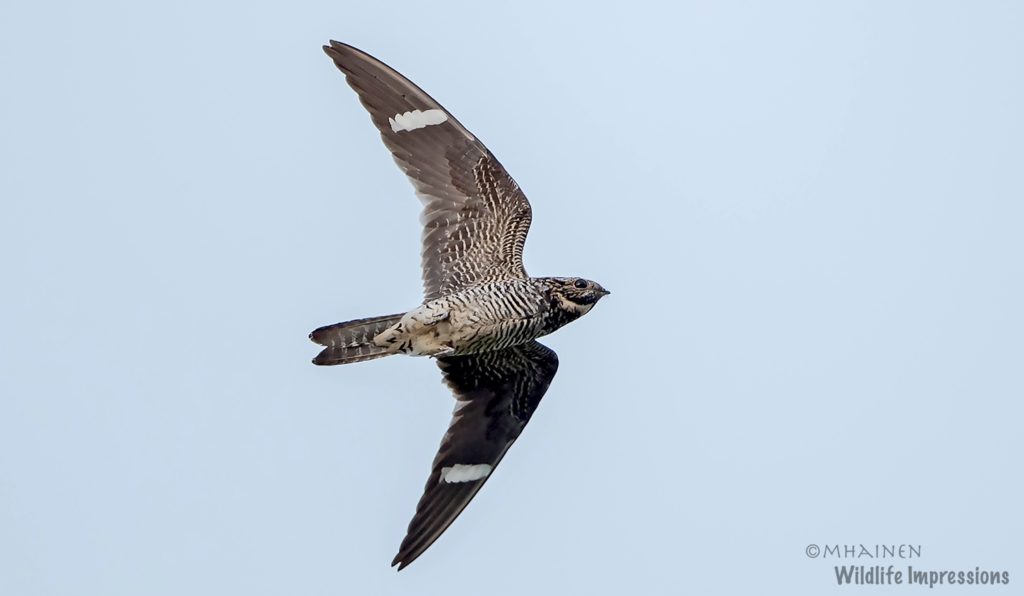
Common Nighthawk (Photo by Mark Hainen)

For me, the sounds of summer include the sounds of Common Nighthawks.

A pair of nighthawks has nested on top of Ferry Elementary School for as long as I can remember. First thing in the morning, and I mean before sunrise, I see him flying in his erratic pattern. I’m not sure of how to describe the call that accompanies the flight. I’ve seen it written as buzz BEEErzh and peent (click here to listen on Cornell’s All About Birds website).

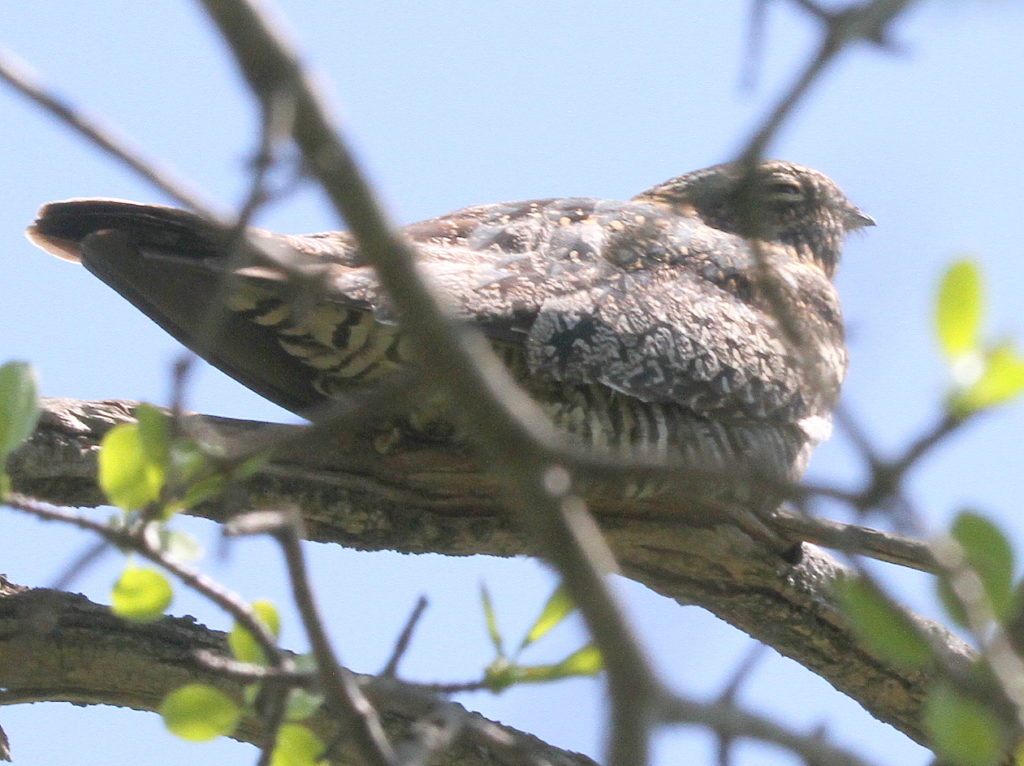
Common Nighthawk perched (Photo by Don Chalfant)

It is sharp and loud, a call to look up to the sky and wait for the wonderful sound to follow. The male nighthawk climbs higher and higher, then dives toward the ground, flexing his wings downward as he peels out of his dive. This causes a sound reminiscent of a race car rounding the edge of the track. To me, it sure sounds like vroom! This wonderful display gets repeated in the evening, a second treat for the summer day. This display serves two purposes; first, to attract a female and bond with her. It also lets other males know the territory is taken.

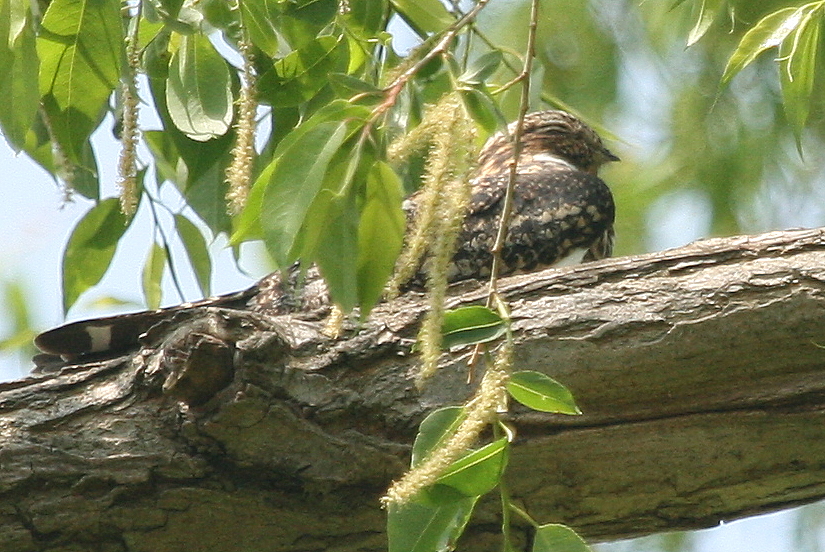
Common Nighthawk (Photo by Don Chalfant)

Field Marks

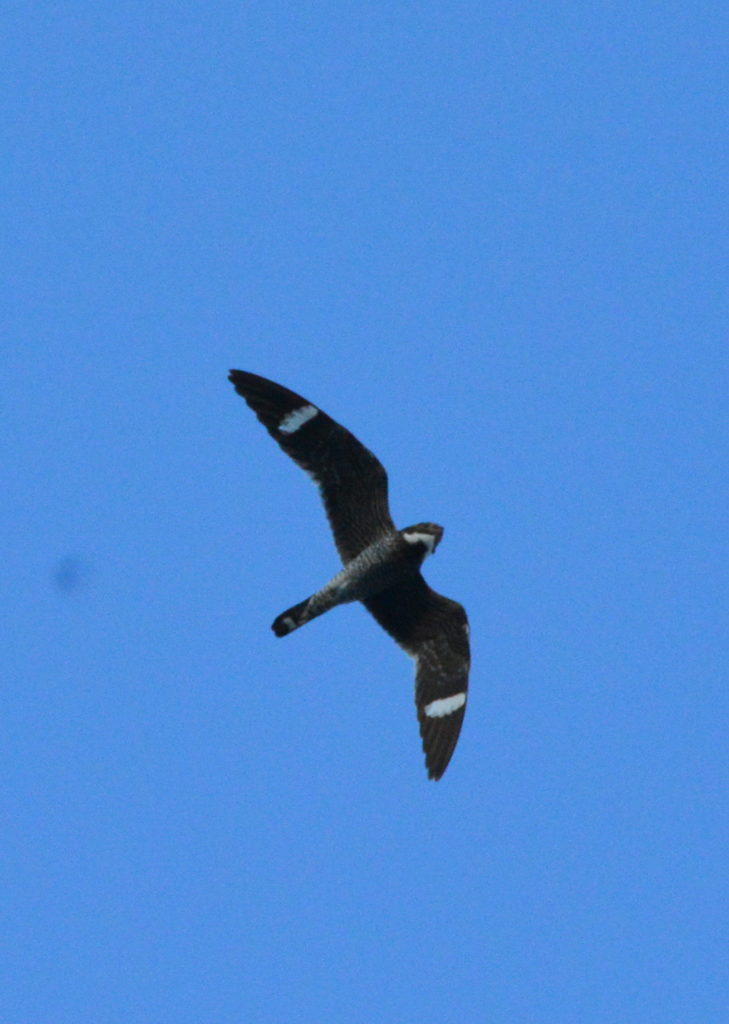
To identify Common Nighthawks, look for a slim, long-winged bird with white patches on the wing. Their pointy wings and streamlined shape make them appear larger than their measurements would indicate. Each bird is typically 9.5” long with a wing span of 24” and a weight of only 2.2 ounces. The type of flight is key – erratic and bounding – look for the white patch which is quite distinct in flight.

Common Nighthawk in flight (Photo by Karen Wade)

Nesting

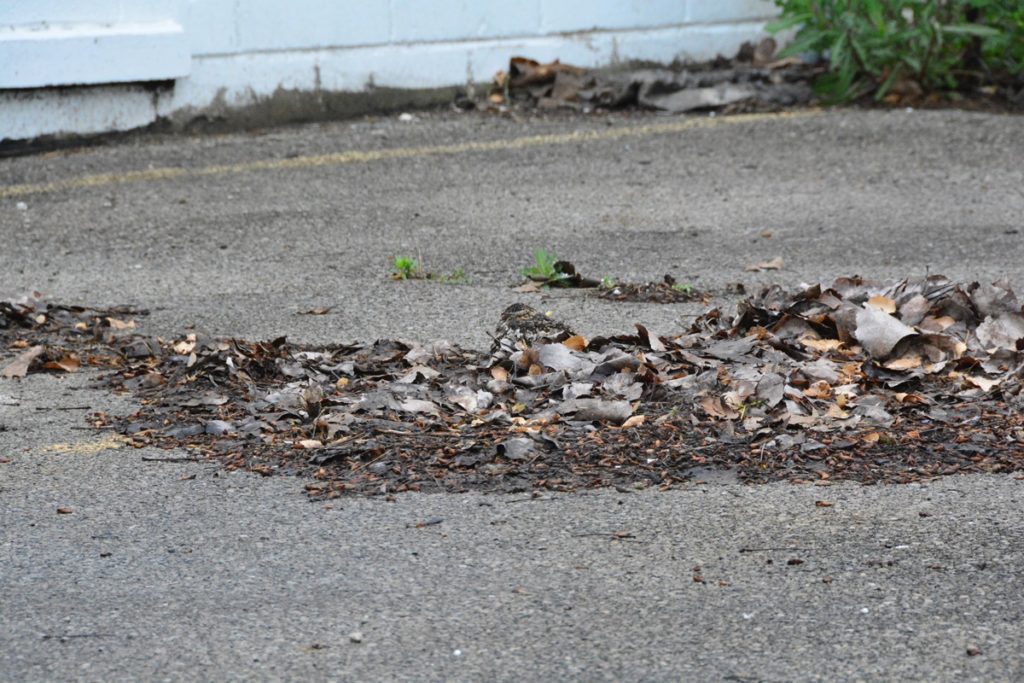
Common Nighthawks nest on open ground, gravel beaches, openings in the forest floor and in our area, on gravel roof tops. Nighthawks, including the eggs and the young, have excellent camouflage in their nesting habitats. These birds need to be hidden from view, so the trend from older style roofs with pebbles to rubber roofs without pebbles is not a good one. This shift leads to a decrease in prime nighthawk nesting habitat. If you can influence a roofing company to keep a corner of the roof covered in pebbles, we can maintain sufficient nesting habitat.

Common Nighthawk female, camouflaged on parking lot nest (Photo by Karen Wade)

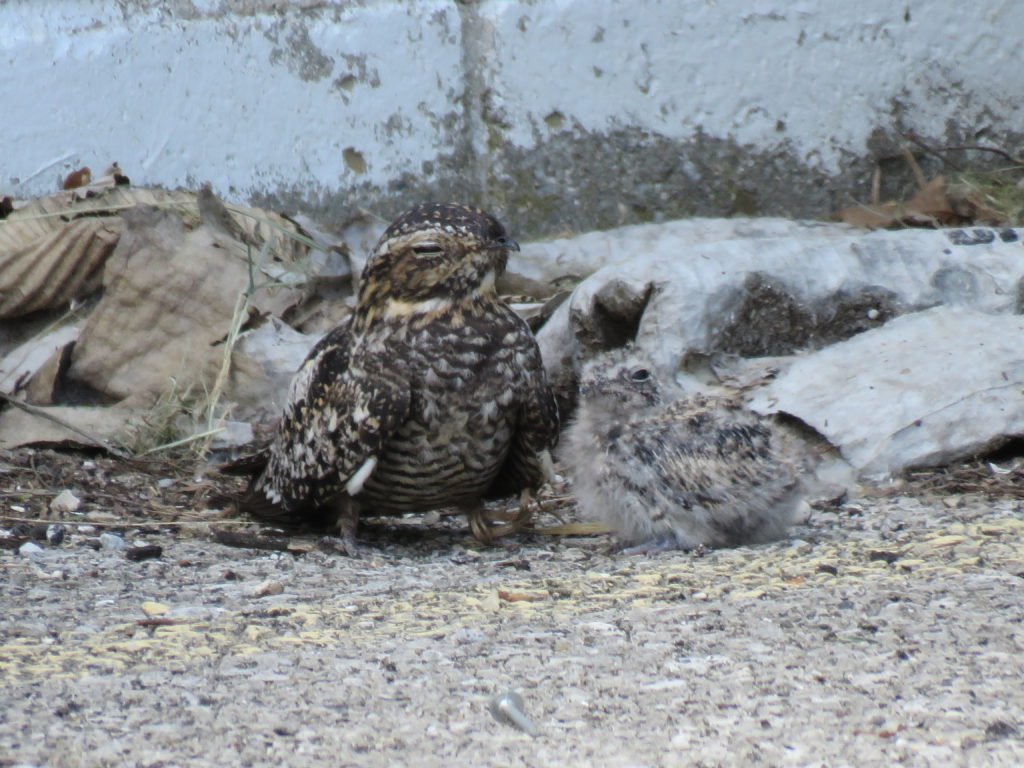
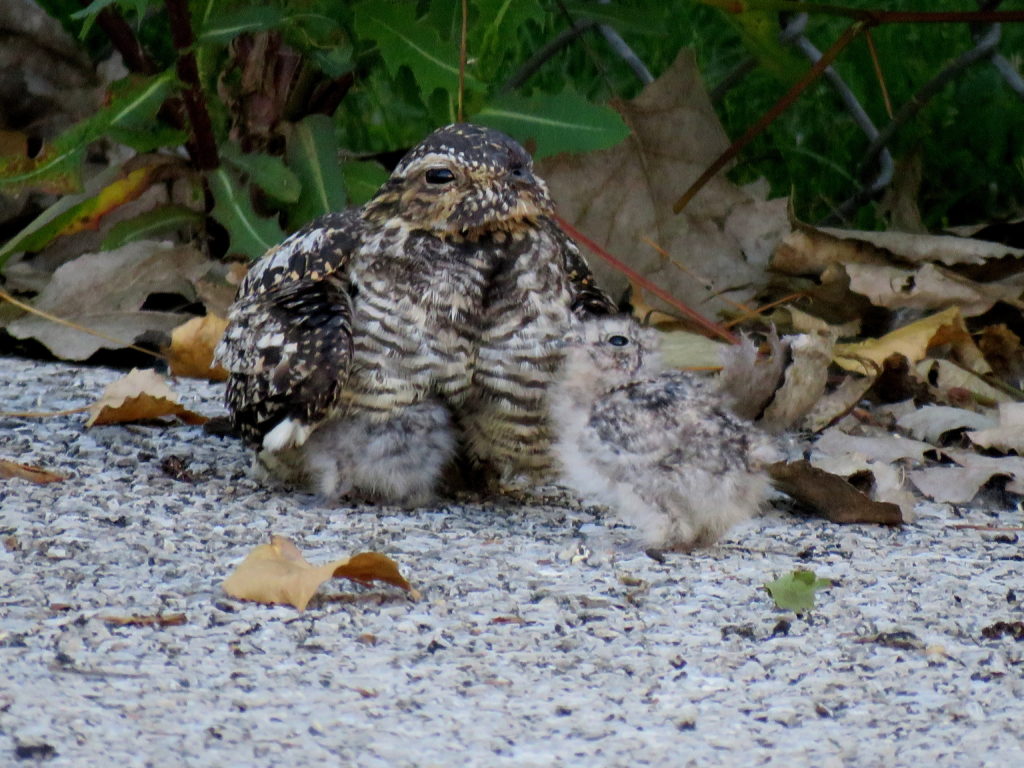
The female lays just one or two eggs at a time, and the pair may have two broods in a season. Females are the primary incubators. At times she will stand over the young with open wings, creating a shade umbrella when needed.

Common Nighthawk with nestling (Photo by Karen Wade)

Common Nighthawk female with young (Photo by Karen Wade)

Diet & Distribution

Common Nighthawks eat flying insects exclusively. Once prey is sighted, the bird will fly toward it, open its beak, and maneuver to catch and swallow the insect. The young are fed these insects in regurgitated form – yummy!

As one would expect of a bird that is an insect-eater, Common Nighthawks migrate south with the change of the seasons. Often in late summertime, Bill Rapai, President of Grosse Pointe Audubon and my co-leader on bird walks, calls to inform me the migration is evident, with streams of nighthawks moving south over Lake St. Clair. Their journey may take them anywhere from 1,600 to 4,200 miles as they have been reported in Ecuador, Peru, Brazil and as far south as Argentina.

I hope that you get a chance to listen for these unique birds, and then look to the sky and experience these seasonal marvels.


Enjoy your birds!

-Rosann Kovalcik

Owner, Wild Birds Unlimited, Grosse Pointe Woods

Have you joined our email list? Click here to sign up, it’s free and gives you access to sales, coupons, nature news, events, and more!
Posted in Summer, Wild Bird Facts | Tags: birds, common nighthawk, Grosse Pointe Woods, nighthawk, summer, wild birds, wild birds unlimited | Leave a comment |

Recent Posts

  • Welcome the Wood Duck as our State Duck
  • Killdeer – our most common Plover returns
  • Red-tailed Hawks, the Common Buteo
  • Bald Eagles –
  • What other owls can you find ?

Archives

  • March 2026
  • March 2023
  • February 2023
  • January 2023
  • April 2022
  • March 2022
  • December 2021
  • September 2021
  • April 2021
  • March 2021
  • May 2020
  • April 2020
  • February 2020
  • January 2020
  • November 2019
  • August 2019
  • July 2019
  • March 2019
  • February 2019
  • December 2018
  • October 2018
  • August 2018
  • July 2018
  • May 2018
  • April 2018
  • March 2018
  • January 2018
  • December 2017
  • November 2017
  • October 2017
  • September 2017
  • August 2017
  • July 2017
  • May 2017
  • April 2017
  • February 2017
  • January 2017
  • December 2016
  • October 2016
  • September 2016
  • August 2016
  • July 2016
  • May 2016
  • February 2016
  • October 2015
  • August 2015
  • July 2015
  • June 2015
  • March 2015
  • October 2014

Categories

  • Bird Feeding Solutions
  • Bird Songs
  • Events & Outings
  • Fall
  • Native Plants
  • Nesting
  • Spring
  • Squirrels
  • Summer
  • Uncategorized
  • Wild Bird Facts
  • Winter

Enter your email address:

Delivered by FeedBurner

  • Prev
  • 1
  • 2
© Wild Birds Unlimited of GPW - Website by TBD Web Services