• Home
  • About Us
  • Blog

Tag Archives: Grosse Pointe Woods

Reconnecting with the Common – A Celebration of Mallards

Posted on February 6, 2020 by Rosann Kovalcik

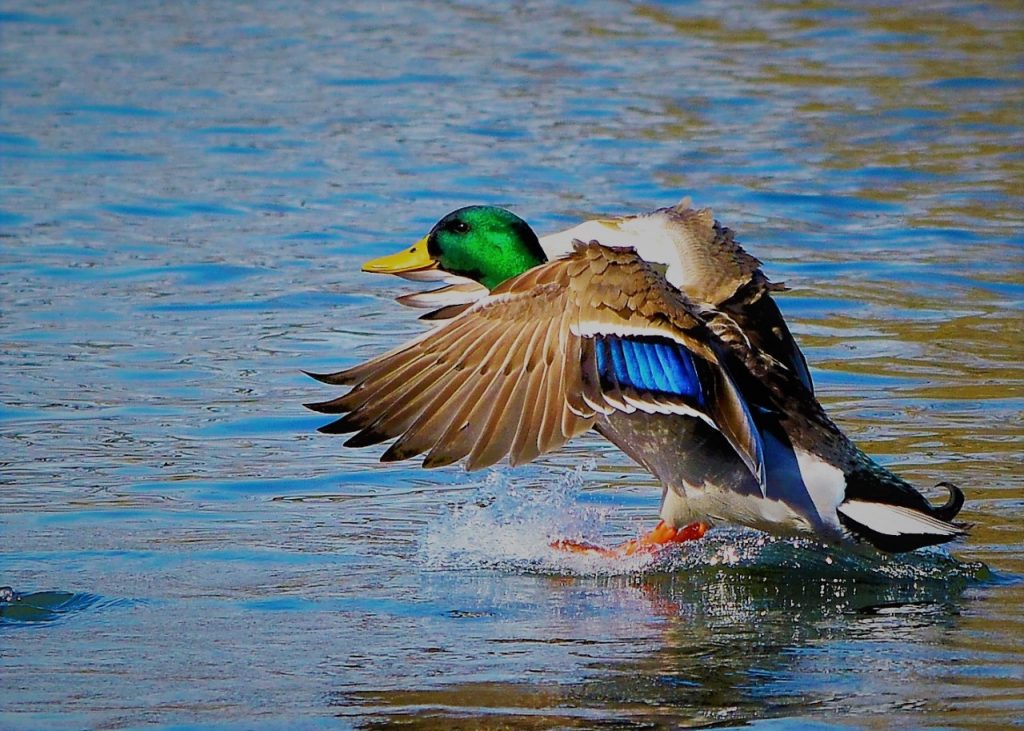
Mallard Duck by Tim Lintz

Mallards, A Reintroduction

Although common in our state, the Mallard Duck male is anything but common in appearance. He is eye-catching with his bold green head, bright yellow bill and equally bright orange legs. He also has a splash of iridescent blue in the wings (on the speculum). By comparison, the female is plain in coloration. This helps her stay concealed for safety during nesting.

My granddaughter, Isabelle, has helped me see Mallards in a re-energized light. She’s so captivated, she’s drawn and written poetry about them. I am grateful these ducks are so common. This makes it easy for her to observe them in the fresh water ponds near her house.
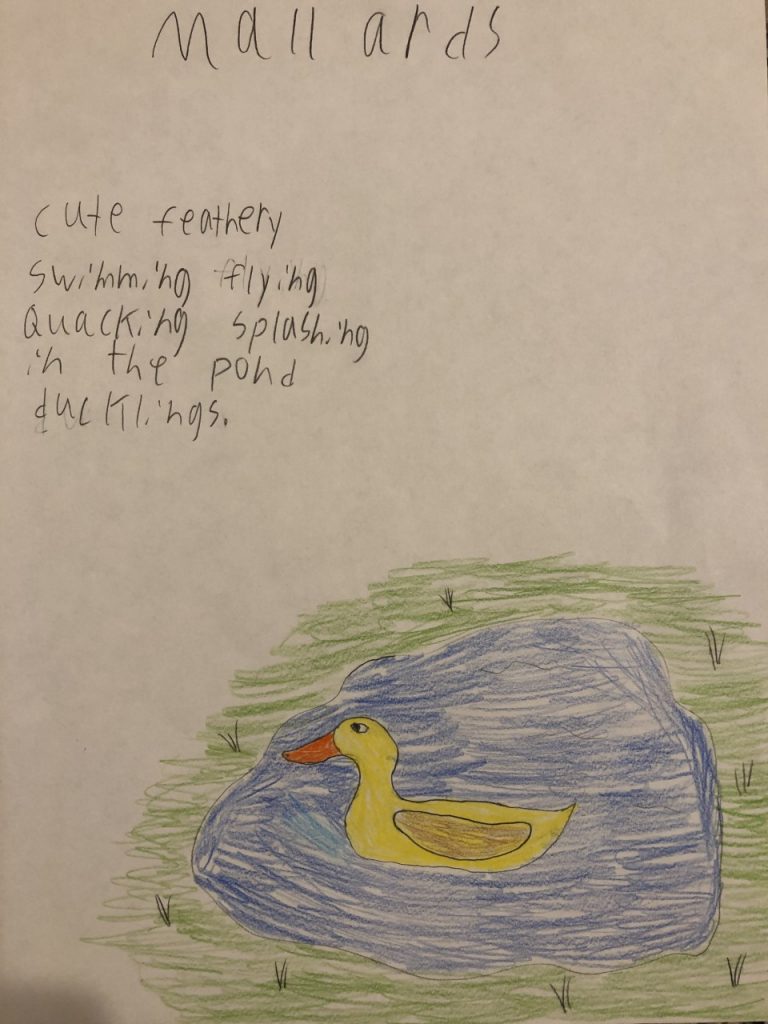
A Poem & Drawing by Isabelle

The Mallard is a dabbling duck, meaning it does not typically dive for food. Instead, Mallards tip end-up and uses their beaks to grab plant food. They will also eat insects, mollusks and crustaceans. Mallards dive for food when needed, although their bodies are not built for this. Their legs are positioned in the middle of their body, which is not ideal for diving. Diving ducks, on the other hand, dive freely with legs near the back of their body.

Fun Facts About Mallards

Migrating Mallards can fly 55 miles per hour!

The “quack” you hear is from the female, as the male gives a quieter, raspy sound.

At the end of breeding season, Mallards lose their flight feathers and cannot fly for 3 to 4 weeks. During this time, they gather in groups in sheltered places as their feathers regenerate. Their body feathers molt during this time into a less striking plumage called “eclipse” plumage.

Many hunters target Mallards for sport. It was hunters who discovered the oldest known Mallard. The bird had been banded in Louisiana in 1981 and was shot in Arkansas in 2008, making it at least 27 years old.

A Place in the Ecosystem

Mallards play an important role in creating habitat. In a recent article published by Audubon, a scientist revealed his discovery of their eating habits after tracking their movements. As the article states, Mallards use the landscape as one big buffet. They will eat plants in one place and as they travel throughout the day, they excrete these seeds into areas sometimes as far away as five miles. This creates habitat, maintaining existing patches of healthy plant communities and creating new habitats. Read the full article here https://www.audubon.org/news/mallards-are-everywhere-and-thats-great-wetlands

Enjoy these ducks as much as Isabelle does, as they return to Michigan from their wintering grounds in the months to come.


Rosann Kovalcik, Owner

Wild Birds Unlimited, Grosse Pointe Woods

Have you joined our email list? Click here to sign up, it’s free and gives you access to sales, coupons, nature news, events, and more!
 

Posted in Wild Bird Facts | Tags: birds, duck, Grosse Pointe Woods, habitat, mallard, Michigan, nature, wild birds unlimited | Leave a comment |

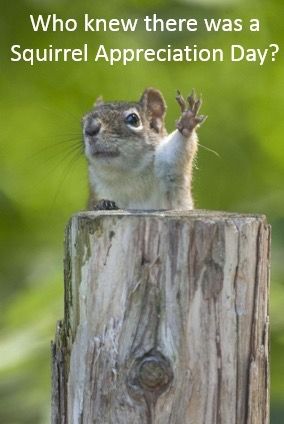
Squirrel Appreciation Day is January 21st

Posted on January 20, 2020 by Rosann Kovalcik

Squirrels: An Introduction

Soft, fluffy and entertaining – the definition of a squirrel. In our area we have both Fox Squirrels and Gray Squirrels. You may also see black squirrels, color variants of Gray Squirrels. Both species mate December through February. You may have noticed “chasing”, which is part of the mating ritual. Females give birth to naked, helpless young about 45 days after mating. They nurse the young until about three months of age. They will also mate again in May to June. Males do not help with the raising of the young. Squirrels build nests of twigs and leaves about 35 to 40 feet up, often in the sturdy crotch of a tree.

Food: Dining, Stashing, Chewing

Squirrels are omnivores and will eat all types of seeds including acorns, hickory, walnut, mulberry and hawthorn seeds. They will also consume bird eggs, birds, insects, arthropods and carrion.

Squirrels gather and stash seeds, an important job in the ecosystem. Some of the seeds are never refound, instead sprouting into new trees. These small mammals also serve as a food source for Red-tailed Hawks, Coopers Hawks, owls, coyotes and fox.

Another amazing aspect of squirrels is their teeth. They grow continuously and are very effective at chewing, as those of us who have them around well know.

Other Fun Facts

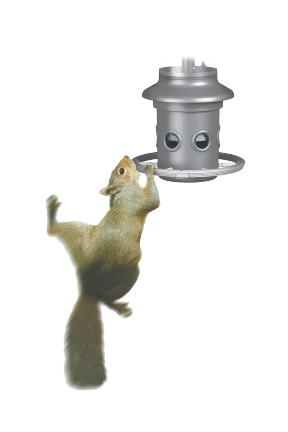
Those who feed the birds know of the squirrels’ leaping abilities. They can leap ten feet from a solid object such as the side of a tree as well as any man-made structure. It seems as if the only surface that they are unable to climb is glass.

Here is your word of the day – vibrissae. These thick hairs (whiskers) are found on the chin, nose, above and below the eyes, and forearms of squirrels. Squirrels rely on these hairs to enhance their sense of touch.

The Flip Side of Appreciation

However, many people are quick to exclaim about “those darned squirrels!” Who cannot relate to the success of squirrels at our bird feeders? Getting into the feeders is their full-time occupation and they are relentless in their efforts. Looking to keep them out of your feeders? We have answers for you at Wild Birds Unlimited in Grosse Pointe Woods!

Deterrents: Feeders

There are some very effective squirrel resistant feeders including the Eliminator. This feeder has a perch that closes with the weight of a squirrel. The length of the feeder prevents the squirrel from hanging from the top of the feeder or reaching the seed ports below.

Baffles

Placement of feeders that do not have a weight device is important if you do not intend to feed the squirrels. If using a pole system, there are steel baffles that are too wide for their paws to get a sufficient grip and too long for them to over reach the baffle. This type of baffle needs to have its top at five feet off of the ground with all feeders hanging so that the bottom of the feeders are above that five foot position. We do not recommend plastic baffles, as squirrels can easily chew through this material. This type of baffled pole system is only effective if placed ten feet from any object the squirrel can jump from. This includes trees, patio furniture, pots, grills and other feeding setups. When using a baffle above a feeder, the baffle needs to be quite wide or shaped to create a slide assisting the squirrels’ exit. Both types of baffles are carried at WBU GPW.

Seeds

Safflower seed used alone is another effective remedy against feeding squirrels as most do not prefer its’ taste. Hot pepper treated seed is also a good deterrent.

Whether you watch them and have names for the ones in your yard or are among those that wave your fist as you exclaim “Those Darned Squirrels”, let’s commend them on Squirrel Appreciation Day.


Posted in Bird Feeding Solutions, Squirrels | Tags: Bird Feeding, bird feeding solutions, Grosse Pointe Woods, solutions, squirrel, squirrel appreciation day, wild birds unlimited | Leave a comment |

Where are the Juncos?

Posted on January 9, 2020 by Rosann Kovalcik

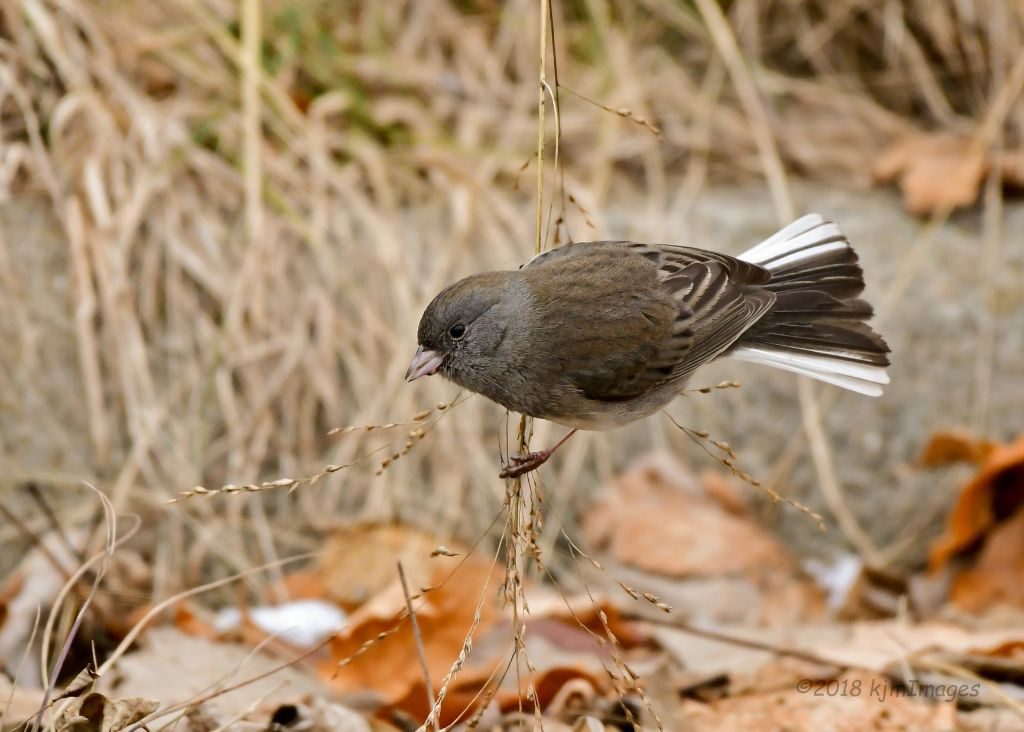
Dark-eyed Junco by Kevin Murphy, Eliza Howell Park, Detroit

Where are all the Juncos?

We have had a number of customers recently ask where the Dark-eyed Juncos have been. Many have not yet seen them at the feeders this winter. My best experience with Juncos this year has been when we had a recent small snowfall. They were perched on the stems of plants I leave up all winter to provide seeds for the birds.

Now that we are not experiencing snow cover, the seeds available to Juncos make their visits to our feeder less of a necessity. I have been missing their subtle gray coloration and their white “snowy” bellies. I also love that their two outer tail feathers are white on each side, looking like a cheerleader skirt as it flies or spreads its tail.

To attract them to your yard, offer White Proso Millet on a tray feeder. The feeder can be on legs and close to the ground, or on a pole system and higher off of the ground. Either way, this stable platform allows them to eat in a way that true sparrows prefer, simulating their groundfeeding preference.

Enjoy this winter visitor while you can!

Rosann Kovalcik, Owner

Wild Birds Unlimited, Grosse Pointe Woods

Have you joined our email list? Click here to sign up, it’s free and gives you access to sales, coupons, nature news, events, and more!


Posted in Bird Feeding Solutions, Winter | Tags: climate, dark-eyed junco, Grosse Pointe Woods, junco, millet, seasonal, snow, sparrow, weather, wild birds, wild birds unlimited, Winter | Leave a comment |

Christmas Tree – Artificial vs. Real

Posted on November 21, 2019 by Rosann Kovalcik

Tradition vs. Change

What a beautiful tradition it is to bring the outside within our homes at the holidays, featuring trees, wreaths and garlands. Who doesn’t have a photo with the family in front of the Christmas tree?

The choice we make as to whether we buy a real tree or an artificial one does have an impact on the world our birds call home. Manufacturing these trees requires fossil fuels. This means, when they are trashed within a landfill, they will not decay. Overseas manufacturing and shipping processes also leave a large carbon footprint.

Sounds like a real Christmas tree is the most environmentally friendly answer. Grown right here in our state of Michigan, the trees produce oxygen while they are growing as well as sequestering carbon. Tree farms will use the same spaces to plant again after harvest, a sustainable way to farm.

Things to Consider

If you are buying a real tree, there are some important factors to consider.

Photo by Lori Campbell

Ask your retailer these questions or research about their farm or shop – do they follow Integrated Pest Management practices and avoid the use of pesticides when possible, and do they practice water conservation?

Just as we have experienced with firewood, real trees used at the holiday can harbor non-native invasive pests. Trees that are grown in one area and then transported to be sold in another area may spread invasive pests such as gypsy moths, balsam woolly adelgid and Phytophthora ramorum, the fungus-like pathogen that causes sudden oak death.

The best way to minimize the chance of introducing a new pest to your neighborhood is by getting a locally sourced tree. Follow these tips:

  • Purchase locally grown trees or greens for wreaths and garland.
  • Cut down your own tree from a local cut-yourself farm or nursery.
  • Obtain a permit and cut your own tree from a local forest within 10 to 20 miles of your house.
  • Buy a pre-cut locally sourced tree from an established local business.
  • Don’t use invasive species such as Asian bittersweet in holiday decorations

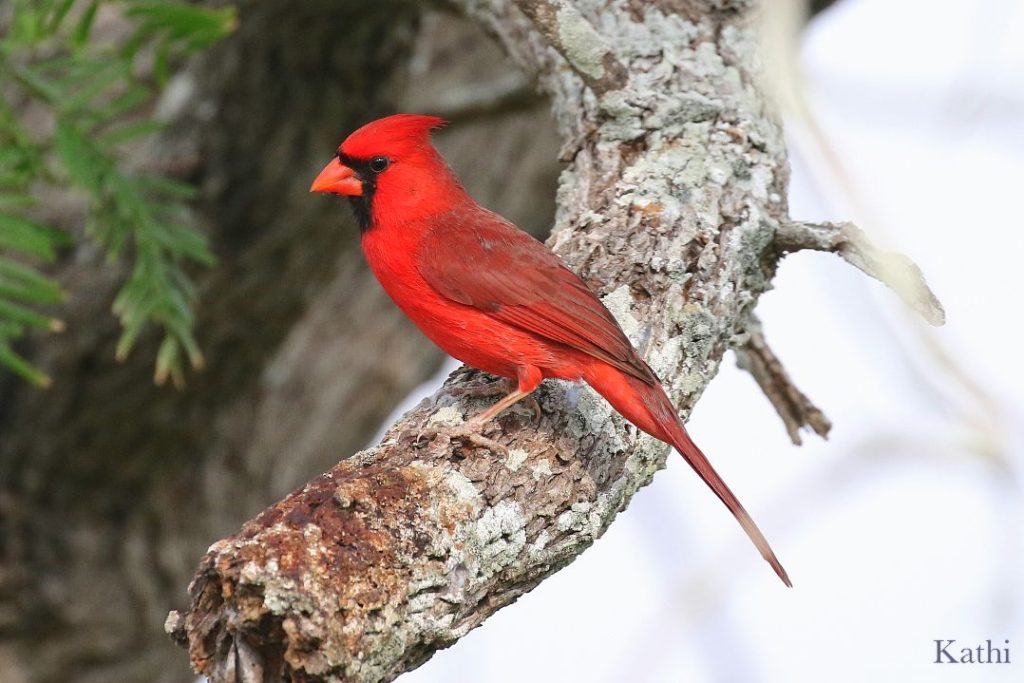
And once you are done with the tree, place it in the yard as shelter for your Cardinals. After all, nothing looks better on an evergreen than a Cardinal!

Northern Cardinal by Kathi Hince

Posted in Winter | Tags: Cardinal, christmas, christmas tree, december, Grosse Pointe Woods, holiday, locally sourced, november, wild birds unlimited | Leave a comment |

Fascinating Blue Jays

Posted on August 12, 2019 by Rosann Kovalcik

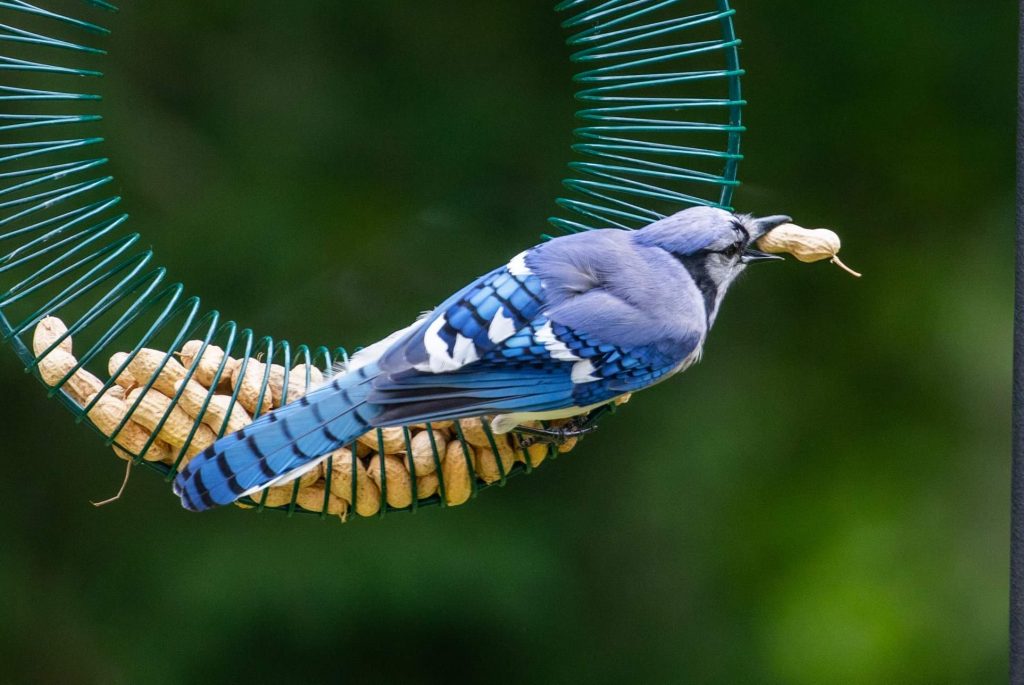
Blue Jay with Peanut by Emily Wolfe

Blue Jays – The Sights and Sounds

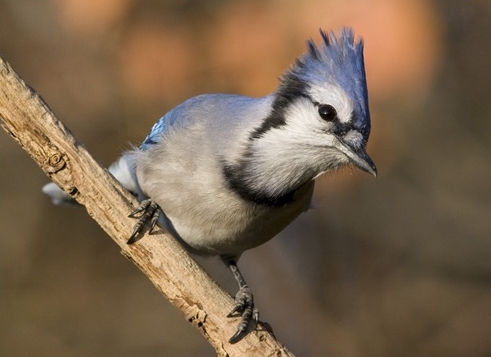
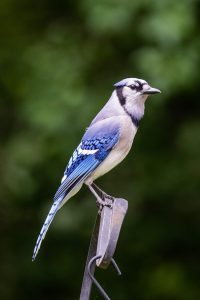
I find Blue Jays to be fascinating – I’m listening to them now as they sing out their “tootle-oot, tootle-oot” from the oak tree. They have such a rich complexity of vocal sounds. The same can be said about their plumage, a rich complexity of blues of every shade. Such a handsome bird with both males and females looking alike, their faces framed by a dark collar. Perhaps one of their finest features is their crest, raised and lowered at will depending upon their mental state – up when alert, feeling territorial, and down when there’s no reason, giving the back of the head a little “flair”.

The Brains

Blue Jay by Emily Wolfe

Jays play an important role among the birds in our yards. They will sound the “Jay! Jay!” alarm when a potential predator is nearby. This allows all of the birds to be on the lookout for the hawk, cat or human that caused the Jay to give the neighbors a warning. One of the most amazing vocalizations of the Blue Jay is their ability to vocally imitate hawks – they have turned my head with the calls of a Red-shouldered Hawk and a Broad-winged Hawk, only to spot them in my binoculars. And just a few short minutes after I wrote that, I heard a Cooper’s Hawk calling from the rooftop – except it was a Blue Jay. Perhaps he was using this as a scare tactic to keep the other birds away so he could swoop down and feed on the seed cylinder I had just put out. Smart move.

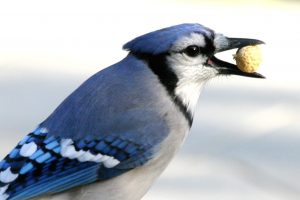
Blue Jays can be entertaining and unafraid in your yard. They will come quite close when any kind of a nut is involved as they naturally seek the mast of trees. Capable of storing a few acorns in their gular pouch, a holding area in the throat, they will transport the acorns to an area to stash away. Placing the acorns on the ground and covering them with leaves, or pushing them into the soil with their strong beaks, they hope to save them for future food. Many of those acorns will grow into trees and in this way, the Blue Jay plays forester for us.

Peanuts in the shell evoke the same mental response in Jays.  They simply cannot resist them when offered and will carry them away where they can hold them with their feet and use their beak to break away the shell and eat the protein-packed nut inside.

Blue Jay

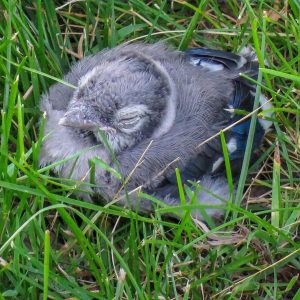
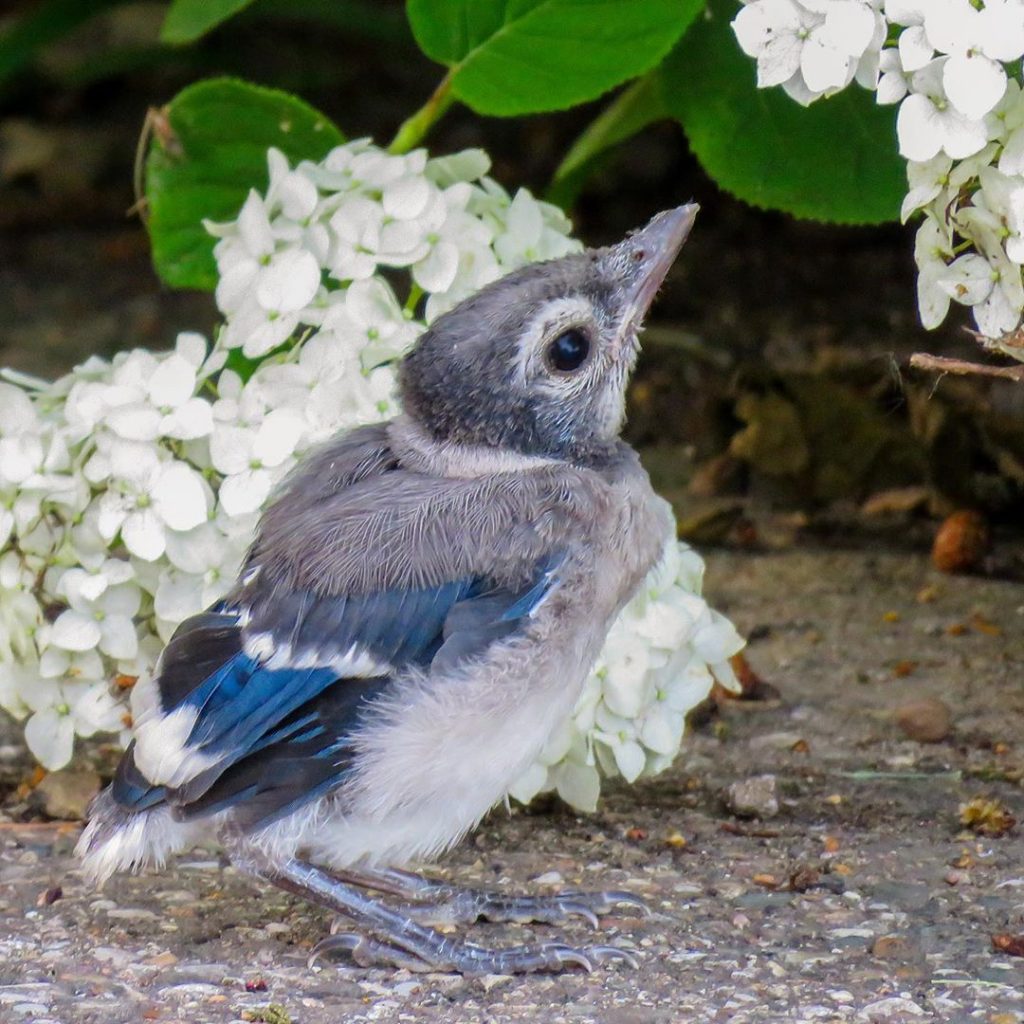
Baby Blue Jay by Samantha Mason

The Babes

Both male and female Blue Jays take an active part in raising their brood of two to seven. They are quite secretive during nesting season as they find food for their young and deliver it to the nestlings. Jays are omnivorous and will eat a wide variety of plants and animals. Once the young fledge the nest, they will travel in family groups for feeding purposes. You can hear their contact calls to each other as they move about the trees.

Movement

Blue Jays take part in their spring and fall migration in very large numbers. They migrate in daytime flocks, unlike many of the small passerines that use the cover of night for migration. We have seen these flocks of hundreds of Blue Jays flying over us at the Ford House during our bird walks. The wing beats blink light and dark flashes as they travel along – a magnificent sight.

Enjoy this adaptable, gorgeous bird and all of the vocalizations that make Jays so unique.

Baby Blue Jay by Samantha Mason

Enjoy your birds!!

Rosann Kovalcik, Owner

Wild Birds Unlimited, Grosse Pointe Woods

Have you joined our email list? Click here to sign up, it’s free and gives you access to sales, coupons, nature news, events, and more!
Posted in Wild Bird Facts | Tags: Bird Feeding, birds, blue jays, Grosse Pointe Woods, jay, Michigan, summer, wild birds, wild birds unlimited | Leave a comment |

Winter Tree Birds

Posted on February 4, 2019 by Rosann Kovalcik

After spring and summer, the majority of birds in Michigan leave for the south. Their instincts pull them to return to wherever they have a full diet of insects and fruits. Those winter birds that stay for the colder months are marvels at finding food. What can they possibly eat? How do they find food?

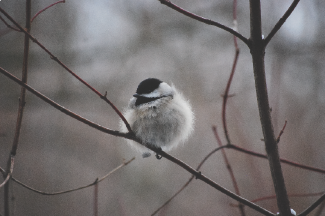
Black-capped Chickadee

Chickadees: The Flock Masters

Whenever I hear the calls of Chickadees in winter, their “dee dees” catching my attention, I know to look for them if I want to locate other winter birds. The Chickadees are what I call the “Flock Masters”. Very hardy and inquisitive, they are usually the first to locate a food source, whether natural foods or those found at feeders. Other birds are keen to the Chickadees’ ability to find food.

Downy Woodpeckers, Tufted Titmice, White-breasted Nuthatches and Brown Creepers make up the companion group that follow Black-capped Chickadees as they forage for food. Even those birds that come to our feeders for sunflower, suet and peanuts will continue to forage for natural foods. They eat what protein they can find, including insect eggs and cocoons, in addition to the insects hidden within the trees. They perform a great service as they keep our trees healthy and strong.

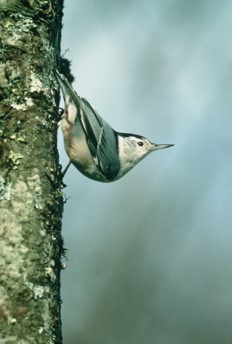
White-breasted Nuthatch

Working on the tiny twigs of the trees is the smallest of the team, the Black-capped Chickadee. The ability to hang upside down and investigate with their sharp eyesight and small, probing beaks enables them to find the eggs and hiding insects on the smallest of twigs.


Tufted Titmice: The Cousins

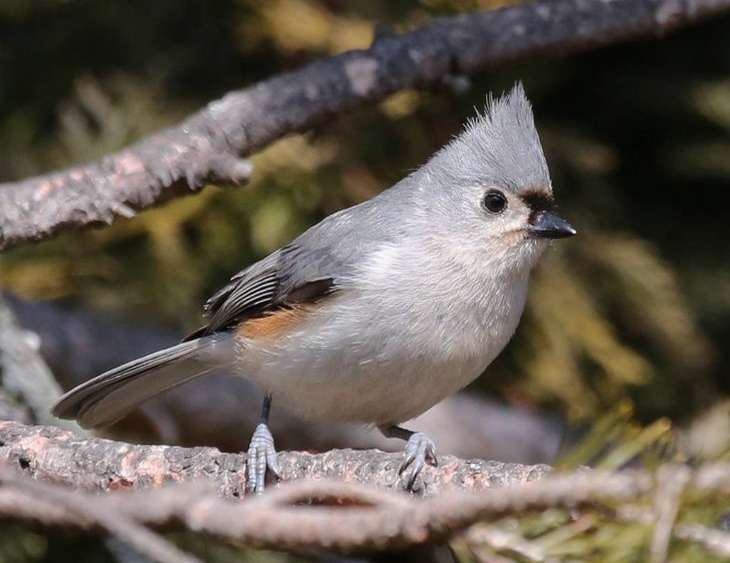
The Tufted Titmouse, a cousin to the Black-capped Chickadee, is a little larger and can focus its energy on the larger twigs. They work more slowly and usually move around in mated pairs. Their comparatively louder calls ring out clearly in the winter time, as “Peter, Peter” or “Cheer, Cheer, Cheer.” Titmice are also adept at hanging on to branches in an acrobatic manner. Sometimes when they are very intent on their food gathering, their head crest will remain down. At other times, the feathers of their crest become erect as a warning. Perhaps they feel a hawk is in the area or a squirrel is getting too close to their food source and they do not want to share.

Tufted Titmouse (Photo by John Graffius)

Downy Woodpeckers: The Listeners

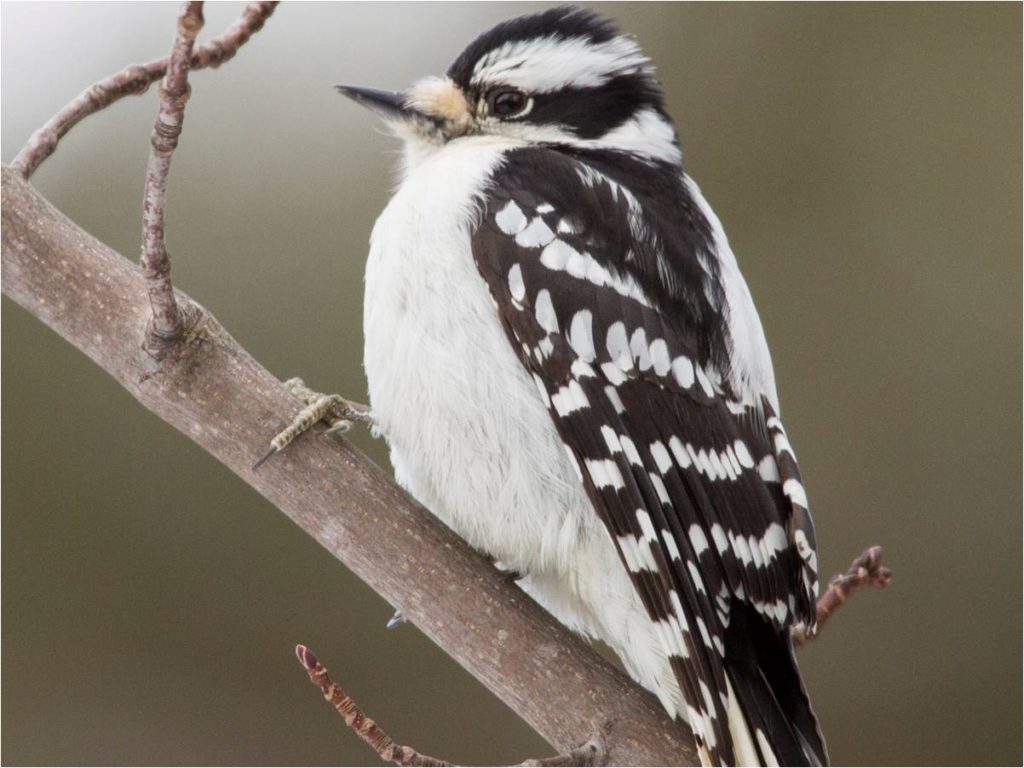
The Downy Woodpecker is an even larger bird in the team of Winter Tree Birds. They work on the limbs and larger branches of the tree. Not only do they look for insects, eggs and cocoons on the branches of the trees, they listen for the sound of insects moving inside the trees. This is why you may watch a Downy Woodpecker clinging to the side of the tree, moving its head from side to side – it is listening for the insects. Once it locates them, it uses its small beak to chisel a hole and extract the insects inside. A woodpecker has special tools for this function, a barbed tongue with sticky saliva that is excellent for extracting the insects it finds.

Downy Woodpecker

Nuthatches & Creepers: The Bark Bandits

The deep cracks in the bark of some trees are a perfect place to find cocoons, insects, and eggs, sheltered from rain and snow. This is where the White-breasted Nuthatch and Brown Creeper are very adept – their beaks well-suited to the job. White-breasted Nuthatches have a thin dagger-like bill that is slightly upturned on the bottom edge to create an angle, perfect for the type of feeding it does. When seeking food, the Nuthatch travels upside down and from top to bottom on the tree trunks. This allows them to find the food the right-side-up birds do not see.

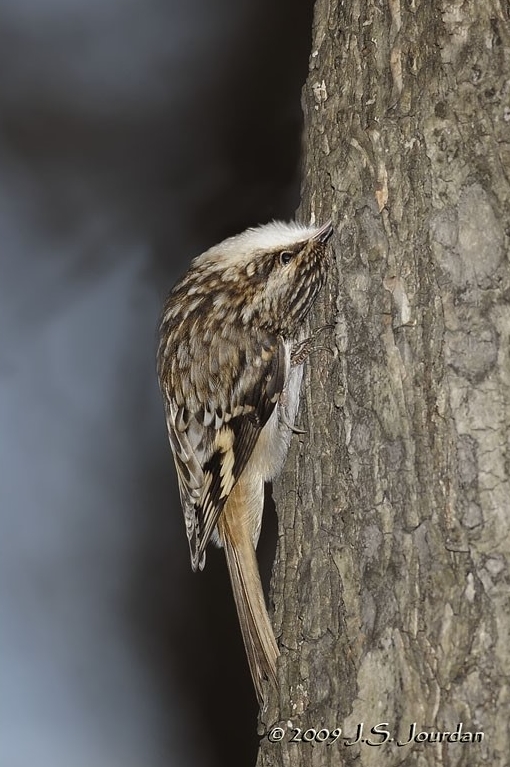
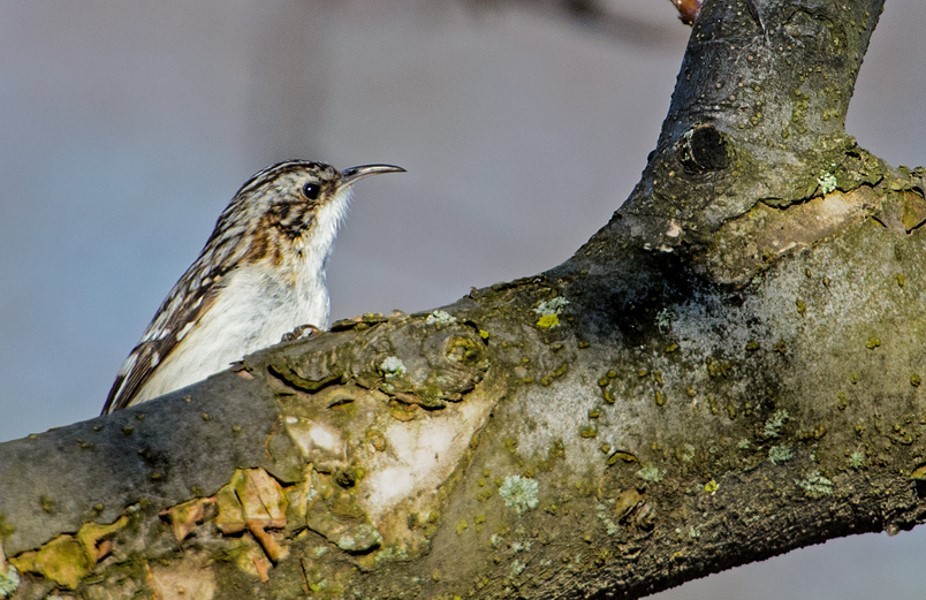
On the other end of the spectrum is the Brown Creeper, who can be identified by its behaviors. Flying from one tree to another, the Brown Creeper lands at the base of the tree and work its way up, searching along the bark for food, and circling the tree as it climbs. Its long, needle-like bill allows for deep probing within the nooks and crannies of trees. This bird eats only insects in the winter – an admirable accomplishment.

Brown Creeper (Photo by Jerry Jourdan)

Brown Creeper

The Black-capped Chickadee takes care of the tiny twigs, the Tufted Titmouse gleans from the larger twigs, the Downy Woodpecker from limbs and branches and the White-breasted Nuthatch and Brown Creeper take from the trunks and larger branches of the trees, travelling in opposite directions. By working as a team, these five species of birds help to keep our trees healthy and strong.

Enjoy your birds!!

Rosann Kovalcik, Owner

Wild Birds Unlimited, Grosse Pointe Woods


Have you joined our email list? Click here to sign up, it’s free and gives you access to sales, coupons, nature news, events, and more!
Posted in Wild Bird Facts, Winter | Tags: birds, brown creeper, chickadee, Grosse Pointe Woods, nature, nuthatch, trees, wild birds unlimited, Winter, woodpecker | Leave a comment |

Bird Spotlight: Long-eared Owl

Posted on December 2, 2018 by Rosann Kovalcik

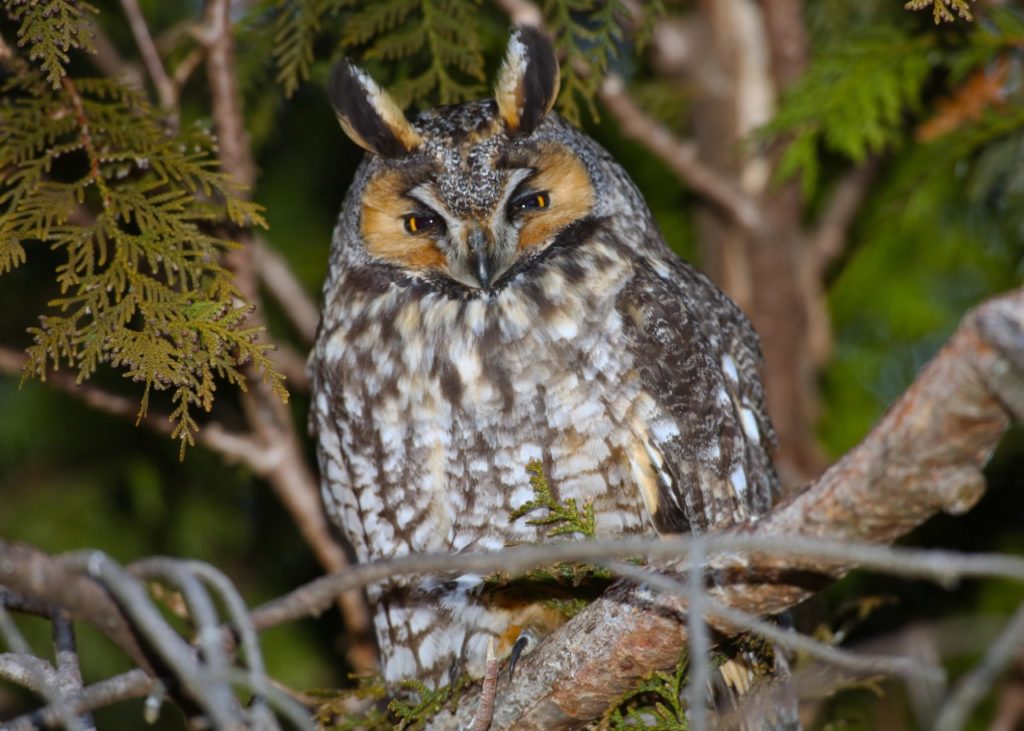
Long-eared Owl (Photo by John Graffius)

An Owl Appears

I can still hear the excitement in my friend Debbie Graffius’ voice as she explained what she was seeing. She was looking in her yard at a large owl with ear tufts. She knew enough to know it was not a Great-horned Owl.

At this point, I grabbed my binoculars, as there was only one answer. I quickly headed to her house in the north part of Grosse Pointe Woods (not far from Lake Shore). Sure enough, perched on a limb open to the sun, yet protected by surrounding evergreens, was a Long-eared Owl. When Debbie’s husband John returned home, his photography skills came into play. Some excellent shots of this comfortably roosting owl resulted.

A Little Bit of Background…

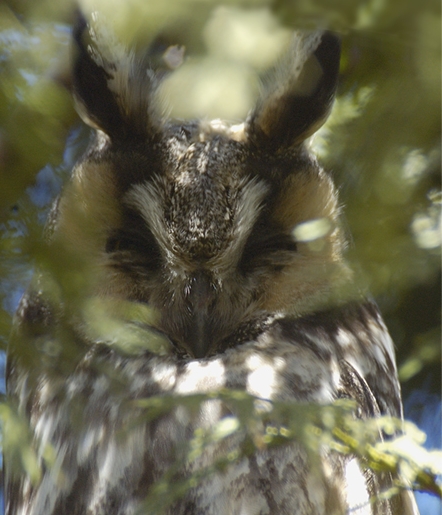
We spotted this bird on March 29th of 2013. We don’t often see Long-eared Owls in our area. The only other time I am aware of was in April 2004, when Tufted Titmice in my yard began to scold. This led to an investigation on my part. Sure enough, a Long-eared Owl was in the evergreens in my 75 x 150 Grosse Pointe Woods yard. This is a great testimony to the need for evergreens as shelter. The bird did not budge during the daylight. Mike Florian, my good buddy and President of the Grosse Pointe Camera Club, was able to get some great photo opportunities that day.

This behavior is typical of Long-eared Owls do. They roost during the day in dense evergreens, typically near field edges. When trying to conceal themselves, Long-eared Owls sit erect, tightening their body feathers,“ear” tufts sticking straight up. One of the most interesting facts I have read about these owls is how they use the same distraction technique as that of Killdeer. When luring predators away from the nest, both the owl and the killdeer often feign a broken wing as they drag themselves along the ground.

Long-eared Owl (Photo by Mike Florian)

Bird Stats

The wingspan-to-body-length ratio of this bird is quite amazing; head to toe it is only 13 – 16 inches tall, with a wingspan tripling that at 39 inches! For a bird this size, it is amazing they weigh only 8 ounces to 1 pound.

To raise their young, Long-eared Owls use the abandoned nests of hawks and crows. These are usually 20 feet or more above ground. They lay between 2 – 10 eggs, with an incubation period of 35 – 40 days. The young are fed the same diet as the adults, torn into bite-sized pieces. This diet consists of mammals including: mice, shrews, voles, rats, rabbits and less commonly, birds. The adults kill the prey with a bite to the back of the neck of the mammal, and eat their prey whole.

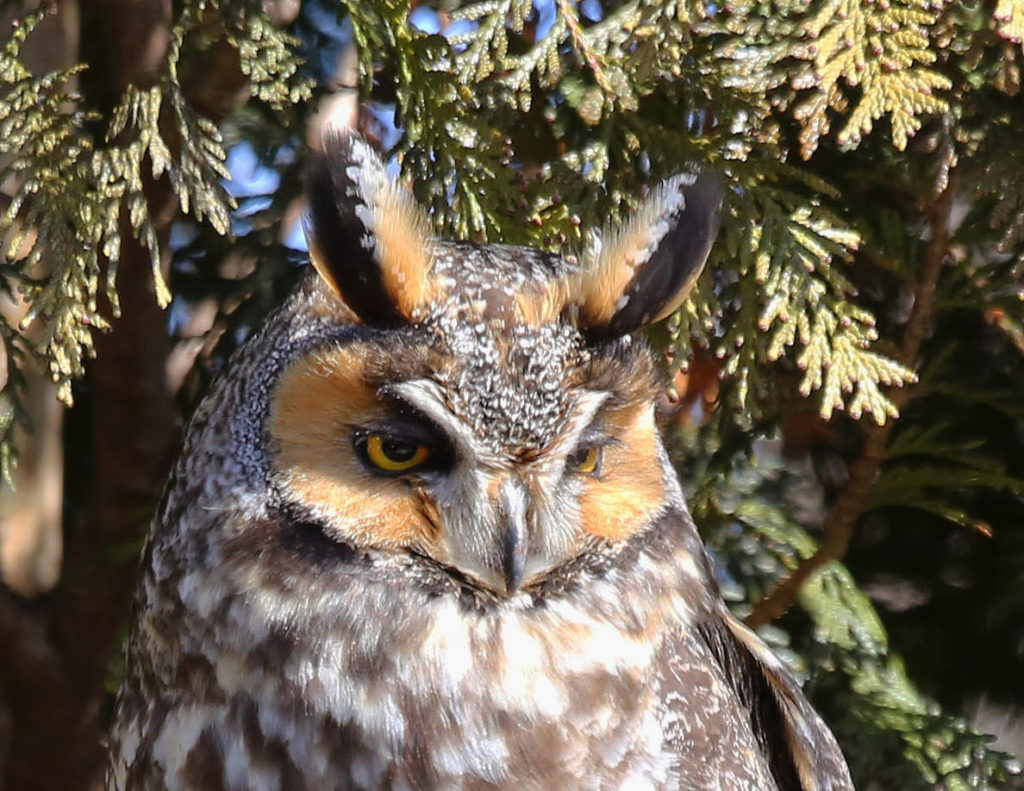
Long-eared Owl (Photo by John Graffius)

Owl sounds are always magical to me, and the sounds of a Long-eared Owl are no exception. The male gives a low hoot call, similar to the sound of blowing across the top of an empty bottle. The owls repeat this call sometimes up to 200 times, between 2 -4 seconds apart. The sound carries more than a half mile away. When disturbed during nesting season, the owls clack their mandibles together and also give a call that sounds like the bark of a small dog.

As set forth on the Cornell web-site, Long-eared Owls are rated as a 13 out of 20 on the Continental Concern Score and they are listed on the 2016 State of North America’s Birds Watch List. This list was compiled to bring attention to those species that are at risk of extinction unless conservation measures are taken to reverse the challenges that they face. For Long-eared Owls, this includes loss of habitat including wooded areas and grasslands. Continued protection of our small wetlands is a step in the right direction for this species’ survival, since many of these wetland areas are adjacent to wooded areas.

Final Reflections

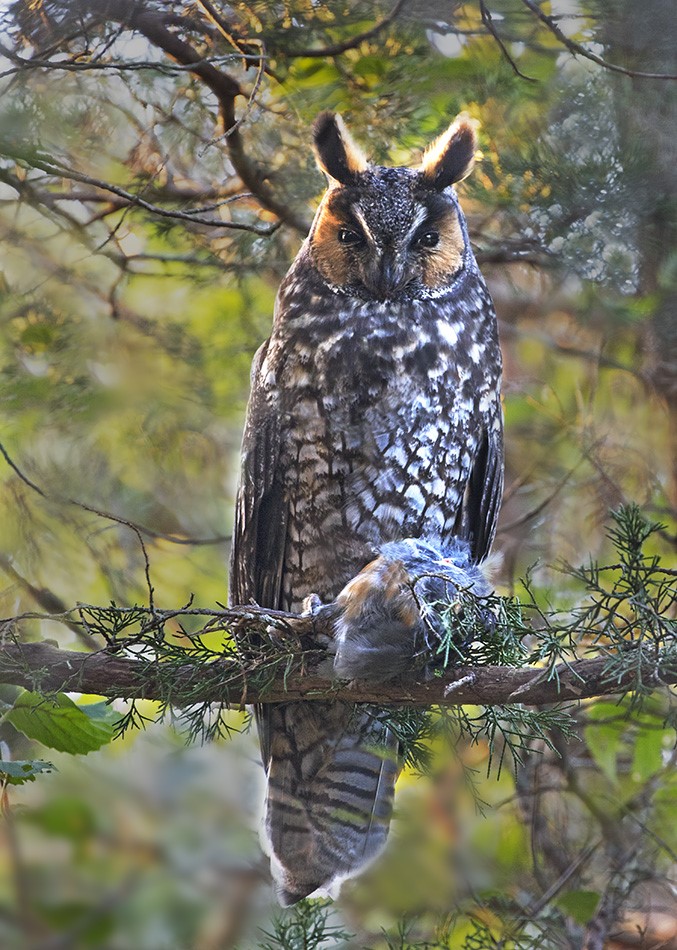
Long-eared Owl (Photo by Kevin Karlson)

Some of my best memories of this bird is watching their moth-like flight as they lift from the trees at dusk at Whitefish Point, on their way to migrate further north. This is when their wingspan can truly be appreciated. Knowing this is their behavior, I advised Deb and John if we sat and patiently watched the Long-eared Owl in their yard, it would become active at dusk. And as if on cue, when the sun began to set, the bird sat more erect and stretched its wings. Looking about, it then flew to the top of the nearest phone pole and after another stretch, lifted itself and headed north.

Do you want to see this owl? Mark your calendar for the Michigan Audubon Spring Fling on April 28th and 29th at Whitefish Point in Paradise, Michigan. Stand on the hawk watch platform at dusk and wait for the magic to begin.

Enjoy your birds!

Rosann Kovalcik, Owner

Wild Birds Unlimited, Grosse Pointe Woods


Have you joined our email list? Click here to sign up, it’s free and gives you access to sales, coupons, nature news, events, and more!
 

Posted in Wild Bird Facts | Tags: audubon, birding, birds, cornell, Grosse Pointe Woods, long-eared owl, Michigan, nature, owl, whitefish point, wild birds, wild birds unlimited | Leave a comment |

Red-breasted Nuthatch, A Predicted Winter Visitor

Posted on October 4, 2018 by Rosann Kovalcik


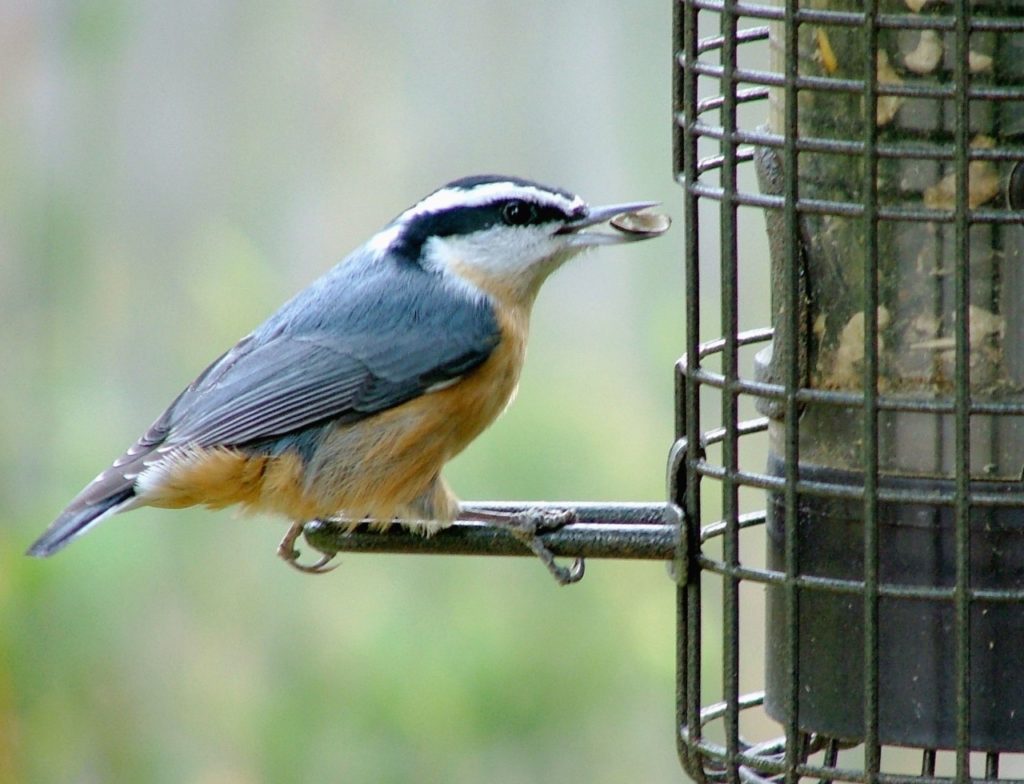
Red-breasted Nuthatch on Squirrel-proof Feeder (photo by  Glen Noyer)

Have you noticed Red-breasted Nuthatches in your yard or at your feeders this year?  I have a pair that have been visiting since the fall and they are such a Joy to watch and to listen to, sounding like little squeak toys.

Irruption

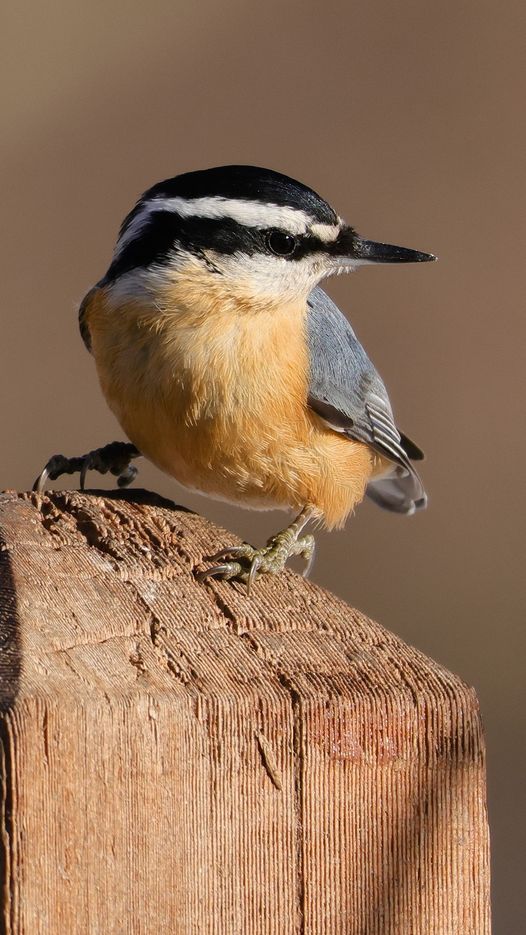
This movement of Red-breasted Nuthatches to our area is called an irruption, a movement of a bird species from their usual wintering grounds, predicted based upon lack of food supply in Ontario forests.  Listen for their nasal “toot, toot, toot” and check out the cones of evergreens.   You may be rewarded with a look at these 4.5” birds, their striking eye line running from their beak to their nape, with a distinct white supercilium (“eye brow”) above that.  Red-breasted Nuthatches have slaty blue-gray backs and wings and, true to their name, a wash of brick red color on their breast. Check out the tail length – it is only slightly longer than their wings.

Red-breasted Nuthatches have a distinctive flight pattern, with an undulating movement as a result of quick bursts of the wings, followed by a glide. Watch them in flight and notice the shortness of the tail.

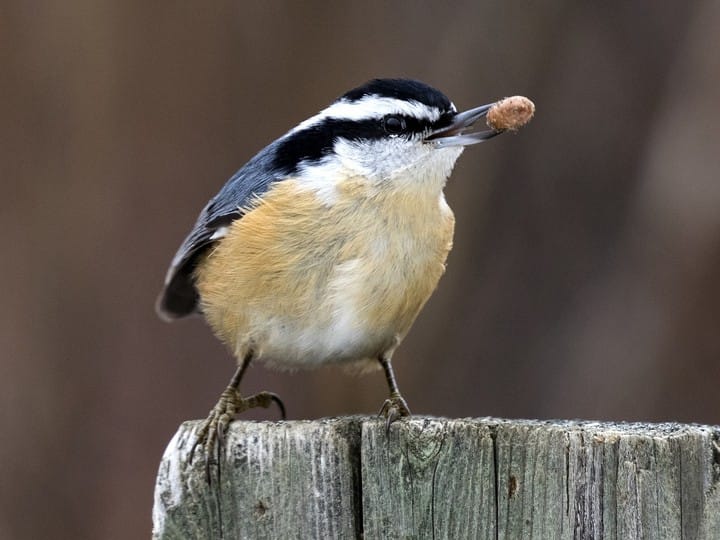
                 Red-breasted Nuthatch with a Bark Butter Bit (photo by Bob Martinka)

Feeding

These birds are fairly tame and can be watched very closely as they forage for food. In fact, I have had them land on my feeder pole, waiting patiently for me to fill the feeder. Offer them sunflower in or out of the shell, suet loaded with peanuts, and peanuts out of the shell to keep them coming back for the fats and protein they will need this winter. Now is the perfect time to try Bark Butter Bits, a small suet nugget that works well in the squirrel-proof feeder shown in the photo below. Spreadable Bark Butter also works well, either spread onto a tree trunk or a bark butter feeder.

Red-breasted Nuthatch on Squirrel-proof Feeder (photo by Bill Rapai)

Behavior

When feeding in trees, Red-breasted Nuthatches stay preoccupied with cones, extracting the seeds with their long, chisel-shaped beaks. They tend to place seeds in the cracks of tree trunks, using their beaks to chisel the shells away. This motion is responsible for the British-derived name, “Nuthatch” as “hatch” was a term used instead of “hack” back when the bird was named. Perhaps the most unique aspect of Red-breasted Nuthatches is their habit of walking down the trunks of trees as well as under the limbs of the tree, in search of insects to consume.  The toes of Nuthatches are perfect to accomplish this bark climbing – very long with sharp, long claws for gripping.


Shelter

During winter, it is not uncommon for groups of these birds to shelter together in a tree cavity or nest box to maintain warmth. Remember to keep your nest boxes up after cleaning them, for you may be visited by this little sprite (and a friend or two).

Enjoy your birds!

Rosann Kovalcik, Owner

Wild Birds Unlimited, Grosse Pointe Woods


Have you joined our email list? Click here to sign up, it’s free and gives you access to sales, coupons, nature news, events, and more!
Posted in Fall, Wild Bird Facts | Tags: Backyard birds, Bird Feeding, birds, Grosse Pointe Woods, irruption, nuthatch, red-breasted nuthatch, wild birds unlimited | Leave a comment |

The Joy of Listening

Posted on August 6, 2018 by Rosann Kovalcik

Working in the garden in the summer can be a delightful experience when we pay attention to the sounds of the birds. It’s educational and entertaining to concentrate on birds sounds and look for the stories behind them. You’ll be surprised at what you can learn just by listening, finding joy in the process.

A Morning In the Garden: The Birdsong Begins!

Blue Jay (Photo by John Graffius)

This morning I heard a conversation between a family of Blue Jays, murmuring to each other with a tone that reminded me of an interplay between The Three Stooges. They seemed to be comparing notes about where they would go to find food. Later, I heard the familiar “Jay! Jay!”  Were they sounding the “jay alarm” for the good of the group, because of a threat of some kind? Or was this practice just a “fire drill”?

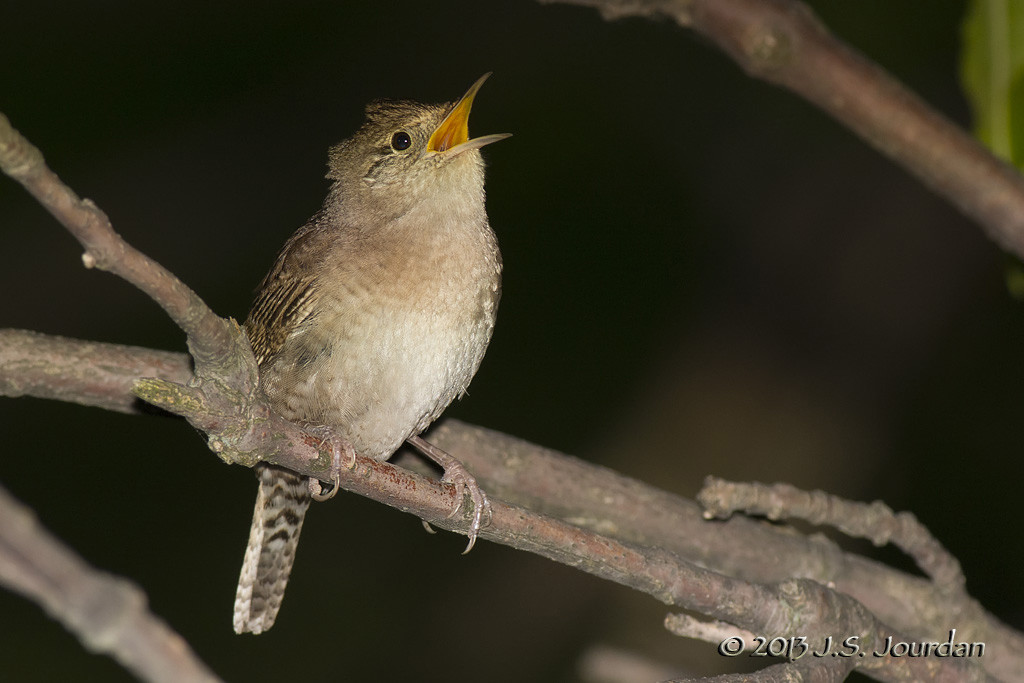
House Wrens are singing less compared to the constant song which announced their arrival back in May. It seems my neighborhood wren gives an earnest song just once or twice these days, and nothing more. Done nesting, there is no need to advertise territory.

House Wren (Photo by Jerry Jourdan)

Afternoon Sounds

At this moment, the Robins are the most vocal. Two spot-breasted youngsters are incessantly reminding mom they are hungry. The young can be easily located by their shrill “peek” calls. Mom is quite silent as she searches continuously for food. This is very different from her morning routine. At daybreak, I hear her frantically repeating, “peek, peek, tut, tut.” She does not stop until both youngsters respond, a way to let her know they made it through the night.

Heard but not easily seen are my neighborhood Northern Flickers, White-breasted Nuthatches and Chickadees. All of them are making contact calls between adults and fledglings, giving clues as to where they are feeding. The nuthatches seem to be in the most constant contact – soft and repeated many times. Maybe this serves as encouragement to the young, that they are doing well finding the bugs they need.

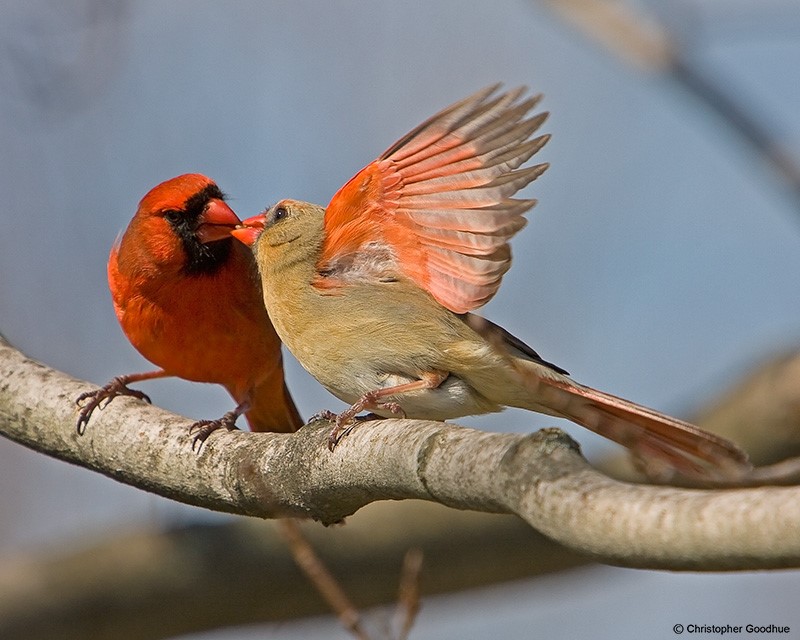
The Northern Cardinal definitely has a second brood of young. How do I know? His song is constant in the neighborhood. He sings from perches in the yards that surround mine, as well as from two places in my yard. These singing points define his territory. When he is closest to the nest site, I can hear the female sing back to him from her place on the nest. Cardinals are one of the few bird species that engage in counter-singing between the pair.

Male & Female Cardinals (Photo by Christopher Goodhue)

Song & Dance

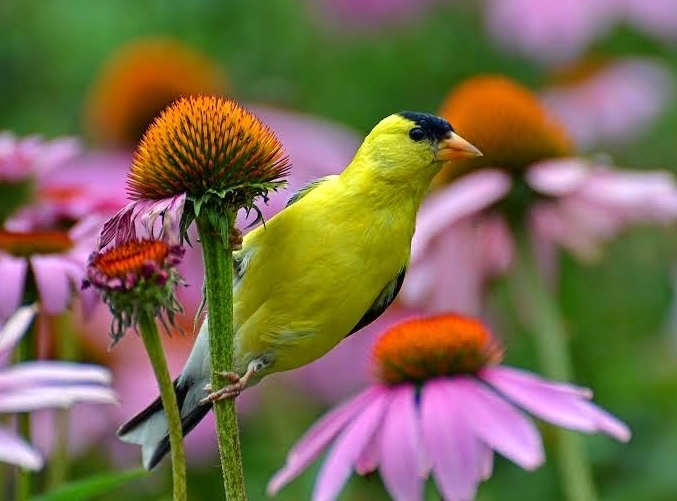
American Goldfinches are in full-on breeding mode. A male makes his presence known, taking flight from the neighbors’ birch trees, singing “per chicory” over and over as he flies. His flight is undulating, a gentle loop up and down, singing continuously. I watch him define his territory, cutting diagonally across my yard, then over two yards, then across towards the fringe of Ferry Elementary property and back to the birch trees. This display is gently repeated about every fifteen minutes.

American Goldfinch (Photo by Rodney Campbell)


Bird Sounds at Dusk

High-pitched calls in the trees overhead give away the presence of Cedar Waxwings. If I watch the area where they are calling long enough, I will eventually see the family group leave in flight together, off to another feeding stop.

As evening approaches, I hear the familiar chatter of Chimney Swifts. Gladly, I take a break from the garden and look up, admiring the family group of six that are flying in unison. Soon after, I know I will hear the Common Nighthawk’s raspy display call, a sound I will dearly miss once they have migrated this fall.

Make your next venture into the yard an auditory experience – you may be amazed at the Joy that listening brings!


Enjoy your Birds!

Rosann Kovalcik, Owner

Wild Birds Unlimited

Grosse Pointe Woods

Have you joined our email list? Click here to sign up, it’s free and gives you access to sales, coupons, nature news, events, and more!
Posted in Summer, Wild Bird Facts | Tags: american robin, august, backyard, birds, blue jay, Cardinal, cedar waxwing, chickadee, chimney swift, common nighthawk, garden, gardening, goldfinch, Grosse Pointe Woods, house wren, joy, july, nature, northern flicker, nuthatch, outdoors, summer, summertime, wild birds | Leave a comment |

Common Nighthawks: Aerial Marvels

Posted on July 9, 2018 by Rosann Kovalcik

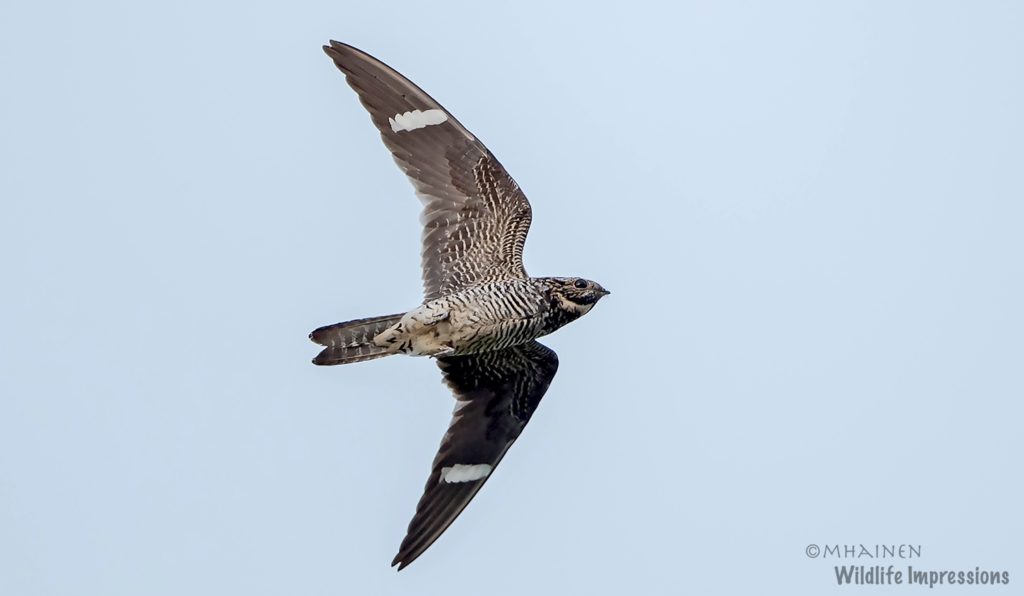
Common Nighthawk (Photo by Mark Hainen)

For me, the sounds of summer include the sounds of Common Nighthawks.

A pair of nighthawks has nested on top of Ferry Elementary School for as long as I can remember. First thing in the morning, and I mean before sunrise, I see him flying in his erratic pattern. I’m not sure of how to describe the call that accompanies the flight. I’ve seen it written as buzz BEEErzh and peent (click here to listen on Cornell’s All About Birds website).

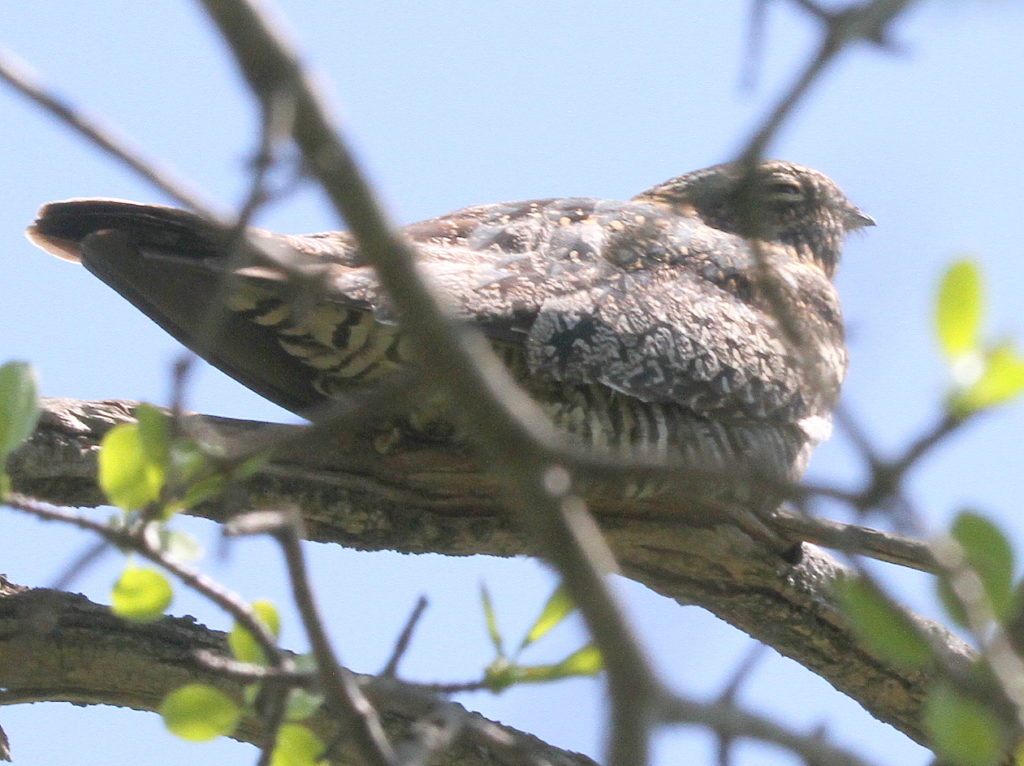
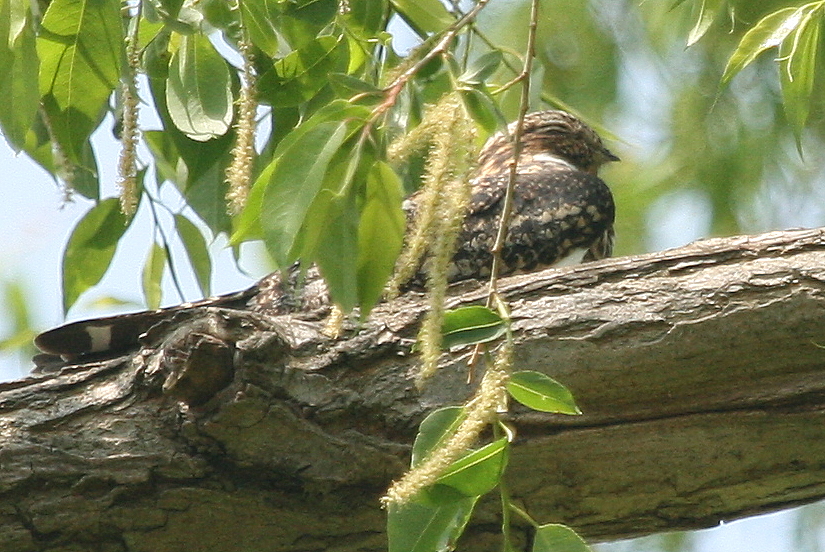
Common Nighthawk perched (Photo by Don Chalfant)

It is sharp and loud, a call to look up to the sky and wait for the wonderful sound to follow. The male nighthawk climbs higher and higher, then dives toward the ground, flexing his wings downward as he peels out of his dive. This causes a sound reminiscent of a race car rounding the edge of the track. To me, it sure sounds like vroom! This wonderful display gets repeated in the evening, a second treat for the summer day. This display serves two purposes; first, to attract a female and bond with her. It also lets other males know the territory is taken.

Common Nighthawk (Photo by Don Chalfant)

Field Marks

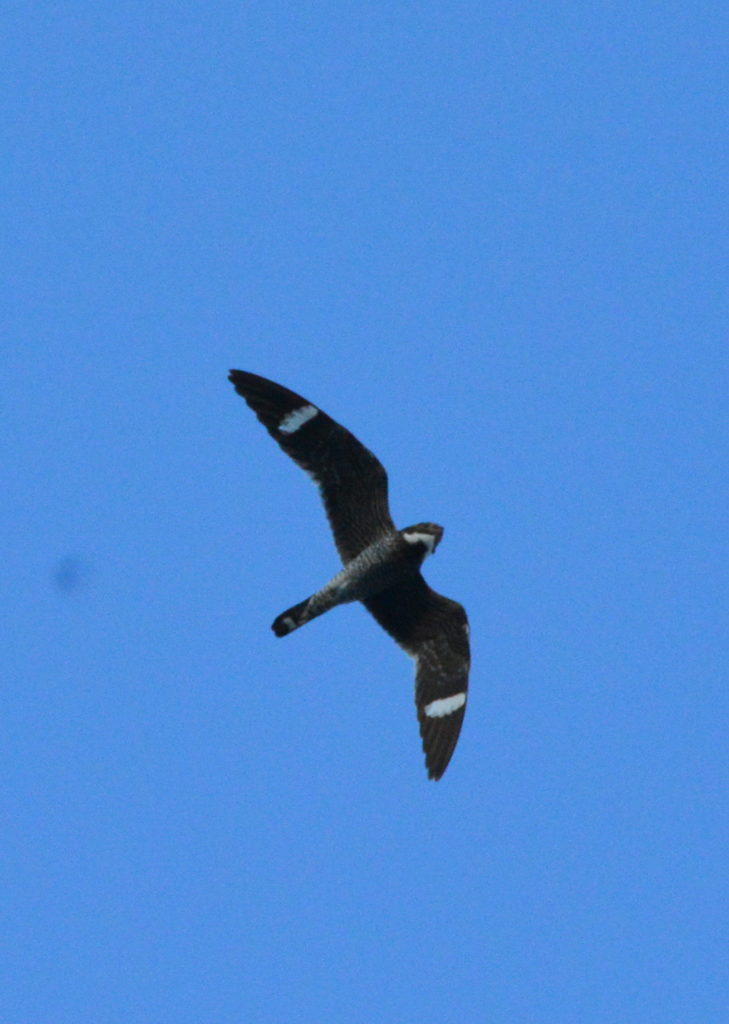
To identify Common Nighthawks, look for a slim, long-winged bird with white patches on the wing. Their pointy wings and streamlined shape make them appear larger than their measurements would indicate. Each bird is typically 9.5” long with a wing span of 24” and a weight of only 2.2 ounces. The type of flight is key – erratic and bounding – look for the white patch which is quite distinct in flight.

Common Nighthawk in flight (Photo by Karen Wade)

Nesting

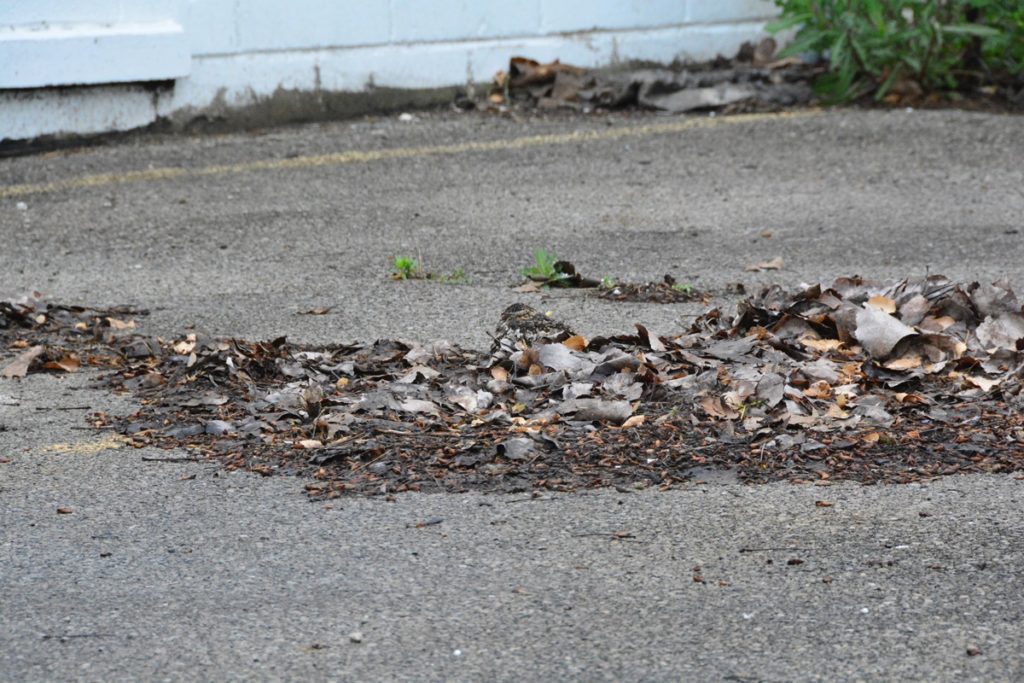
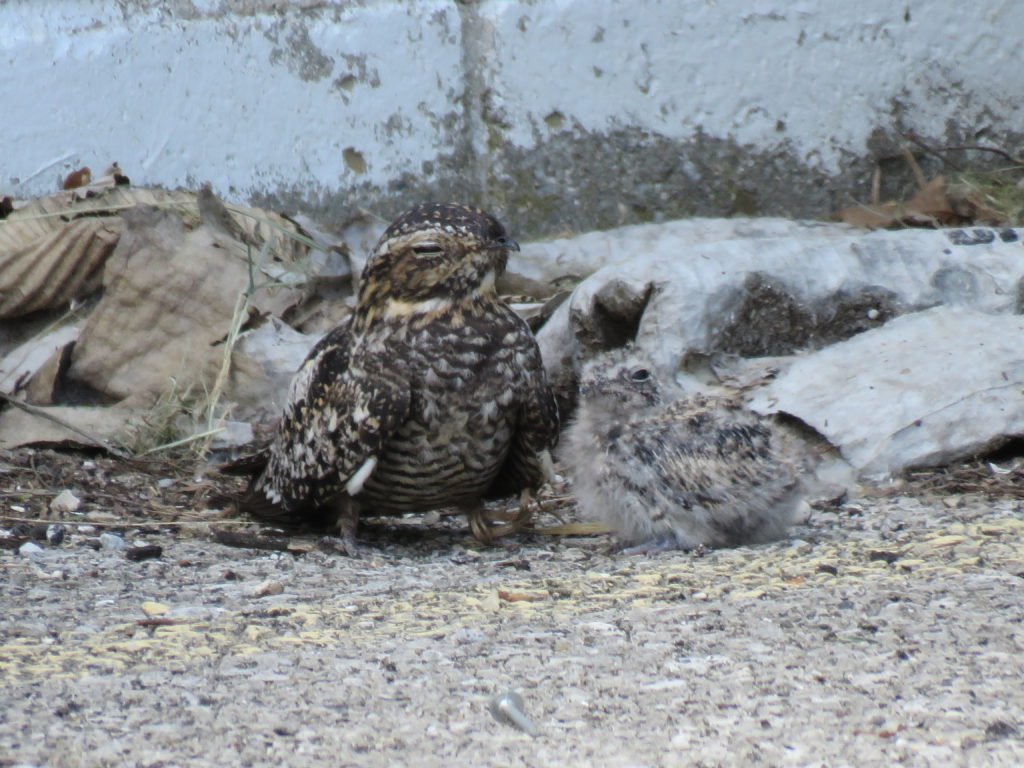
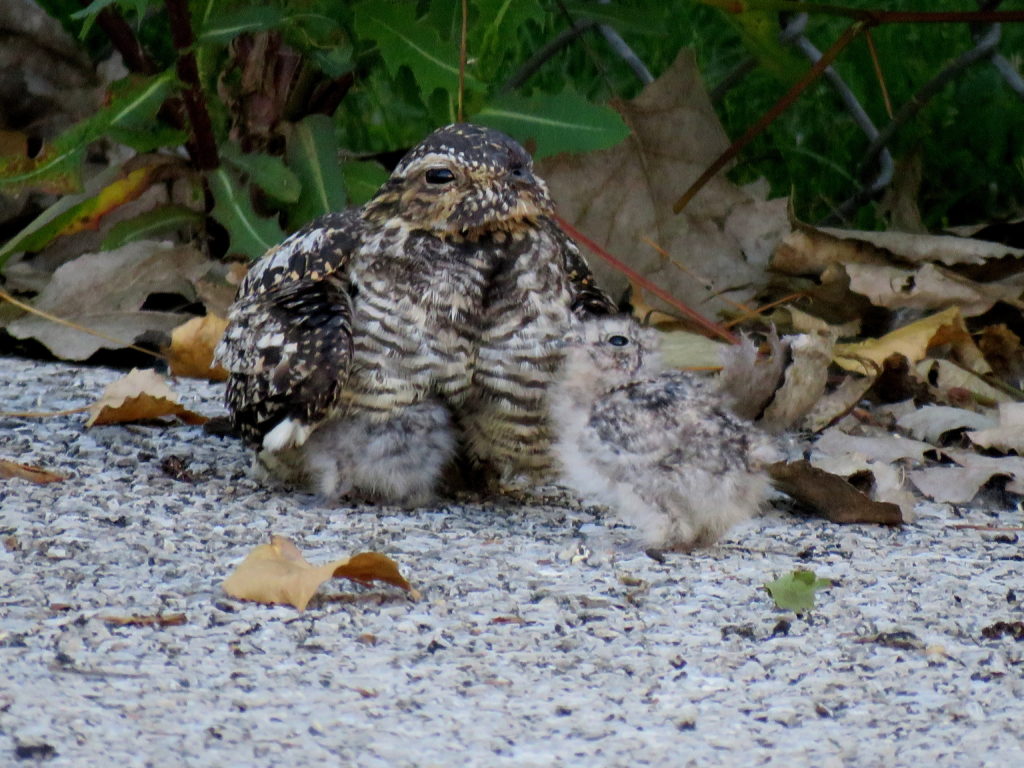
Common Nighthawks nest on open ground, gravel beaches, openings in the forest floor and in our area, on gravel roof tops. Nighthawks, including the eggs and the young, have excellent camouflage in their nesting habitats. These birds need to be hidden from view, so the trend from older style roofs with pebbles to rubber roofs without pebbles is not a good one. This shift leads to a decrease in prime nighthawk nesting habitat. If you can influence a roofing company to keep a corner of the roof covered in pebbles, we can maintain sufficient nesting habitat.

Common Nighthawk female, camouflaged on parking lot nest (Photo by Karen Wade)

The female lays just one or two eggs at a time, and the pair may have two broods in a season. Females are the primary incubators. At times she will stand over the young with open wings, creating a shade umbrella when needed.

Common Nighthawk with nestling (Photo by Karen Wade)

Common Nighthawk female with young (Photo by Karen Wade)

Diet & Distribution

Common Nighthawks eat flying insects exclusively. Once prey is sighted, the bird will fly toward it, open its beak, and maneuver to catch and swallow the insect. The young are fed these insects in regurgitated form – yummy!

As one would expect of a bird that is an insect-eater, Common Nighthawks migrate south with the change of the seasons. Often in late summertime, Bill Rapai, President of Grosse Pointe Audubon and my co-leader on bird walks, calls to inform me the migration is evident, with streams of nighthawks moving south over Lake St. Clair. Their journey may take them anywhere from 1,600 to 4,200 miles as they have been reported in Ecuador, Peru, Brazil and as far south as Argentina.

I hope that you get a chance to listen for these unique birds, and then look to the sky and experience these seasonal marvels.


Enjoy your birds!

-Rosann Kovalcik

Owner, Wild Birds Unlimited, Grosse Pointe Woods

Have you joined our email list? Click here to sign up, it’s free and gives you access to sales, coupons, nature news, events, and more!
Posted in Summer, Wild Bird Facts | Tags: birds, common nighthawk, Grosse Pointe Woods, nighthawk, summer, wild birds, wild birds unlimited | Leave a comment |

Recent Posts

  • Welcome the Wood Duck as our State Duck
  • Killdeer – our most common Plover returns
  • Red-tailed Hawks, the Common Buteo
  • Bald Eagles –
  • What other owls can you find ?

Archives

  • March 2026
  • March 2023
  • February 2023
  • January 2023
  • April 2022
  • March 2022
  • December 2021
  • September 2021
  • April 2021
  • March 2021
  • May 2020
  • April 2020
  • February 2020
  • January 2020
  • November 2019
  • August 2019
  • July 2019
  • March 2019
  • February 2019
  • December 2018
  • October 2018
  • August 2018
  • July 2018
  • May 2018
  • April 2018
  • March 2018
  • January 2018
  • December 2017
  • November 2017
  • October 2017
  • September 2017
  • August 2017
  • July 2017
  • May 2017
  • April 2017
  • February 2017
  • January 2017
  • December 2016
  • October 2016
  • September 2016
  • August 2016
  • July 2016
  • May 2016
  • February 2016
  • October 2015
  • August 2015
  • July 2015
  • June 2015
  • March 2015
  • October 2014

Categories

  • Bird Feeding Solutions
  • Bird Songs
  • Events & Outings
  • Fall
  • Native Plants
  • Nesting
  • Spring
  • Squirrels
  • Summer
  • Uncategorized
  • Wild Bird Facts
  • Winter

Enter your email address:

Delivered by FeedBurner

  • 1
  • 2
  • 3
  • Next
© Wild Birds Unlimited of GPW - Website by TBD Web Services