• Home
  • About Us
  • Blog

Author Archives: Rosann Kovalcik

Cedar Waxwings

Posted on January 15, 2020 by Rosann Kovalcik

Cedar Waxwings – An Introduction

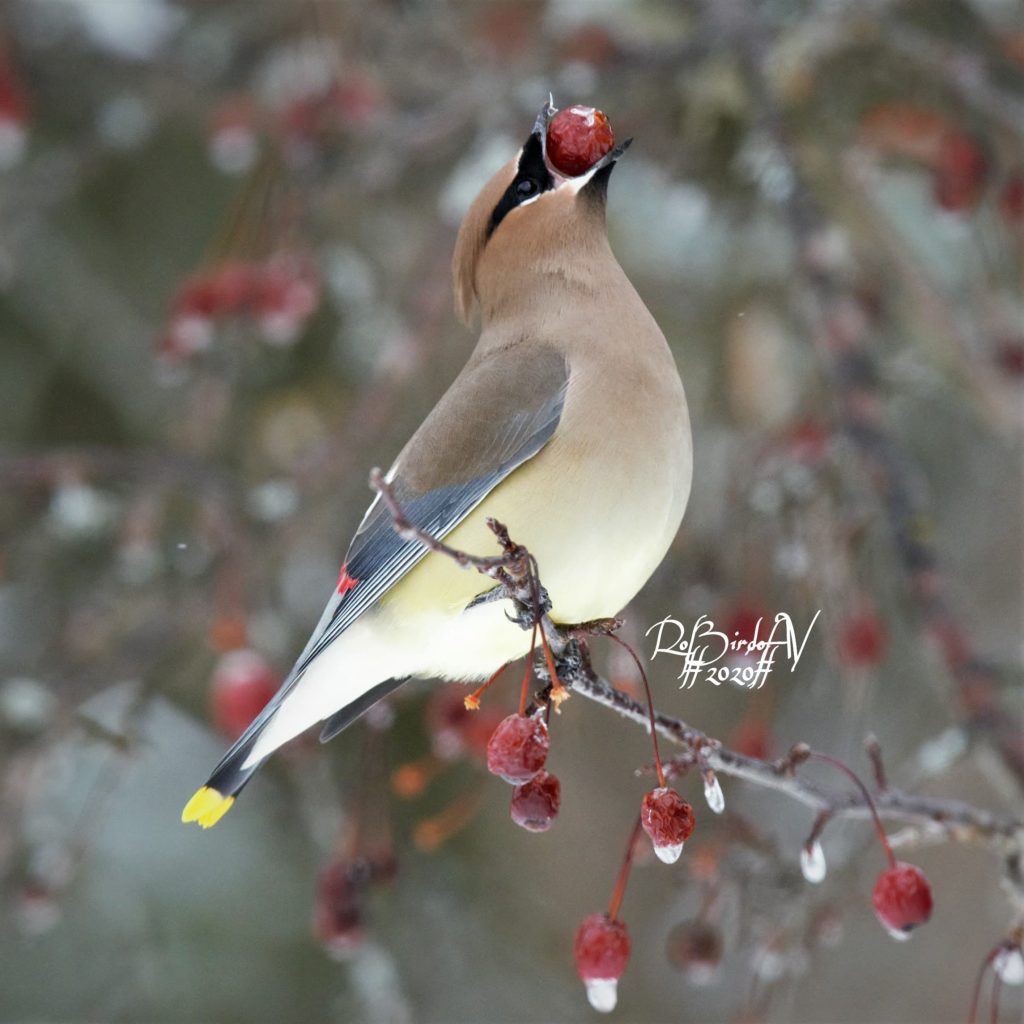
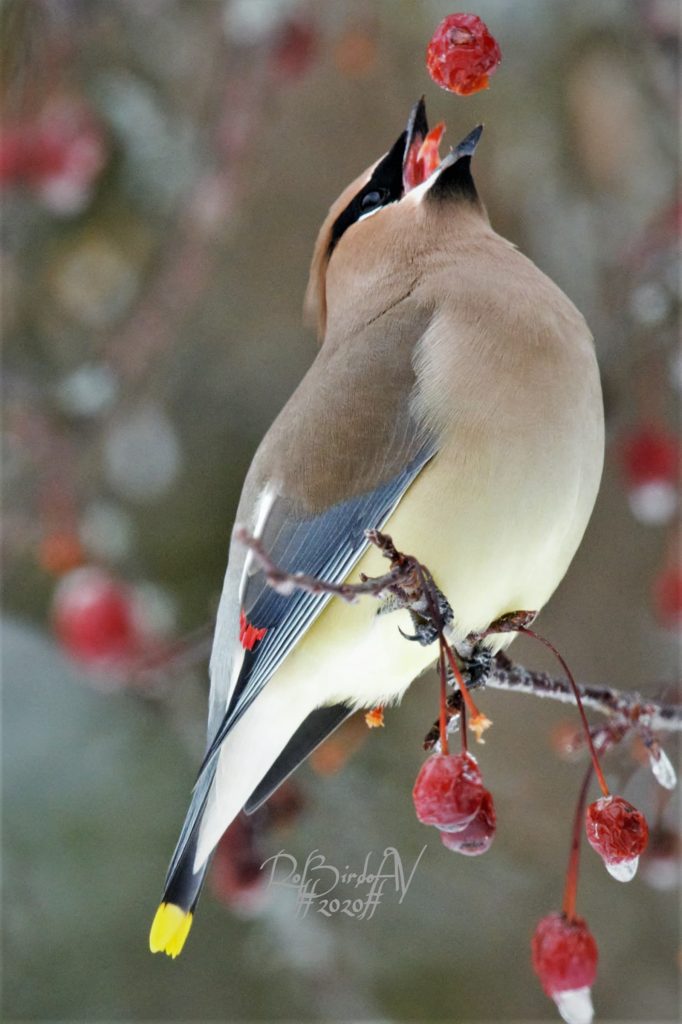
How fabulous-looking are Cedar Waxwings? The plumage appears soft and perfectly groomed. The facial mask is so striking. The wings have tips that appear as if they have been dipped in bright red wax. The bird has an elegant look, its tail edged in yellow, its head topped with a feathery crest. Winter is a great time to look for these birds as they eat fruit. You’ll find them travelling in flocks, often congregating near trees with berries.
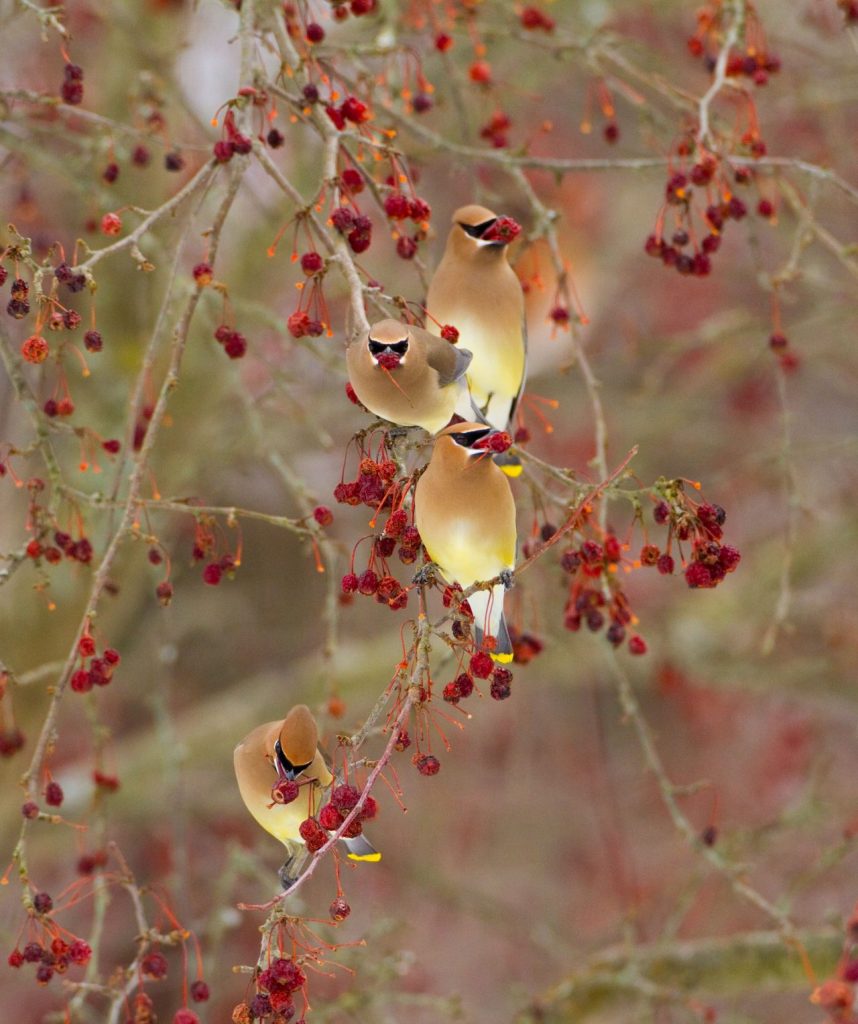
My most recent experience with Cedar Waxwings was at Ira Township Park in New Baltimore. A group of 45 of them attracted my attention, sitting in the sunshine at the tops of trees. They flew down a few at a time to an area behind tangled vines where a creek could be accessed. Daintily dipping their beaks, some drank from the running stream while others stood sentinel above. Such a peaceful sight made the winter walk so rewarding.

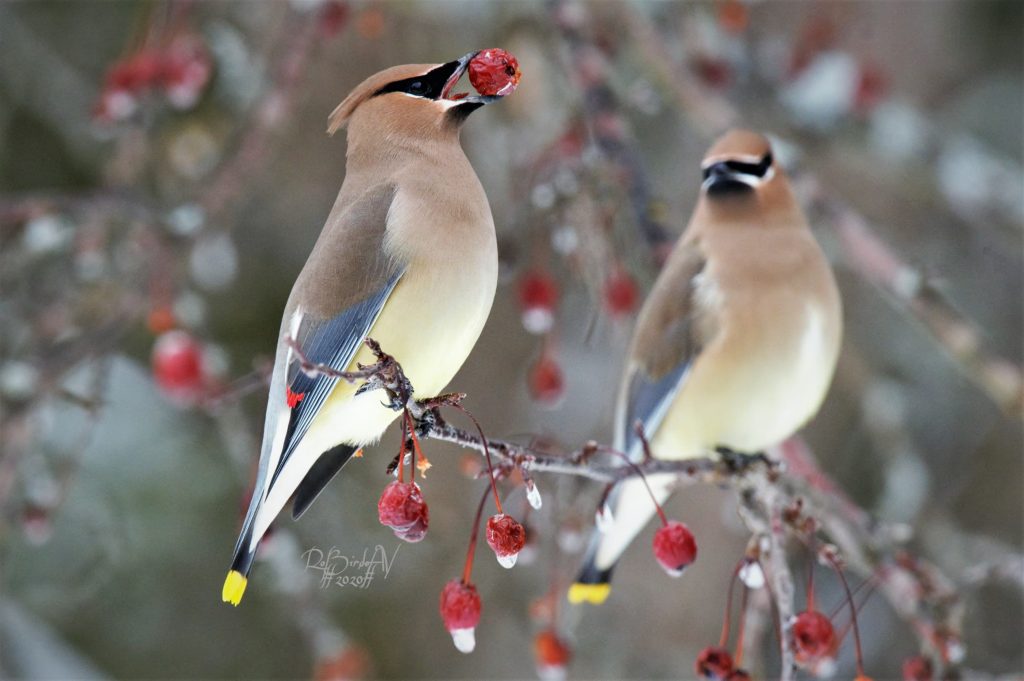
Cedar Waxwings are known to pass fruit back and forth. This can be a courtship ritual or bonding between a mated pair. Many times it is not just one bird that passes the fruit. Rather, two birds may pass back and forth until one bird finally eats the berry, typically the female.

On a Personal Note…

The Cedar Waxwing was a prominent bird in the book “Mystery on Mackinaw Island”. The librarian in this story had a stuffed Cedar Waxwing and used it as a signal to let the main character, a young boy, know she needed to see him. The dead bird had been found by him outside of the library when he was nine years old and he gave it to her. The book was a page turner for me – how couldn’t I love a book where the main character aspired to become “a real Bird Man”.

The book came to my attention when I spoke with Kathy Schmitz, a teacher at Kerby Elementary School in Grosse Pointe Farms. Her class was reading the book and she discovered the Cedar Waxwing was our bird of the month for our coloring contest! I look forward to seeing the masterpieces from these children. I hope they feel more deeply connected to the story and the main character as a result of this artistic enterprise.

Thinking Bigger

What can you do to become more engaged and attuned to Cedar Waxwings? Give serious consideration to planting fruiting trees for these beauties. They can subsist for months on a diet of fruit alone. Cornell Laboratory suggests juniper, mountain ash, crabapple and hawthorn as well as their namesake cedars for winter fruit. In summer, serviceberry, strawberry, mulberry, raspberries and dogwoods all provide a good food source. Envision your yard as a place to welcome these lovelies, as you make your planting plans. Get outside and search for berries, and you may be rewarded with some sights similar to these fabulous photographs, compliments of Roberto Viguilla and Marie Read.
Posted in Wild Bird Facts, Winter | Tags: bird watching, birds, cedar waxwing, mystery on mackinac island, native plants, nature, wild birds unlimited | Leave a comment |

Where are the Juncos?

Posted on January 9, 2020 by Rosann Kovalcik

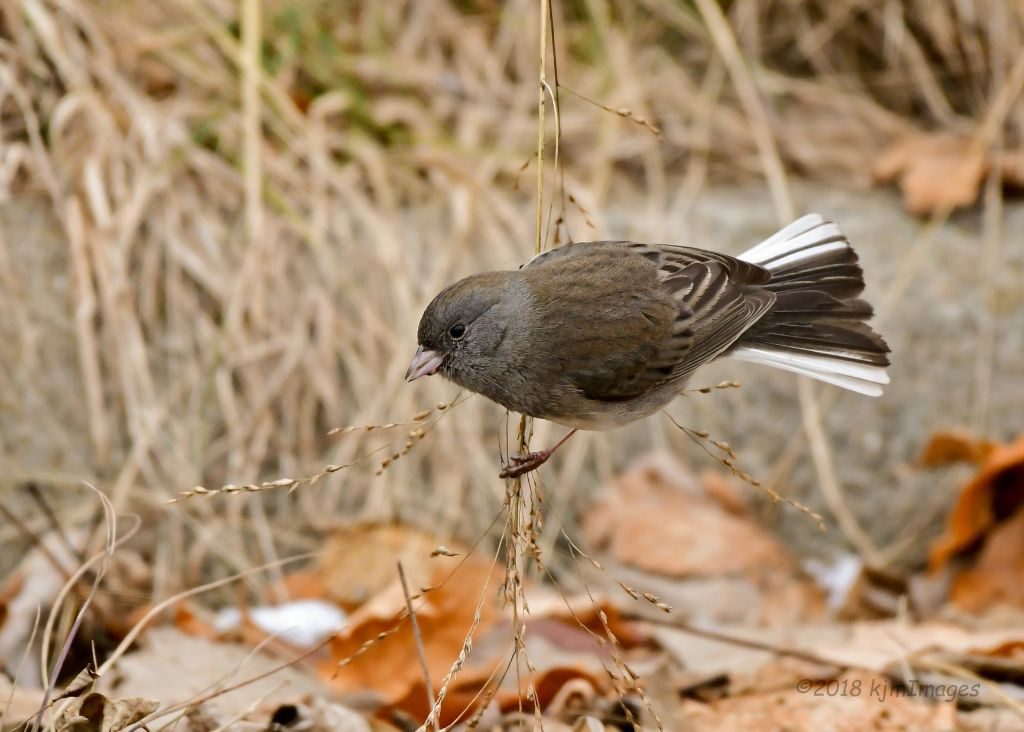
Dark-eyed Junco by Kevin Murphy, Eliza Howell Park, Detroit

Where are all the Juncos?

We have had a number of customers recently ask where the Dark-eyed Juncos have been. Many have not yet seen them at the feeders this winter. My best experience with Juncos this year has been when we had a recent small snowfall. They were perched on the stems of plants I leave up all winter to provide seeds for the birds.

Now that we are not experiencing snow cover, the seeds available to Juncos make their visits to our feeder less of a necessity. I have been missing their subtle gray coloration and their white “snowy” bellies. I also love that their two outer tail feathers are white on each side, looking like a cheerleader skirt as it flies or spreads its tail.

To attract them to your yard, offer White Proso Millet on a tray feeder. The feeder can be on legs and close to the ground, or on a pole system and higher off of the ground. Either way, this stable platform allows them to eat in a way that true sparrows prefer, simulating their groundfeeding preference.
Enjoy this winter visitor while you can!

Rosann Kovalcik, Owner

Wild Birds Unlimited, Grosse Pointe Woods

Have you joined our email list? Click here to sign up, it’s free and gives you access to sales, coupons, nature news, events, and more!


Posted in Bird Feeding Solutions, Winter | Tags: climate, dark-eyed junco, Grosse Pointe Woods, junco, millet, seasonal, snow, sparrow, weather, wild birds, wild birds unlimited, Winter | Leave a comment |

Christmas Tree – Artificial vs. Real

Posted on November 21, 2019 by Rosann Kovalcik

Tradition vs. Change

What a beautiful tradition it is to bring the outside within our homes at the holidays, featuring trees, wreaths and garlands. Who doesn’t have a photo with the family in front of the Christmas tree?

The choice we make as to whether we buy a real tree or an artificial one does have an impact on the world our birds call home. Manufacturing these trees requires fossil fuels. This means, when they are trashed within a landfill, they will not decay. Overseas manufacturing and shipping processes also leave a large carbon footprint.

Sounds like a real Christmas tree is the most environmentally friendly answer. Grown right here in our state of Michigan, the trees produce oxygen while they are growing as well as sequestering carbon. Tree farms will use the same spaces to plant again after harvest, a sustainable way to farm.

Things to Consider

If you are buying a real tree, there are some important factors to consider.

Photo by Lori Campbell

Ask your retailer these questions or research about their farm or shop – do they follow Integrated Pest Management practices and avoid the use of pesticides when possible, and do they practice water conservation?

Just as we have experienced with firewood, real trees used at the holiday can harbor non-native invasive pests. Trees that are grown in one area and then transported to be sold in another area may spread invasive pests such as gypsy moths, balsam woolly adelgid and Phytophthora ramorum, the fungus-like pathogen that causes sudden oak death.

The best way to minimize the chance of introducing a new pest to your neighborhood is by getting a locally sourced tree. Follow these tips:

  • Purchase locally grown trees or greens for wreaths and garland.
  • Cut down your own tree from a local cut-yourself farm or nursery.
  • Obtain a permit and cut your own tree from a local forest within 10 to 20 miles of your house.
  • Buy a pre-cut locally sourced tree from an established local business.
  • Don’t use invasive species such as Asian bittersweet in holiday decorations

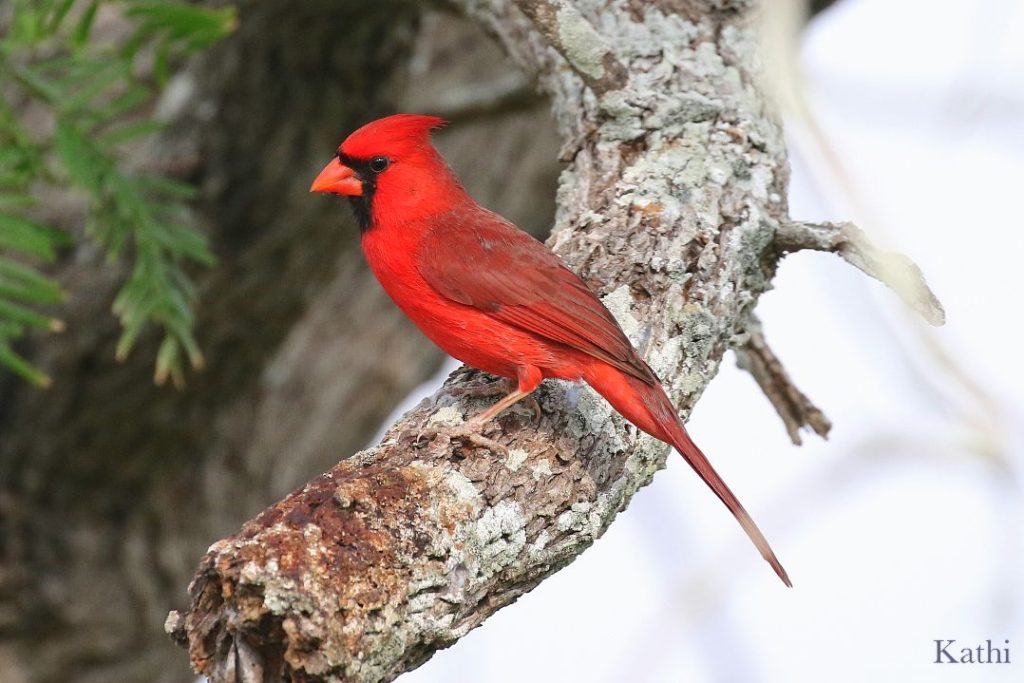
And once you are done with the tree, place it in the yard as shelter for your Cardinals. After all, nothing looks better on an evergreen than a Cardinal!

Northern Cardinal by Kathi Hince

Posted in Winter | Tags: Cardinal, christmas, christmas tree, december, Grosse Pointe Woods, holiday, locally sourced, november, wild birds unlimited | Leave a comment |

Fascinating Blue Jays

Posted on August 12, 2019 by Rosann Kovalcik

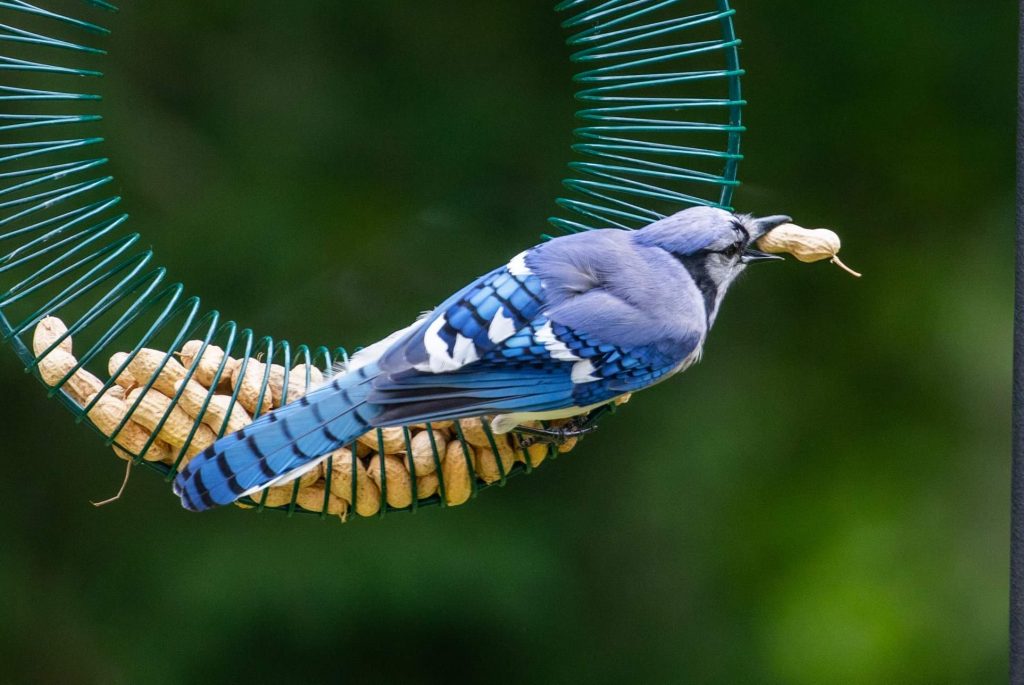
Blue Jay with Peanut by Emily Wolfe

Blue Jays – The Sights and Sounds

I find Blue Jays to be fascinating – I’m listening to them now as they sing out their “tootle-oot, tootle-oot” from the oak tree. They have such a rich complexity of vocal sounds. The same can be said about their plumage, a rich complexity of blues of every shade. Such a handsome bird with both males and females looking alike, their faces framed by a dark collar. Perhaps one of their finest features is their crest, raised and lowered at will depending upon their mental state – up when alert, feeling territorial, and down when there’s no reason, giving the back of the head a little “flair”.

The Brains

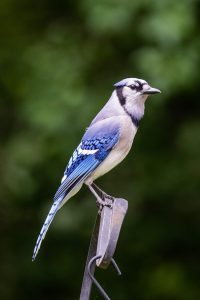
Blue Jay by Emily Wolfe

Jays play an important role among the birds in our yards. They will sound the “Jay! Jay!” alarm when a potential predator is nearby. This allows all of the birds to be on the lookout for the hawk, cat or human that caused the Jay to give the neighbors a warning. One of the most amazing vocalizations of the Blue Jay is their ability to vocally imitate hawks – they have turned my head with the calls of a Red-shouldered Hawk and a Broad-winged Hawk, only to spot them in my binoculars. And just a few short minutes after I wrote that, I heard a Cooper’s Hawk calling from the rooftop – except it was a Blue Jay. Perhaps he was using this as a scare tactic to keep the other birds away so he could swoop down and feed on the seed cylinder I had just put out. Smart move.

Blue Jays can be entertaining and unafraid in your yard. They will come quite close when any kind of a nut is involved as they naturally seek the mast of trees. Capable of storing a few acorns in their gular pouch, a holding area in the throat, they will transport the acorns to an area to stash away. Placing the acorns on the ground and covering them with leaves, or pushing them into the soil with their strong beaks, they hope to save them for future food. Many of those acorns will grow into trees and in this way, the Blue Jay plays forester for us.

Peanuts in the shell evoke the same mental response in Jays.  They simply cannot resist them when offered and will carry them away where they can hold them with their feet and use their beak to break away the shell and eat the protein-packed nut inside.

Blue Jay

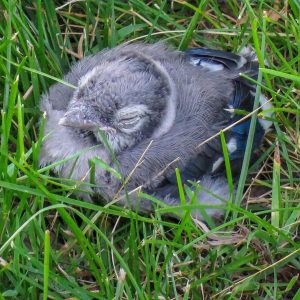
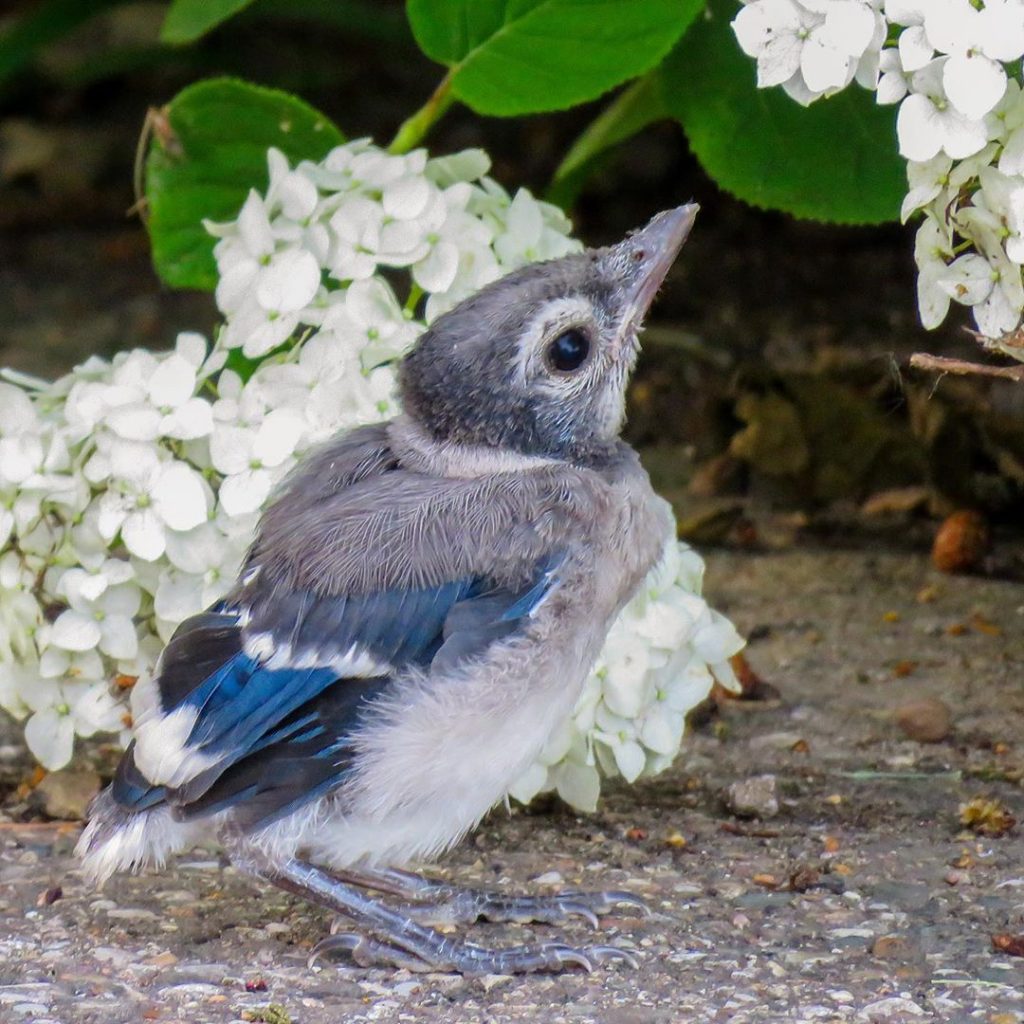
Baby Blue Jay by Samantha Mason

The Babes

Both male and female Blue Jays take an active part in raising their brood of two to seven. They are quite secretive during nesting season as they find food for their young and deliver it to the nestlings. Jays are omnivorous and will eat a wide variety of plants and animals. Once the young fledge the nest, they will travel in family groups for feeding purposes. You can hear their contact calls to each other as they move about the trees.

Movement

Blue Jays take part in their spring and fall migration in very large numbers. They migrate in daytime flocks, unlike many of the small passerines that use the cover of night for migration. We have seen these flocks of hundreds of Blue Jays flying over us at the Ford House during our bird walks. The wing beats blink light and dark flashes as they travel along – a magnificent sight.

Enjoy this adaptable, gorgeous bird and all of the vocalizations that make Jays so unique.

Baby Blue Jay by Samantha Mason

Enjoy your birds!!

Rosann Kovalcik, Owner

Wild Birds Unlimited, Grosse Pointe Woods

Have you joined our email list? Click here to sign up, it’s free and gives you access to sales, coupons, nature news, events, and more!

Posted in Wild Bird Facts | Tags: Bird Feeding, birds, blue jays, Grosse Pointe Woods, jay, Michigan, summer, wild birds, wild birds unlimited | Leave a comment |

Where Have My Goldfinches Gone?

Posted on July 25, 2019 by Rosann Kovalcik

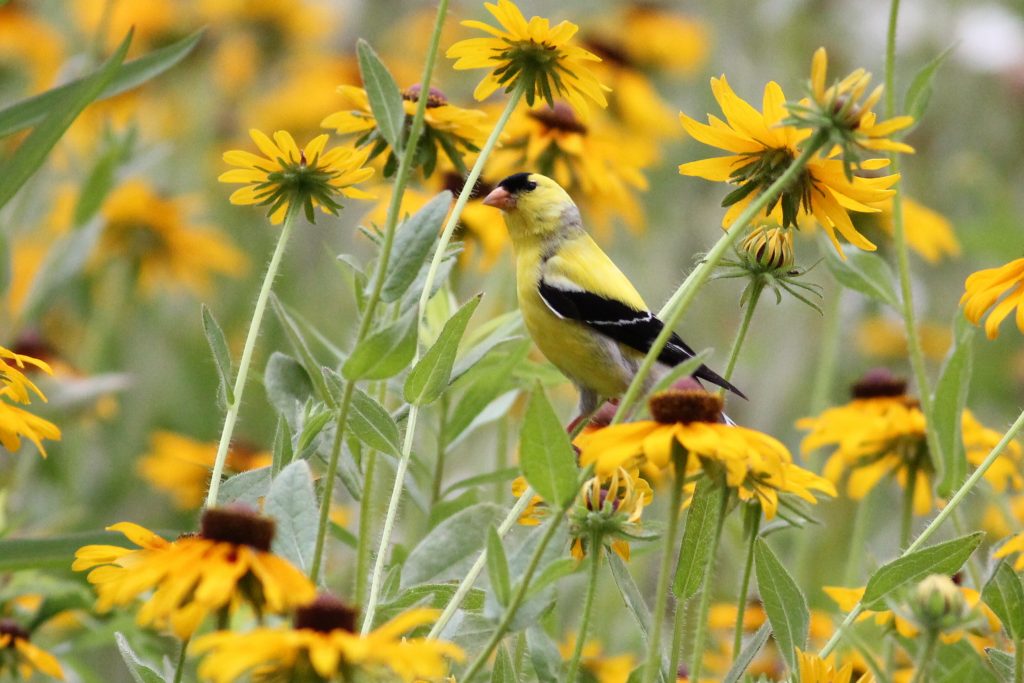
American Goldfinch male

Where have my Goldfinches gone? This is a question that we hear often at the store this time of year. Goldfinches nest later than many other birds in our area. When they establish their territories, they don’t allow other pairs in that area. So, unlike the spring when they were migrating through in large numbers, you will have one pair that calls your yard part of their territory (if you are lucky)!

Nesting Prep

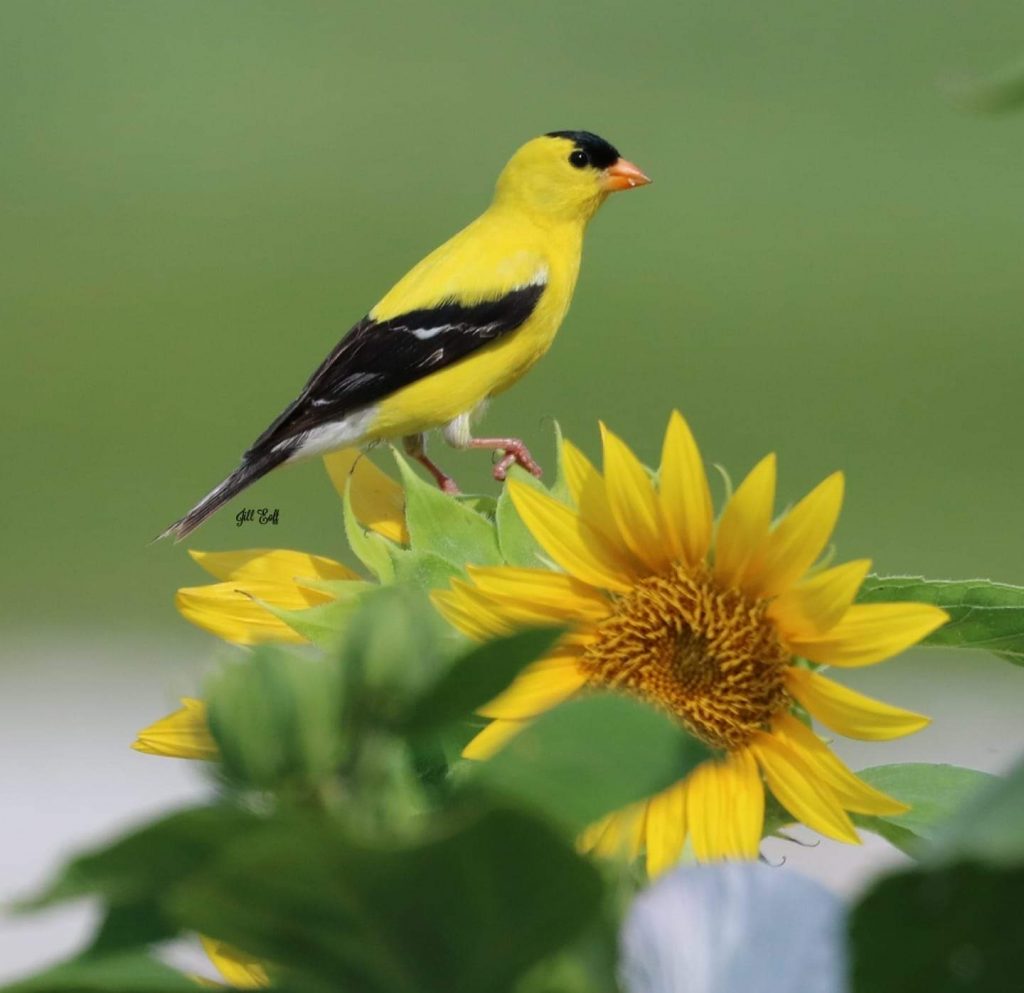
Goldfinch on Sunflower (Photo by Jill Eoff)

The male advertises his territory with a beautiful, long, sweet melodic song. Part of the territorial behavior consists of him flying in large circles around the area, singing as he flies, advertising that the area is his and available to one female to share with him. This behavior continues as she constructs the nest and she sits on their eggs.

Because she alone incubates those eggs, the male will bring her food as she continues to sit on the nest. How sweet is that? If you are seeing a single male at your feeders, this is the reason why. With natural food sources becoming abundant this time of year, these fresh resources are used by the finches in addition to quick stops at the feeder.

American Goldfinch male (Photo by Rosann Kovalcik)

Time to Hatch!

When the young hatch, the female will now come to the feeder for short periods, to feed herself and to carry seed back to the nestlings. When you see her at the feeder, you know the eggs have hatched. Both parents feed the young birds seeds, from feeders and natural sources.

Within a few weeks after they hatch, young goldfinches are following parents around, begging for food with a characteristic, high-pitched “chippee, chippee” call. Seeing them beg with open beaks and wings fluttering is a summer delight.

While there is less activity at your feeder, fill it only part way. The seed needs to be fresh if it is going to compete with the natural food sources that are available. Using a mix of nyjer and fine sunflower chips is a good strategy as the sunflower chips offer high protein and fat content, which the birds need this time of year. Using Feeder Fresh, a silicate additive, will help your seed stay fresh and moisture free. When filling the feeder, add the new seed and mix it about with the older seed to avoid clumping. Once finch activity picks up and those goldfinch families are coming to eat, you can start filling the feeder with a greater quantity of seed.

American Goldfinch male (Photo by Jill Eoff)

Enjoy your birds!!

Rosann Kovalcik, Owner

Wild Birds Unlimited, Grosse Pointe Woods

Have you joined our email list? Click here to sign up, it’s free and gives you access to sales, coupons, nature news, events, and more!

Posted in Summer, Wild Bird Facts | Tags: Bird Feeding, birds, finches, goldfinches, nyjer, summer, sunflower, wild birds unlimited | Leave a comment |

Decluttering Your Bird Feeders… Or Not

Posted on March 25, 2019 by Rosann Kovalcik

Much has been written about decluttering lately. And so, of course, my thoughts turn to bird feeders.

A common bit of wisdom regarding decluttering is to ask yourself if an item brings you Joy.

Cylinder Feeders

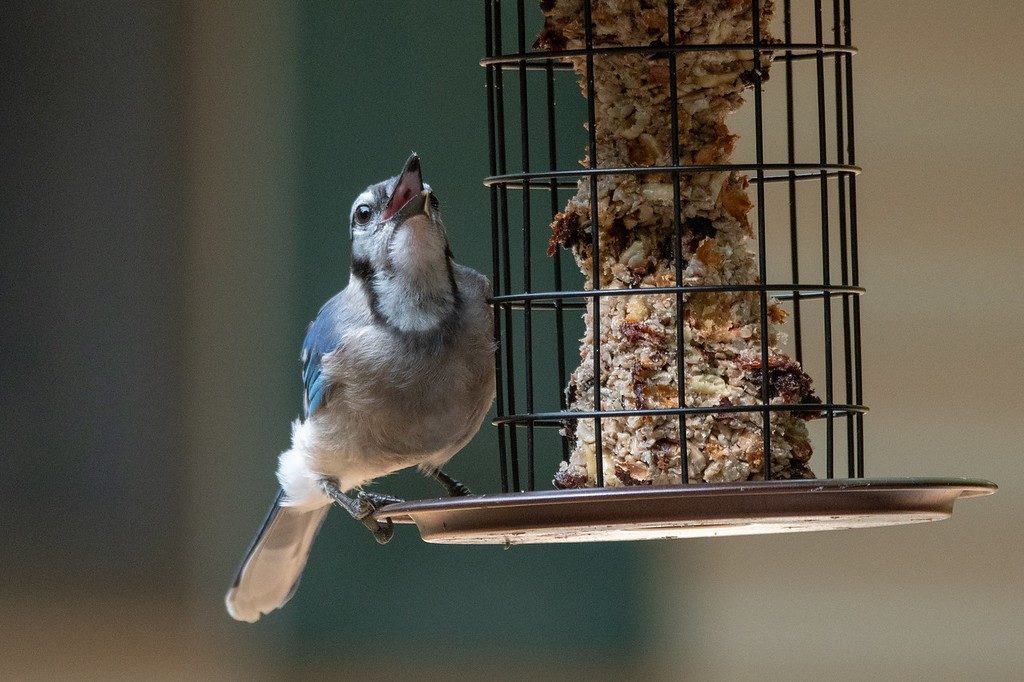
Blue Jay on Cylinder Feeder (Photo by Lisa Vreede)

When I fill my cylinder feeder with a new No-Mess seed cylinder, I notice Blue Jays coming in groups. Perhaps the first jay to discover the gleaming peanuts will stand atop the pole and give a little bounce up and down as he calls to the others in his tribe. Then the hammering begins; the birds’ feet holding on tightly, their heads moving back and forth, excavating each peanut with precision. Then off the Jay flies to a branch to eat its prize. Or maybe it plans to stash the peanuts. The flurry of blue from feeder to tree branches is so beautiful to watch.

Okay – Joy with the cylinder feeder… keep it!

Suet Feeders

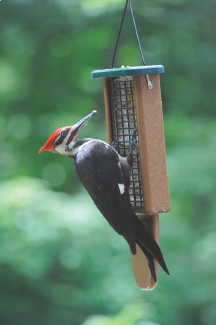
Pileated Woodpecker on Double Tail Prop Feeder

Then I consider my suet feeders. I have a lot of those. Tail prop feeders – I have two of the extra-large version. Last time I filled them with Nuts and Berries Suet I was in Boyne City, and when I was done, I called out to the woods ,“Hey Buddy (my male Pileated Woodpecker’s  given name), I just filled the feeders for you!” And I kid you not; within two minutes, he flew into the woods along the road and hammered away at one of his favorite trees, doing some serious excavation. Then, as I backed away from the feeders, he came in on his landing tree. By the time I was in the house, I had the Pileated Woodpecker on one of the double tail-prop suet feeders, and a Hairy Woodpecker on the other one.

Okay –  true Joy with the double tail-prop suet feeders – keep them. All of them.

Finch Feeders

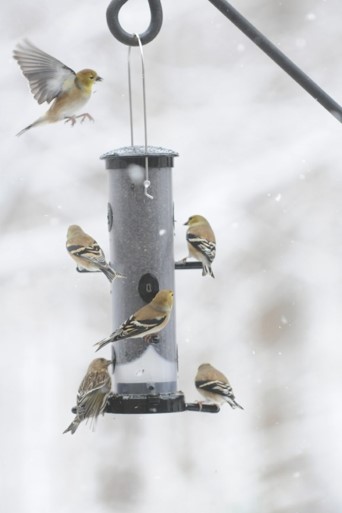
American Goldfinches

Next I reflect on my finch feeders. Yes, that’s plural as well. This past winter, it was so exciting to watch for finches of all varieties. The Winter Finch Forecast predicted we would have many irruptions into our area. This happens when seed crops are not optimal in Ontario, so irregularly occurring species move south in search of plentiful food sources. Pine Siskins can be identified at a distance by their very pointy beaks, looking like just-sharpened pencils. Careful observations need to be made to notice the potential Common Redpoll – such a dainty bird with the sweetest red cap. Of course, these winter visitors mix in well with American Goldfinches who visit the feeders all year long. As we move into spring, I watch my goldfinches carefully with binoculars to note when I see the first hint of yellow feathers as they molt into spring plumage.

Joy with the finch feeders – keep those too!

Hopper Feeders

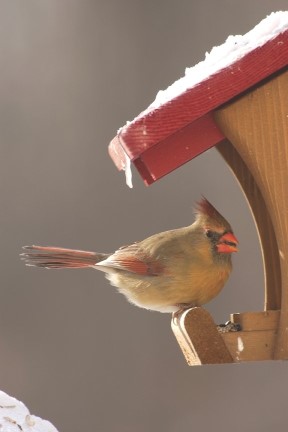
Female Northern Cardinal at Hopper Feeder

Time to evaluate the large hopper feeder, which holds an abundance of seed. I am relieved when the birds visit first thing in the morning, proof they made it through another challenging night. I feel so fortunate to be able to provide them with readily available food that has no shells, allowing for quick energy. If it’s cold enough, birds can go through all of their fat reserves in one night just to keep alive.

More Joy with the foundational hopper feeder – keep it.

Specialty Feeders

Red-breasted Nuthatch (Photo by Bill Rapai)

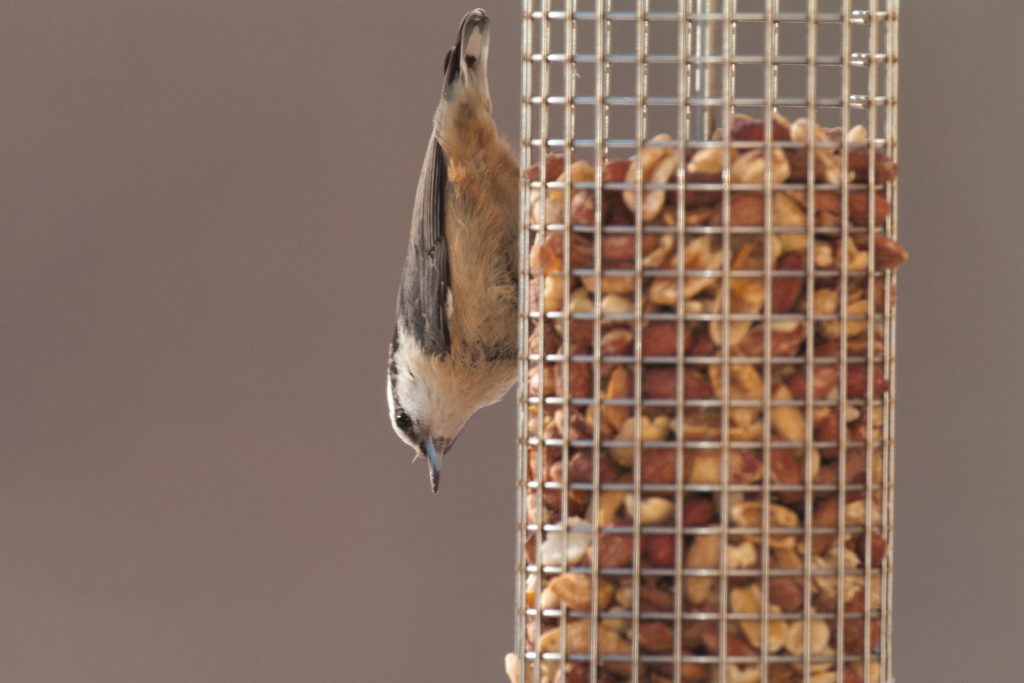
Then there is the peanut feeder, a draw for specific birds. It is certainly a favorite of Red-breasted Nuthatches that cling on upside-down.  I love to watch their bodies teeter back and forth like little sledge hammers as they pound away to extract a peanut. They make the dearest sounds, similar to small squeak toys. It has been an irruptive season for Red-breasted Nuthatches and I wouldn’t want to miss a moment of them.

Joy with my peanut feeder – keep it!

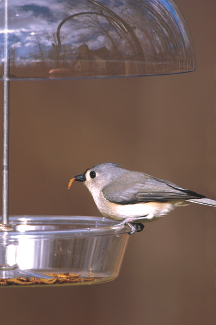
Tufted Titmouse on Dinner Bell Feeder

Finally, my thoughts turn to the variety of foods I offer the birds when I’m in a time crunch. For example, I can simply open a bag of Bark Butter Bits and pour them into my Dinner Bell feeder. This feeder is the most versatile and I dare say one of my absolute favorites. I can lower the weather dome so just the smaller birds fit between the tray and the dome, even excluding House Sparrows if low enough. It gives the Black-capped Chickadees a place they can dart to, picking up the beak-sized Bark Butter Bit and flying off to a branch. It is so fun to watch as they hold it in their feet and eat it with dainty bites. The Dinner Bell is also great for mealworm feeding. Mealworms give birds the protein they need for feather production when molting and for calcium when they are ready for egg-laying season.

Okay – Joy with my Dinner Bell Feeder – keep them.  Both of them.

So much for ridding myself of the “clutter” of bird feeders. Anything that bring me this much Joy is a keeper!

Posted in Bird Feeding Solutions, Spring, Wild Bird Facts | Tags: bird feeder, birds, blue jay, chickadee, declutter, finch, Spring, tidy, wild birds, wild birds unlimited, Winter, woodpecker | Leave a comment |

Winter Tree Birds

Posted on February 4, 2019 by Rosann Kovalcik

After spring and summer, the majority of birds in Michigan leave for the south. Their instincts pull them to return to wherever they have a full diet of insects and fruits. Those winter birds that stay for the colder months are marvels at finding food. What can they possibly eat? How do they find food?

Black-capped Chickadee

Chickadees: The Flock Masters

Whenever I hear the calls of Chickadees in winter, their “dee dees” catching my attention, I know to look for them if I want to locate other winter birds. The Chickadees are what I call the “Flock Masters”. Very hardy and inquisitive, they are usually the first to locate a food source, whether natural foods or those found at feeders. Other birds are keen to the Chickadees’ ability to find food.

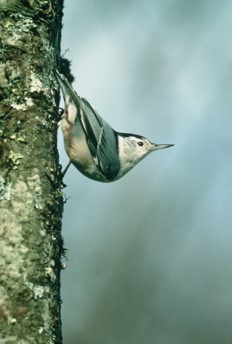
Downy Woodpeckers, Tufted Titmice, White-breasted Nuthatches and Brown Creepers make up the companion group that follow Black-capped Chickadees as they forage for food. Even those birds that come to our feeders for sunflower, suet and peanuts will continue to forage for natural foods. They eat what protein they can find, including insect eggs and cocoons, in addition to the insects hidden within the trees. They perform a great service as they keep our trees healthy and strong.

White-breasted Nuthatch

Working on the tiny twigs of the trees is the smallest of the team, the Black-capped Chickadee. The ability to hang upside down and investigate with their sharp eyesight and small, probing beaks enables them to find the eggs and hiding insects on the smallest of twigs.


Tufted Titmice: The Cousins

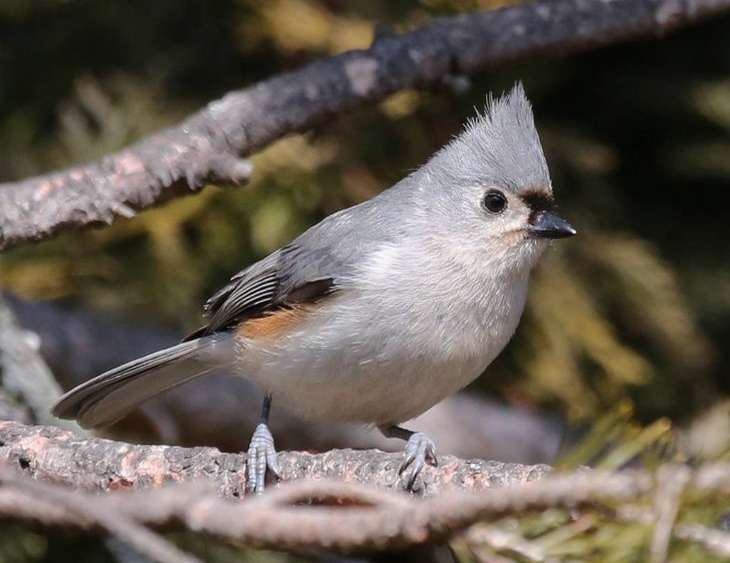
The Tufted Titmouse, a cousin to the Black-capped Chickadee, is a little larger and can focus its energy on the larger twigs. They work more slowly and usually move around in mated pairs. Their comparatively louder calls ring out clearly in the winter time, as “Peter, Peter” or “Cheer, Cheer, Cheer.” Titmice are also adept at hanging on to branches in an acrobatic manner. Sometimes when they are very intent on their food gathering, their head crest will remain down. At other times, the feathers of their crest become erect as a warning. Perhaps they feel a hawk is in the area or a squirrel is getting too close to their food source and they do not want to share.

Tufted Titmouse (Photo by John Graffius)

Downy Woodpeckers: The Listeners

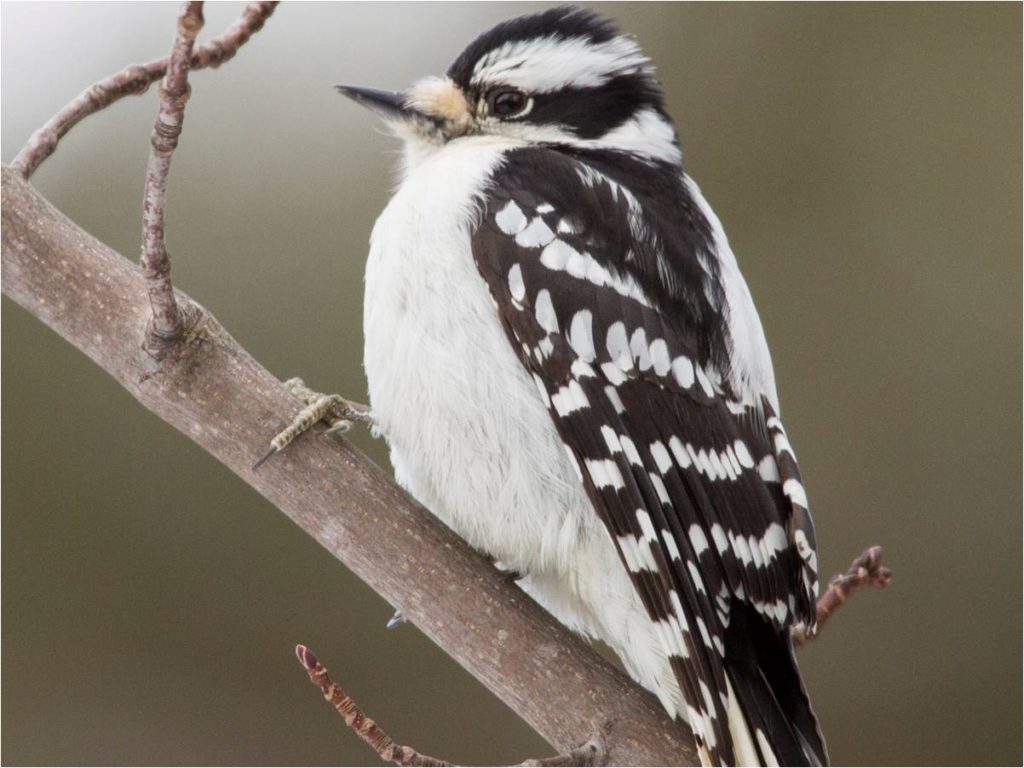
The Downy Woodpecker is an even larger bird in the team of Winter Tree Birds. They work on the limbs and larger branches of the tree. Not only do they look for insects, eggs and cocoons on the branches of the trees, they listen for the sound of insects moving inside the trees. This is why you may watch a Downy Woodpecker clinging to the side of the tree, moving its head from side to side – it is listening for the insects. Once it locates them, it uses its small beak to chisel a hole and extract the insects inside. A woodpecker has special tools for this function, a barbed tongue with sticky saliva that is excellent for extracting the insects it finds.

Downy Woodpecker

Nuthatches & Creepers: The Bark Bandits

The deep cracks in the bark of some trees are a perfect place to find cocoons, insects, and eggs, sheltered from rain and snow. This is where the White-breasted Nuthatch and Brown Creeper are very adept – their beaks well-suited to the job. White-breasted Nuthatches have a thin dagger-like bill that is slightly upturned on the bottom edge to create an angle, perfect for the type of feeding it does. When seeking food, the Nuthatch travels upside down and from top to bottom on the tree trunks. This allows them to find the food the right-side-up birds do not see.

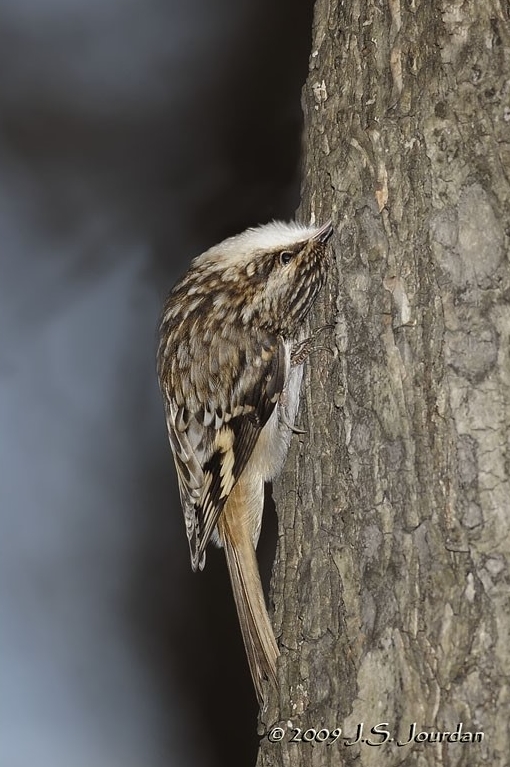
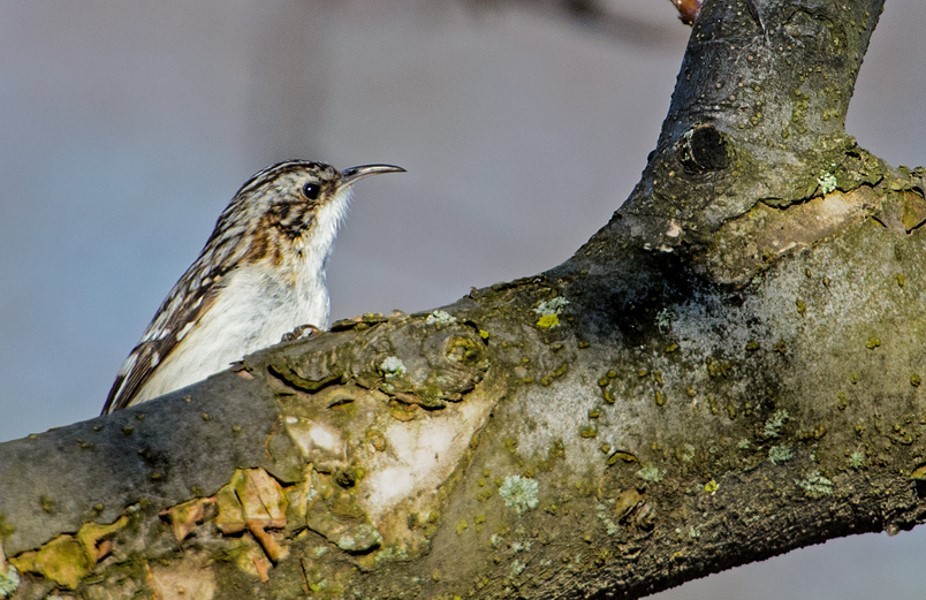
On the other end of the spectrum is the Brown Creeper, who can be identified by its behaviors. Flying from one tree to another, the Brown Creeper lands at the base of the tree and work its way up, searching along the bark for food, and circling the tree as it climbs. Its long, needle-like bill allows for deep probing within the nooks and crannies of trees. This bird eats only insects in the winter – an admirable accomplishment.

Brown Creeper (Photo by Jerry Jourdan)

Brown Creeper

The Black-capped Chickadee takes care of the tiny twigs, the Tufted Titmouse gleans from the larger twigs, the Downy Woodpecker from limbs and branches and the White-breasted Nuthatch and Brown Creeper take from the trunks and larger branches of the trees, travelling in opposite directions. By working as a team, these five species of birds help to keep our trees healthy and strong.

Enjoy your birds!!

Rosann Kovalcik, Owner

Wild Birds Unlimited, Grosse Pointe Woods


Have you joined our email list? Click here to sign up, it’s free and gives you access to sales, coupons, nature news, events, and more!

Posted in Wild Bird Facts, Winter | Tags: birds, brown creeper, chickadee, Grosse Pointe Woods, nature, nuthatch, trees, wild birds unlimited, Winter, woodpecker | Leave a comment |

Bird Spotlight: Long-eared Owl

Posted on December 2, 2018 by Rosann Kovalcik

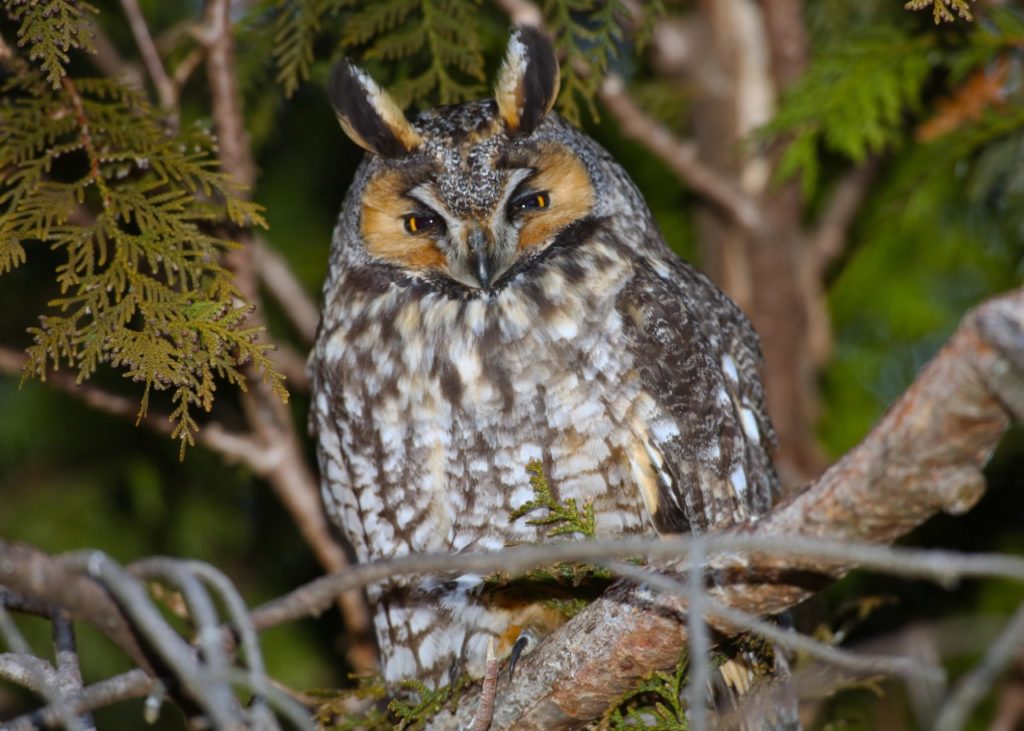
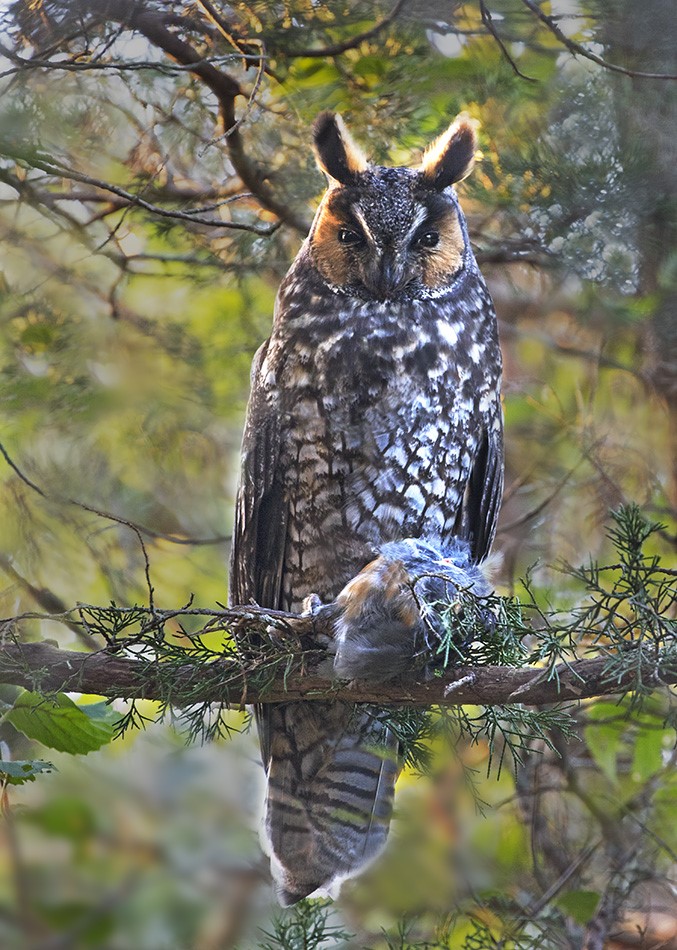
Long-eared Owl (Photo by John Graffius)

An Owl Appears

I can still hear the excitement in my friend Debbie Graffius’ voice as she explained what she was seeing. She was looking in her yard at a large owl with ear tufts. She knew enough to know it was not a Great-horned Owl.

At this point, I grabbed my binoculars, as there was only one answer. I quickly headed to her house in the north part of Grosse Pointe Woods (not far from Lake Shore). Sure enough, perched on a limb open to the sun, yet protected by surrounding evergreens, was a Long-eared Owl. When Debbie’s husband John returned home, his photography skills came into play. Some excellent shots of this comfortably roosting owl resulted.

A Little Bit of Background…

We spotted this bird on March 29th of 2013. We don’t often see Long-eared Owls in our area. The only other time I am aware of was in April 2004, when Tufted Titmice in my yard began to scold. This led to an investigation on my part. Sure enough, a Long-eared Owl was in the evergreens in my 75 x 150 Grosse Pointe Woods yard. This is a great testimony to the need for evergreens as shelter. The bird did not budge during the daylight. Mike Florian, my good buddy and President of the Grosse Pointe Camera Club, was able to get some great photo opportunities that day.

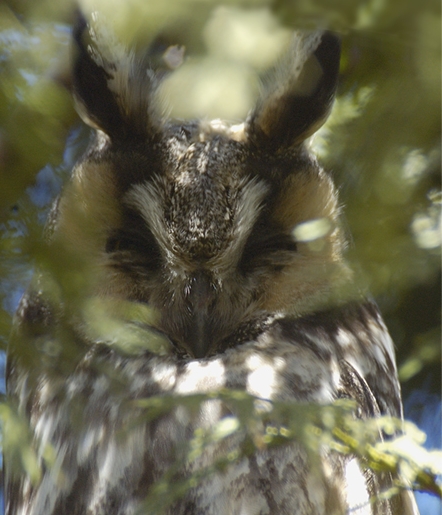
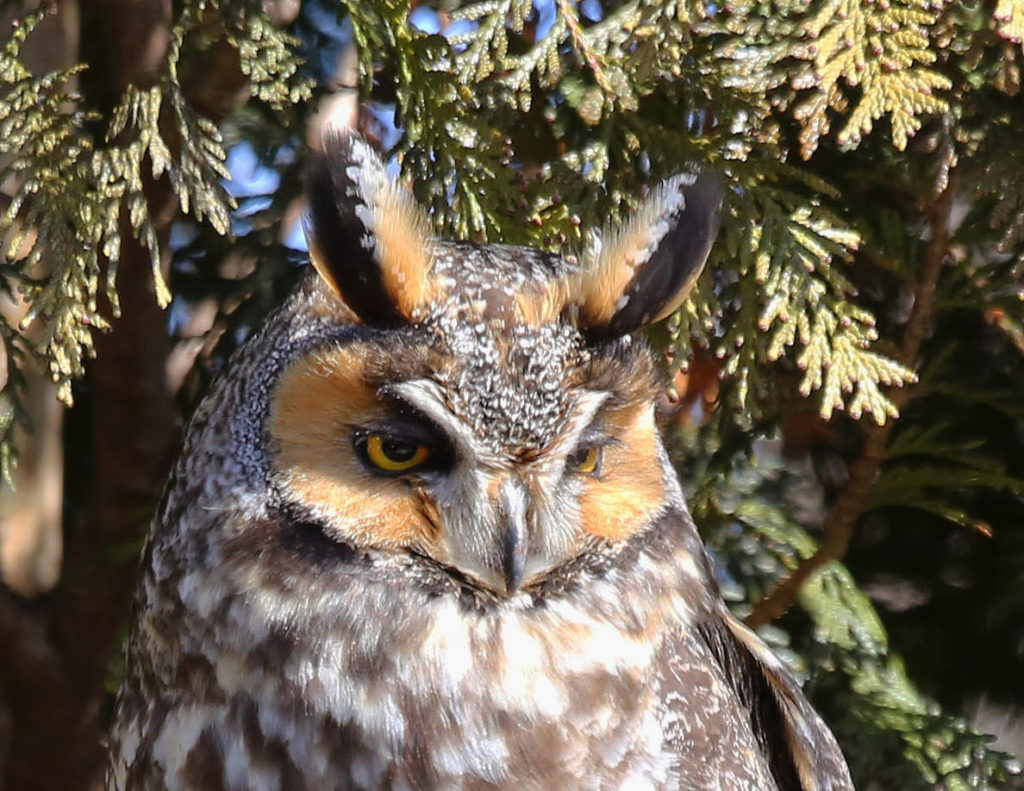
This behavior is typical of Long-eared Owls do. They roost during the day in dense evergreens, typically near field edges. When trying to conceal themselves, Long-eared Owls sit erect, tightening their body feathers,“ear” tufts sticking straight up. One of the most interesting facts I have read about these owls is how they use the same distraction technique as that of Killdeer. When luring predators away from the nest, both the owl and the killdeer often feign a broken wing as they drag themselves along the ground.

Long-eared Owl (Photo by Mike Florian)

Bird Stats

The wingspan-to-body-length ratio of this bird is quite amazing; head to toe it is only 13 – 16 inches tall, with a wingspan tripling that at 39 inches! For a bird this size, it is amazing they weigh only 8 ounces to 1 pound.

To raise their young, Long-eared Owls use the abandoned nests of hawks and crows. These are usually 20 feet or more above ground. They lay between 2 – 10 eggs, with an incubation period of 35 – 40 days. The young are fed the same diet as the adults, torn into bite-sized pieces. This diet consists of mammals including: mice, shrews, voles, rats, rabbits and less commonly, birds. The adults kill the prey with a bite to the back of the neck of the mammal, and eat their prey whole.

Long-eared Owl (Photo by John Graffius)

Owl sounds are always magical to me, and the sounds of a Long-eared Owl are no exception. The male gives a low hoot call, similar to the sound of blowing across the top of an empty bottle. The owls repeat this call sometimes up to 200 times, between 2 -4 seconds apart. The sound carries more than a half mile away. When disturbed during nesting season, the owls clack their mandibles together and also give a call that sounds like the bark of a small dog.

As set forth on the Cornell web-site, Long-eared Owls are rated as a 13 out of 20 on the Continental Concern Score and they are listed on the 2016 State of North America’s Birds Watch List. This list was compiled to bring attention to those species that are at risk of extinction unless conservation measures are taken to reverse the challenges that they face. For Long-eared Owls, this includes loss of habitat including wooded areas and grasslands. Continued protection of our small wetlands is a step in the right direction for this species’ survival, since many of these wetland areas are adjacent to wooded areas.

Final Reflections

Long-eared Owl (Photo by Kevin Karlson)

Some of my best memories of this bird is watching their moth-like flight as they lift from the trees at dusk at Whitefish Point, on their way to migrate further north. This is when their wingspan can truly be appreciated. Knowing this is their behavior, I advised Deb and John if we sat and patiently watched the Long-eared Owl in their yard, it would become active at dusk. And as if on cue, when the sun began to set, the bird sat more erect and stretched its wings. Looking about, it then flew to the top of the nearest phone pole and after another stretch, lifted itself and headed north.

Do you want to see this owl? Mark your calendar for the Michigan Audubon Spring Fling on April 28th and 29th at Whitefish Point in Paradise, Michigan. Stand on the hawk watch platform at dusk and wait for the magic to begin.

Enjoy your birds!

Rosann Kovalcik, Owner

Wild Birds Unlimited, Grosse Pointe Woods


Have you joined our email list? Click here to sign up, it’s free and gives you access to sales, coupons, nature news, events, and more!


Posted in Wild Bird Facts | Tags: audubon, birding, birds, cornell, Grosse Pointe Woods, long-eared owl, Michigan, nature, owl, whitefish point, wild birds, wild birds unlimited | Leave a comment |

Red-breasted Nuthatch, A Predicted Winter Visitor

Posted on October 4, 2018 by Rosann Kovalcik


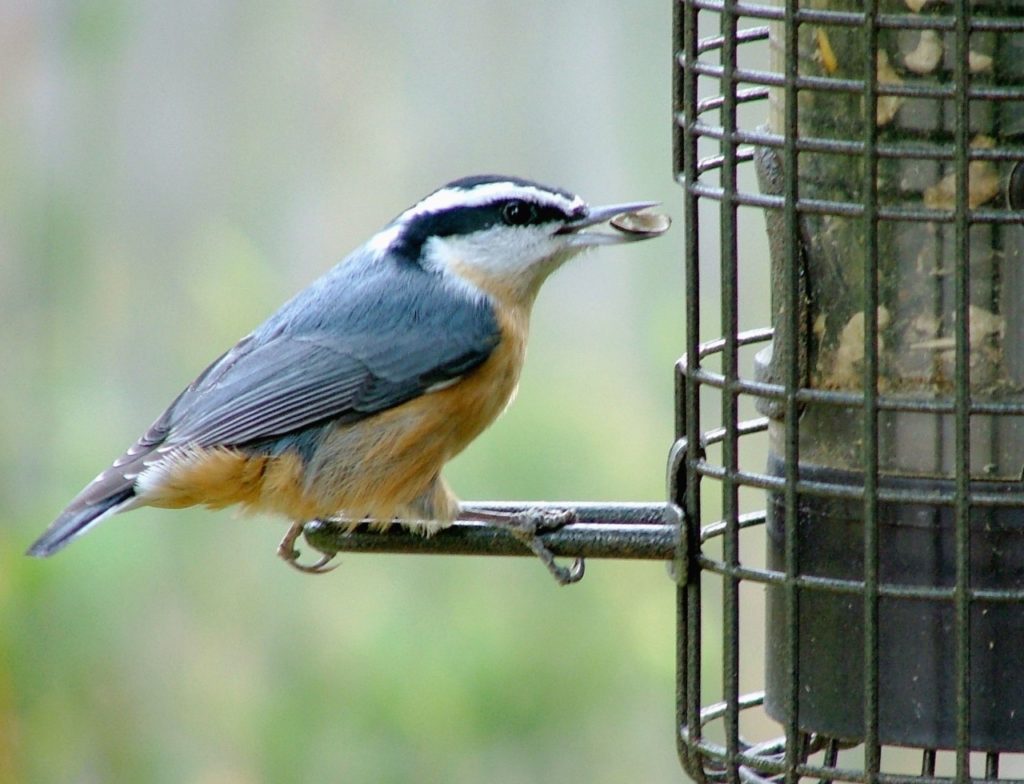
Red-breasted Nuthatch on Squirrel-proof Feeder (photo by  Glen Noyer)

Have you noticed Red-breasted Nuthatches in your yard or at your feeders this year?  I have a pair that have been visiting since the fall and they are such a Joy to watch and to listen to, sounding like little squeak toys.

Irruption

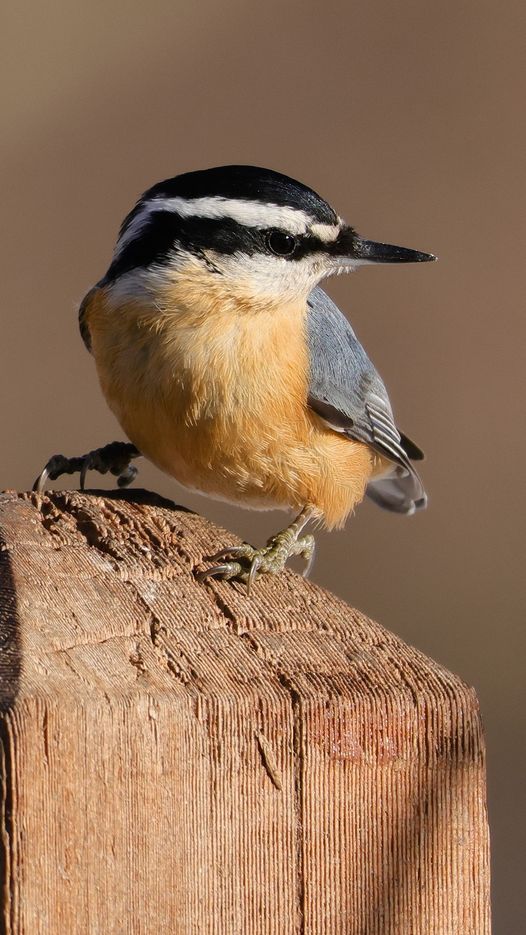
This movement of Red-breasted Nuthatches to our area is called an irruption, a movement of a bird species from their usual wintering grounds, predicted based upon lack of food supply in Ontario forests.  Listen for their nasal “toot, toot, toot” and check out the cones of evergreens.   You may be rewarded with a look at these 4.5” birds, their striking eye line running from their beak to their nape, with a distinct white supercilium (“eye brow”) above that.  Red-breasted Nuthatches have slaty blue-gray backs and wings and, true to their name, a wash of brick red color on their breast. Check out the tail length – it is only slightly longer than their wings.

Red-breasted Nuthatches have a distinctive flight pattern, with an undulating movement as a result of quick bursts of the wings, followed by a glide. Watch them in flight and notice the shortness of the tail.

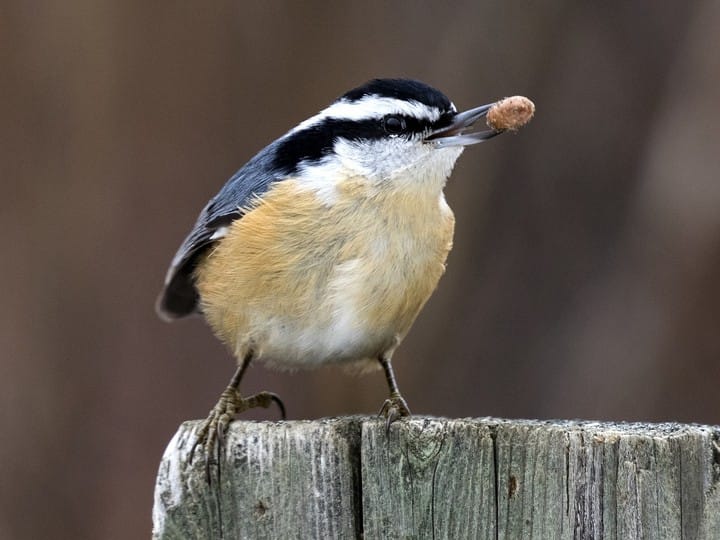
                 Red-breasted Nuthatch with a Bark Butter Bit (photo by Bob Martinka)

Feeding

These birds are fairly tame and can be watched very closely as they forage for food. In fact, I have had them land on my feeder pole, waiting patiently for me to fill the feeder. Offer them sunflower in or out of the shell, suet loaded with peanuts, and peanuts out of the shell to keep them coming back for the fats and protein they will need this winter. Now is the perfect time to try Bark Butter Bits, a small suet nugget that works well in the squirrel-proof feeder shown in the photo below. Spreadable Bark Butter also works well, either spread onto a tree trunk or a bark butter feeder.

Red-breasted Nuthatch on Squirrel-proof Feeder (photo by Bill Rapai)

Behavior

When feeding in trees, Red-breasted Nuthatches stay preoccupied with cones, extracting the seeds with their long, chisel-shaped beaks. They tend to place seeds in the cracks of tree trunks, using their beaks to chisel the shells away. This motion is responsible for the British-derived name, “Nuthatch” as “hatch” was a term used instead of “hack” back when the bird was named. Perhaps the most unique aspect of Red-breasted Nuthatches is their habit of walking down the trunks of trees as well as under the limbs of the tree, in search of insects to consume.  The toes of Nuthatches are perfect to accomplish this bark climbing – very long with sharp, long claws for gripping.


Shelter

During winter, it is not uncommon for groups of these birds to shelter together in a tree cavity or nest box to maintain warmth. Remember to keep your nest boxes up after cleaning them, for you may be visited by this little sprite (and a friend or two).

Enjoy your birds!

Rosann Kovalcik, Owner

Wild Birds Unlimited, Grosse Pointe Woods


Have you joined our email list? Click here to sign up, it’s free and gives you access to sales, coupons, nature news, events, and more!

Posted in Fall, Wild Bird Facts | Tags: Backyard birds, Bird Feeding, birds, Grosse Pointe Woods, irruption, nuthatch, red-breasted nuthatch, wild birds unlimited | Leave a comment |

The Joy of Feeding Birds with Seed Cylinders

Posted on August 27, 2018 by Rosann Kovalcik

What type of bird food satisfies birds, is easy to use, keeps birds in place for longer views and leaves no mess to clean? The answer to all of the above? Seed cylinders!

One of the true benefits of owning the local Wild Birds Unlimited is that I get to try out all of the products! Seed cylinders are convenient as they are held together with a natural gelatin, easy to unwrap as well as easy to place into a feeder.

With a tray on the feeder there is no seed on the ground which is certainly a benefit when trying to avoid mammals under the feeders. Seed cylinders are available with a hot pepper coating so that they won’t be attractive to mammals with sensitive taste buds, while birds do not react adversely.

Watching The Birds – Nuthatch Style

Birds need to peck the seeds apart from the cylinder, which means they spend more time at the feeder. And that’s one of the true benefits – the long looks at the various behaviors. I love the way the Red-breasted Nuthatch lands upside down and with the thinnest of beaks, chips away at the seed until it can fly away with a piece in its’ beak. I watch the bird then fly to the safety of the foliage in the tree above, further pecking the seed down into smaller pieces.

Red-breasted Nuthatch Chooses The Perfect Seed (Photo by Lisa Vreede)

There’s No Missing those Jays!

Blue Jays are always excited to see the feeder newly filled. It is as if they are prompted by the sight of the pieces of nuts to scream out for Joy! They really hammer at the pieces with their larger beaks, tossing them down their throat and going for more. Jays have a gular pouch in their throat which allows them to store food and then bring it back up for eating or caching.

Blue Jay Proclaiming His Joy! (Photo by Lisa Vreede)

All of the woodpecker species love to eat at cylinders.  It seems as if the pecking at the seed satisfies their urge to feed in a way that is already natural for them.

Chickadees – Crowd Pleasers

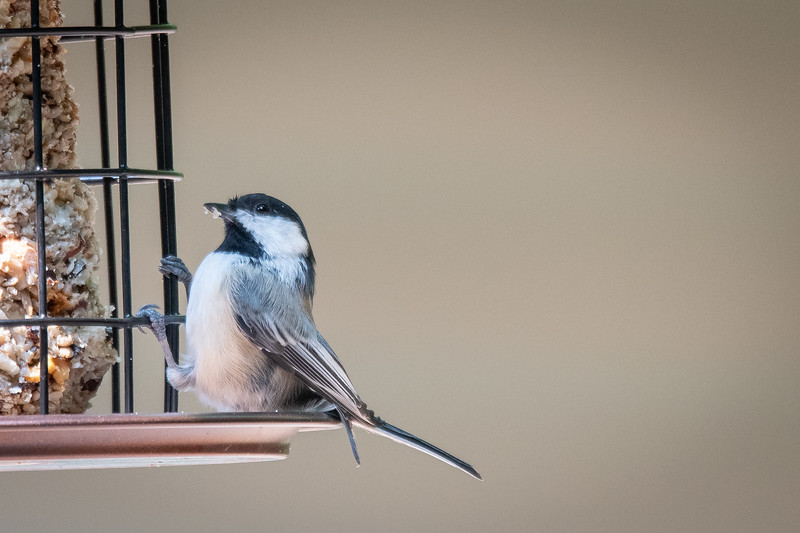
Black-capped Chickadees usually grab a loose seed and quickly scuttle back to the safety of tree branches. With a seed cylinder, they have to work a little longer which is a great way for you to be able to observe them for longer periods of time. The one in this photo looks as if it is having a seat while working on its’ meal.

Black-capped Chickadee Hanging On Tight! (Photo by Lisa Vreede)


Enjoy your Birds!

Rosann Kovalcik, Owner

Wild Birds Unlimited,

Grosse Pointe Woods


Have you joined our email list? Click here to sign up, it’s free and gives you access to sales, coupons, nature news, events, and more!

Posted in Bird Feeding Solutions, Wild Bird Facts | Leave a comment |

Recent Posts

  • Welcome the Wood Duck as our State Duck
  • Killdeer – our most common Plover returns
  • Red-tailed Hawks, the Common Buteo
  • Bald Eagles –
  • What other owls can you find ?

Archives

  • March 2026
  • March 2023
  • February 2023
  • January 2023
  • April 2022
  • March 2022
  • December 2021
  • September 2021
  • April 2021
  • March 2021
  • May 2020
  • April 2020
  • February 2020
  • January 2020
  • November 2019
  • August 2019
  • July 2019
  • March 2019
  • February 2019
  • December 2018
  • October 2018
  • August 2018
  • July 2018
  • May 2018
  • April 2018
  • March 2018
  • January 2018
  • December 2017
  • November 2017
  • October 2017
  • September 2017
  • August 2017
  • July 2017
  • May 2017
  • April 2017
  • February 2017
  • January 2017
  • December 2016
  • October 2016
  • September 2016
  • August 2016
  • July 2016
  • May 2016
  • February 2016
  • October 2015
  • August 2015
  • July 2015
  • June 2015
  • March 2015
  • October 2014

Categories

  • Bird Feeding Solutions
  • Bird Songs
  • Events & Outings
  • Fall
  • Native Plants
  • Nesting
  • Spring
  • Squirrels
  • Summer
  • Uncategorized
  • Wild Bird Facts
  • Winter

Enter your email address:

Delivered by FeedBurner

  • Prev
  • 1
  • 2
  • 3
  • 4
  • 5
  • …
  • 7
  • Next
© Wild Birds Unlimited of GPW - Website by TBD Web Services