• Home
  • About Us
  • Blog

Author Archives: Rosann Kovalcik

Goldfinches – Plant It, and They Will Come

Posted on September 5, 2021 by Rosann Kovalcik

For as many summers as I can recall, I have had one pair of American Goldfinches nesting in my yard.
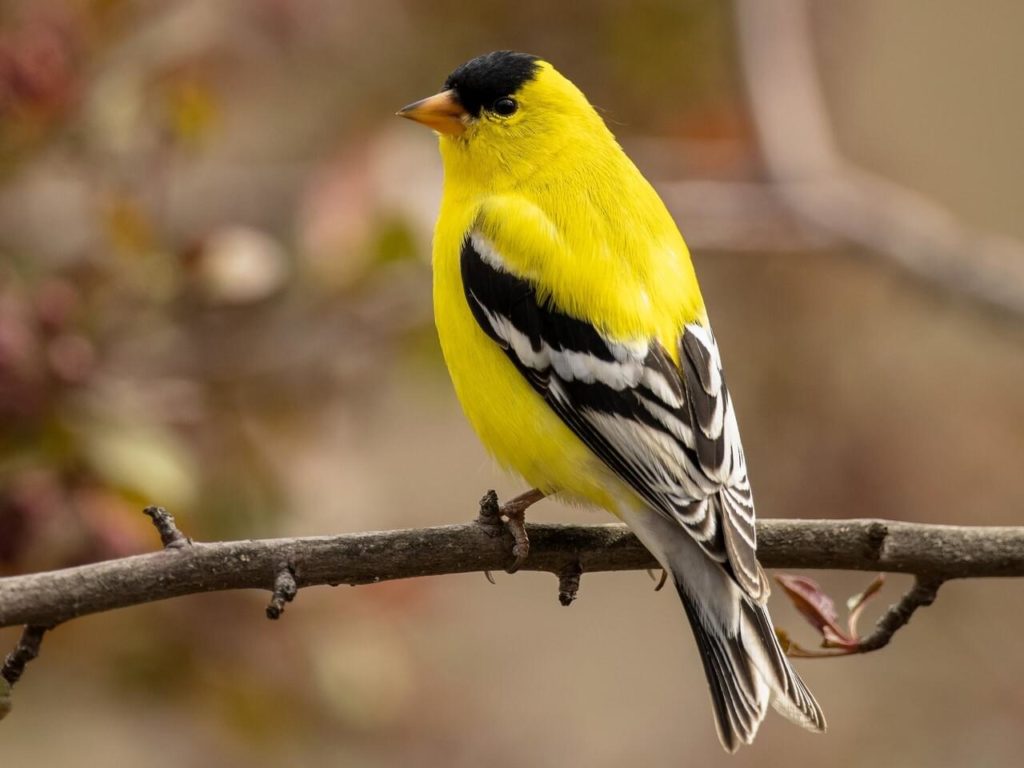
The male displays over the open space above my back yard, singing as he flies and then alighting in the birch trees at my neighbors. All of the activity to and from the grove of birches by both the male and female goldfinches would be a strong indication that they choose it for their nest site.


When the female goldfinch is on the nest it is obvious, as only her male will be coming to my feeder.  In fact, he comes more frequently as he brings food to her as she sits on the nest, incubating the eggs.  Once the eggs hatch, she comes to the feeder in a few weeks, while the male watches the young.  Both parents take seed to their young, one of the few birds that do not feed insects to their offspring.  Natural seeds from plants are a staple in the goldfinches’ diet.

Within a few more weeks, I am able to enjoy the fledged goldfinches as they follow Dad around, landing near him and fluttering their wings accompanied by incessant, sweet chirps.
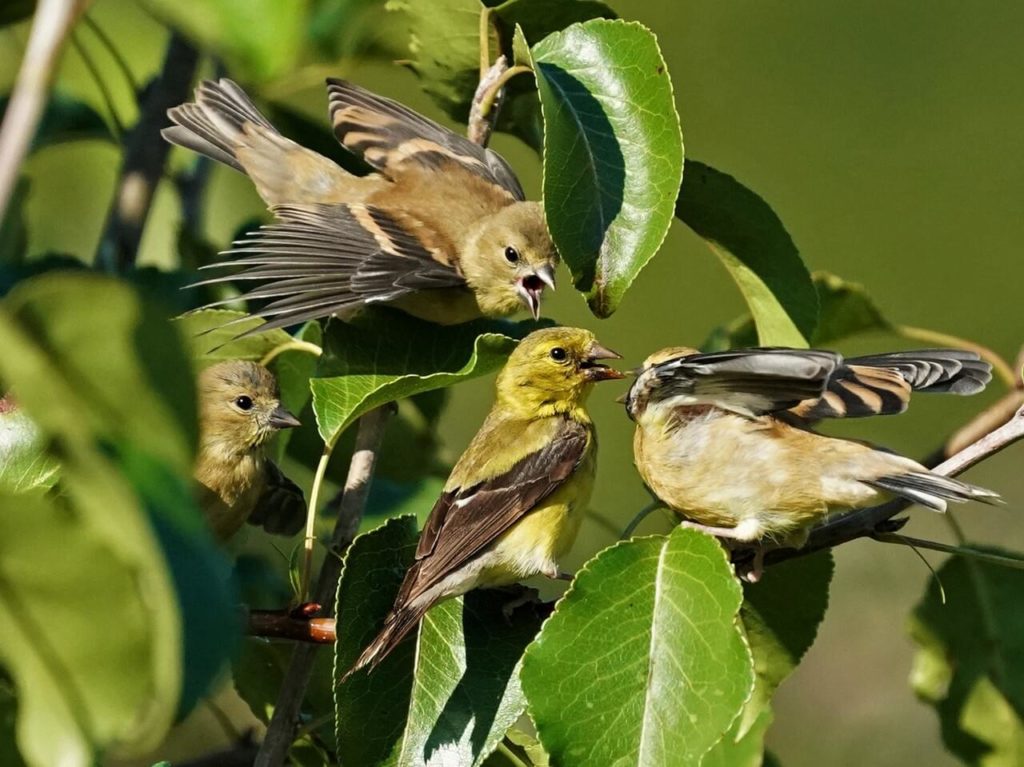
This year it’s a completely different situation as I have had three male Goldfinches consistently all summer.  I can’t be sure if the groups of fledglings are with different males although I can say that one group is four fledglings and the other group is five.  Hmmm.
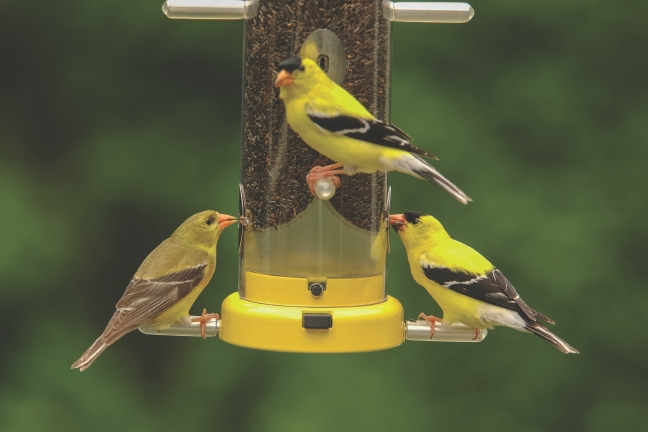
 

What changed that my feeding station is so different this year?  The answer became very apparent the more that I observed bird behavior in my yard.   I planted a native habitat that was successful beyond what I could have imagined.  The planting took place in June of 2020 and the mature plants have provided a bounty of seeds for the Goldfinches to eat.

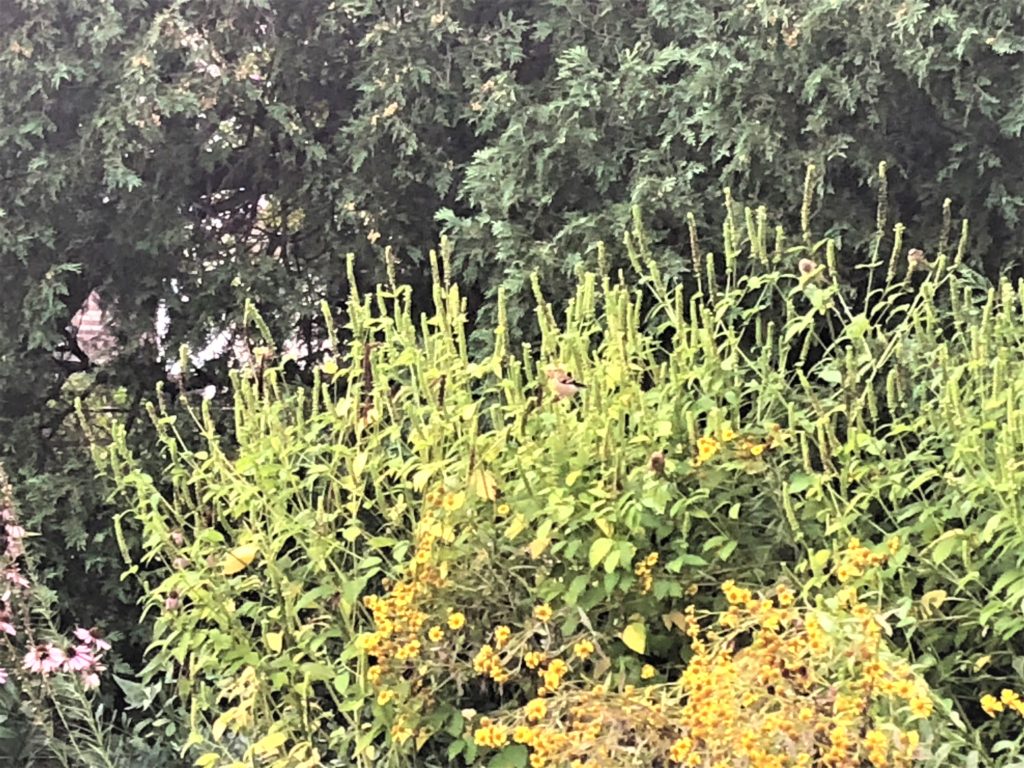
I especially love to check out the flowers with my binoculars as I am amazed at how well the goldfinches blend in with the plants.  Perfect camouflage for a bird that is out in the open – they need to be invisible to raptors.

If you are looking to change your habitat to make it irresistible for Goldfinches, here are a few suggestions –
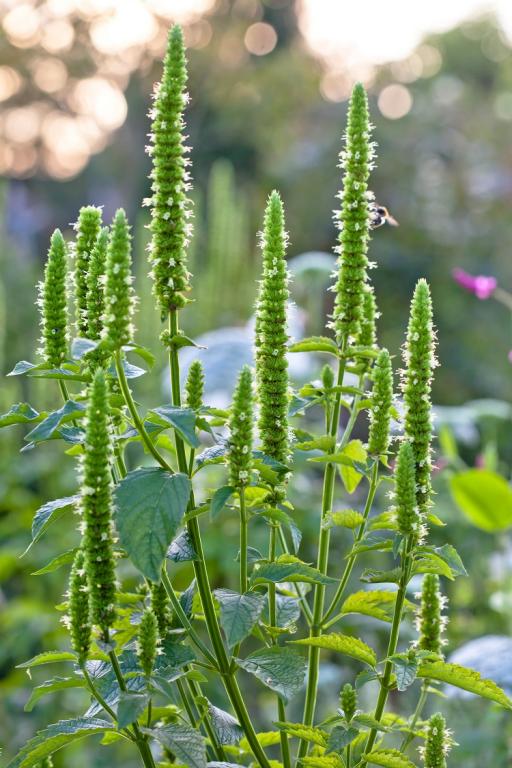
Agastache nepetoides- (giant yellow hyssop) has been a constant source of seeds for the Goldfinches since July.  A large stand of this native plant was placed in front of the established cedars, an appropriate place given their height of 3 to 8 feet.
From July to September they will be in bloom, an added benefit, as they suit our native pollinators.  This native plant is characterized as easily grown in average, medium, or well-drained soil in part shade to full sun.  I love this description from Missouri Botanical Garden – “A bold plant that masses well in the perennial border, native wildflower area, woodland or butterfly garden.” It is also planted in an area behind my garage that has been dedicated to pollinators. Of note, the bitterness of its leaves make Agastache nepetoides deer resistant.
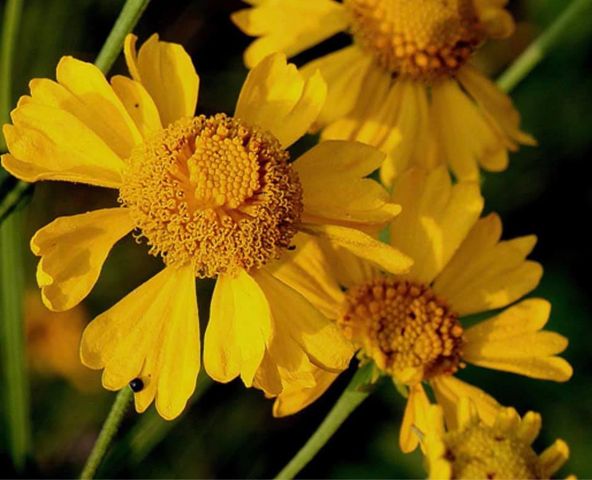
Helenium atumnale – (sneezeweed) was added in a layer in front of the Agastache nepetoides.  The large and numerous daisy-like, yellow flowers of Helenium autumnale can provide welcome color in late summer and autumn when many other blossoms have disappeared. Sneezeweed prefers full to partial sun and wet to wet-medium soils that are average to rich. Despite its common name, it presents no problems for allergy sufferers, its’ pollen is distributed by insects, not wind. Sneezeweed is one of the host plants of the Dainty Sulphur butterfly.
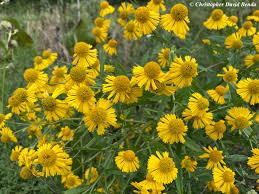
The plants often become so tall they need staking or other support. Alternatively, they can be cut back in early summer to force shorter, more-branched flowering heads. I have experienced this exact situation as one group of this flower was cut back and has stayed shorter and a great compliment to a different group of cedars growing behind the sneezeweed.  The other group were not cut back and they have flopped, as predicted.  Either way, they attract large groups of goldfinch, many of which go from the plant seeds to the feeder and back.  Best to leave the plant standing all winter so that the Goldfinch can continue to feed on the seed heads.
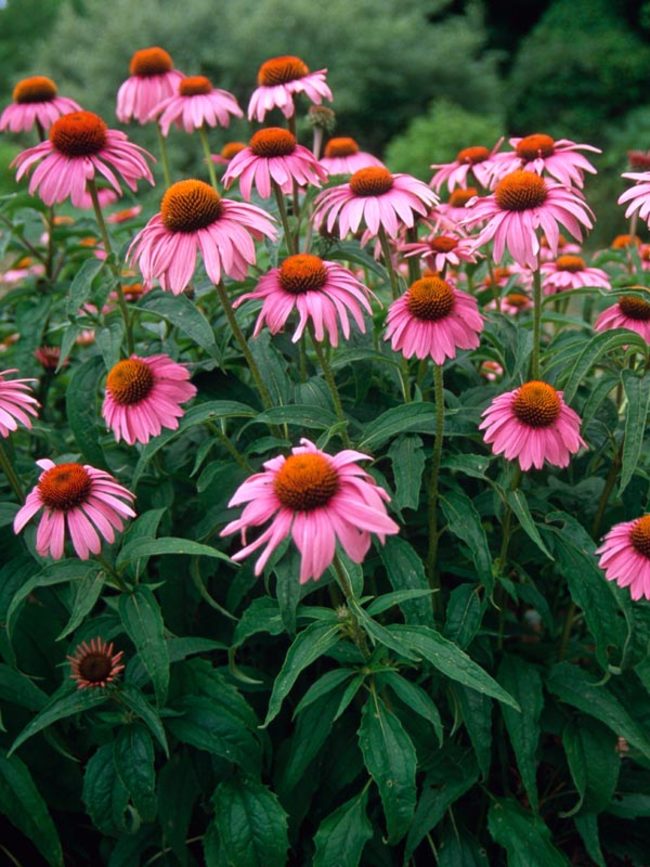
 

Echinacea purpurea – (purple coneflower) – an absolute favorite and a consistently attractive seed plant for Goldfinches.  Extra bonus is that it is attractive to Hummingbirds as well !  Easily grown in average, dry to medium, well-drained soil in full sun to part shade.  An adaptable plant that is tolerant of drought, heat, humidity and poor soil.
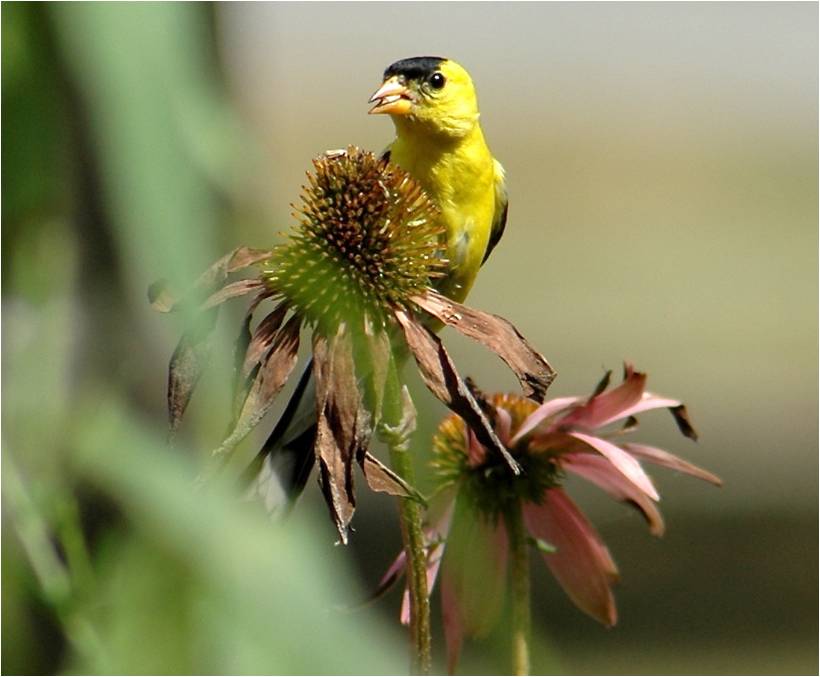
The long bloom times from June through August are a plus and no fall clean-up is needed, as the seed heads provide food for finches all winter long.
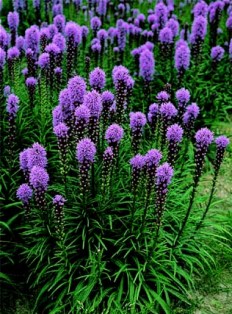
 

Liatris spicata and Liatris aspera – Marsh blazing star and Rough blazing star – these flowers blend beautifully with the Echinacea purpurea, the Helenium autumnale and the Agastache nepetoides.  These liatris were planted in many places and its so fun to watch the goldfinches land on the seed stalks and tip upside down as they eat the seeds. These plants flower from July through August/September.  Easily grown in average, medium, soils in full sun.  Spicata  prefers a moist soil whereas aspera is drought tolerant.
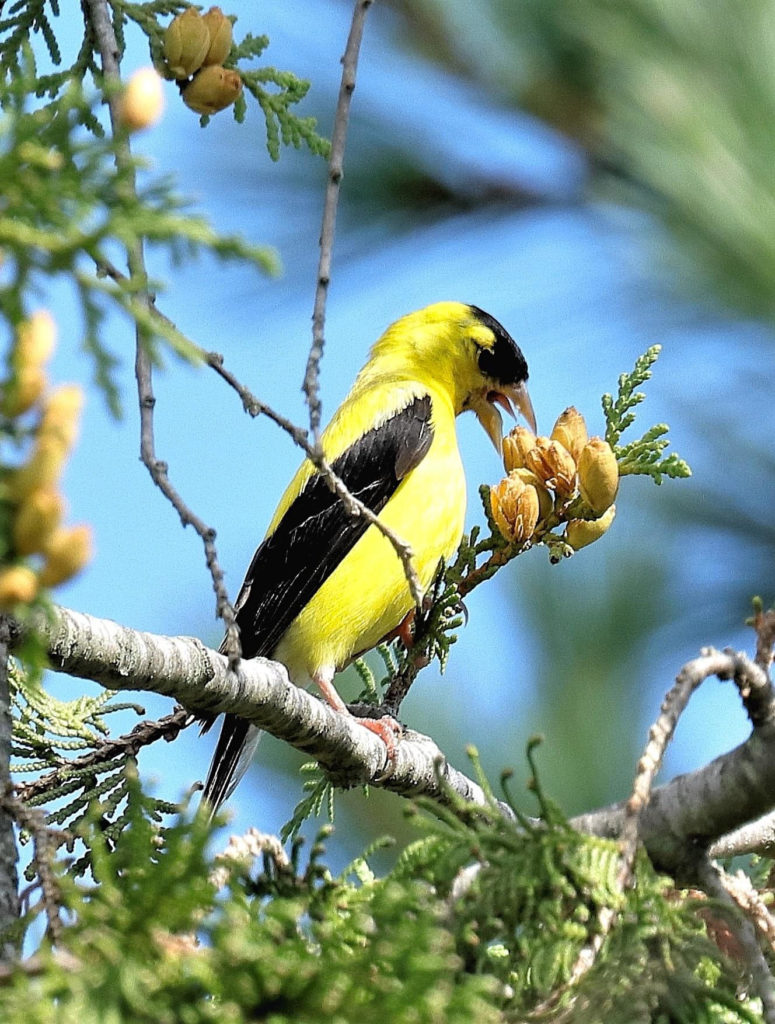
Perhaps the most surprising observation was a Goldfinch eating the seeds of the cedars that are the basic foundation plants in my backyard.  Certainly an important evergreen for shelter and food.

Have fun adding native plants in your yard to improve the habitat


and welcome even more finches !


Posted in Native Plants, Nesting, Summer | Leave a comment |

Bird Walk at Ford House April 24, 2021

Posted on April 25, 2021 by Rosann Kovalcik

Our group this morning at the Ford House consisted of many first-time birders.  It was as delightful to see their reactions to the birds they could see as much as it was a delight to see the returning migrants ourselves.  The group was led by me, Bill Rapai (President, G. P. Aududon) and Jim Szelc, who used to carry the telescope for the crowd.  In this covid cautious Bird Walk era, we rely upon him for dispensing great information and encouragement as well as his knowledgeable commentary.

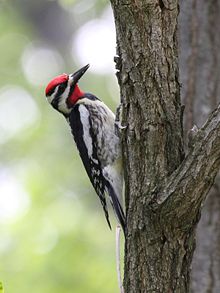
Tree Swallows had returned and were very vocal over the middle section of Bird Island, landing on the bare branches of the central tree and then taking off in pursuit of insects.  A solitary Chimney Swift joined them in the sky, and we noted the different wing beat between the two aerialists.  Yellow-rumped Warblers, both species of Kinglets, a single Yellow-bellied Sapsucker and a Hermit Thrush were also located.  Along the edge of the water where it meets the brush, important habitat to preserve, we spotted two stunning Swamp Sparrows and a Winter Wren.

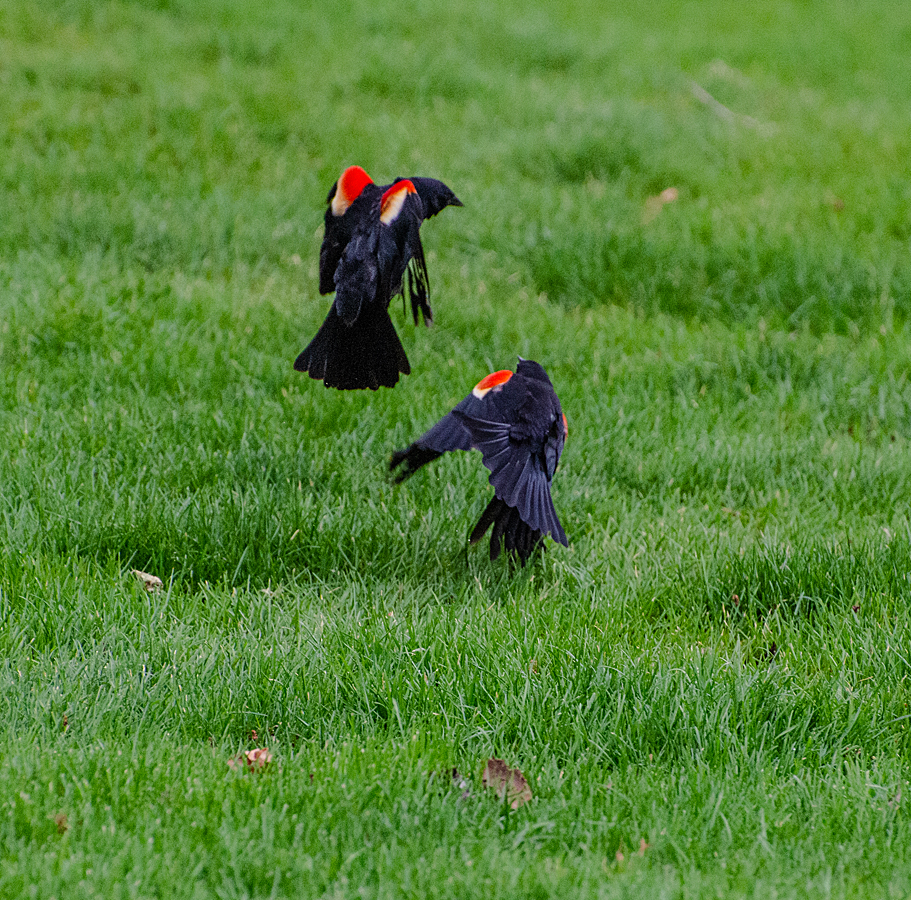
Of course, Red-winged Blackbird males were all over, engaged in territorial skirmishes.

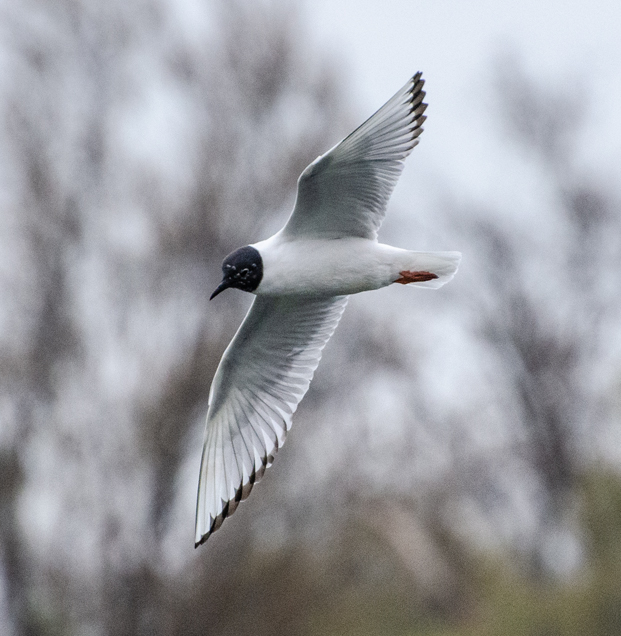
The water brought us other beautiful species including Wood Duck and Bufflehead.  Forster’s Terns were gracefully flying along the water near the G. P. Woods Park and moments later we were able to make comparisons to a Bonaparte’s Gull who put on quite the show as it circled around the cove in search of fish near the surface.

Killdeer and Robins were already on nests. We had a great look at a Baltimore Oriole Nest left hanging from last year, an educational piece as a few in our group had not realized that they stayed and nested. There were lots of vocalizations by the Red-bellied Woodpeckers which led to a discussion about the sad fact that European Starlings will sometimes usurp the resident Woodpeckers to claim the nesting cavity that they just finished for themselves.

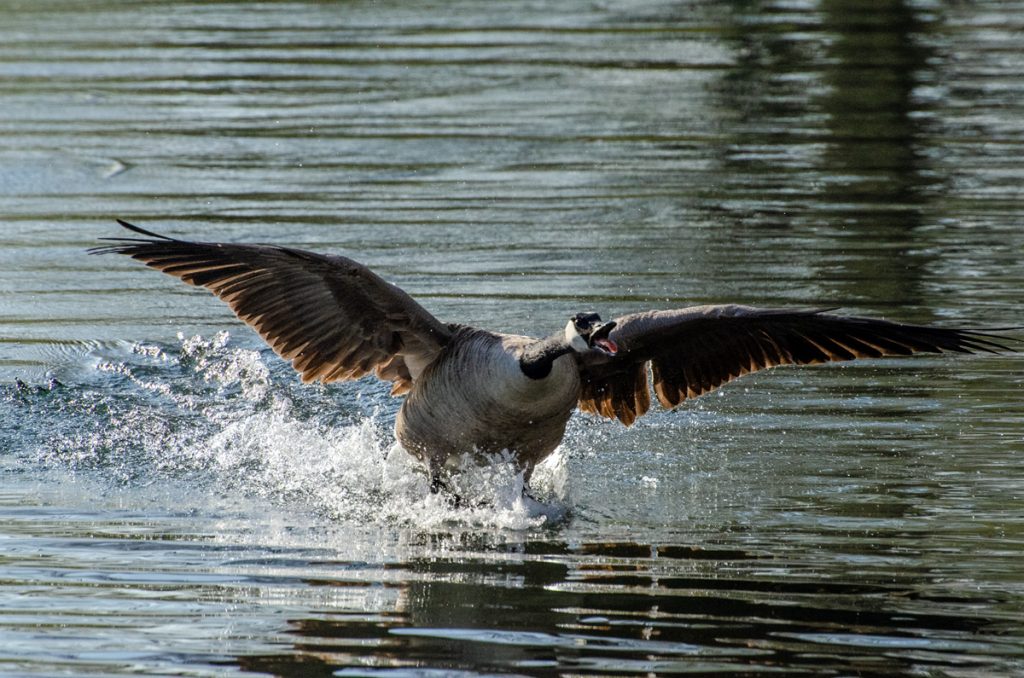
One of the Canada Goose pair already had young ones that they were vigorously defending against anyone that got too close.


Lots of bird species were on the move and gave us opportunities to compare wing beat style and speed.  Great-Blue Heron and Double-crested Cormorants flew high overhead while the female Belted Kingfisher paraded back and forth in the cove.

The Red-tailed Hawk was very obvious when we first arrived.  We were unable to locate a nest as in years’ past.

All in all, a wonderful two hour relaxing stroll, with the good fortune of fine looks and observations of 41 species of birds.

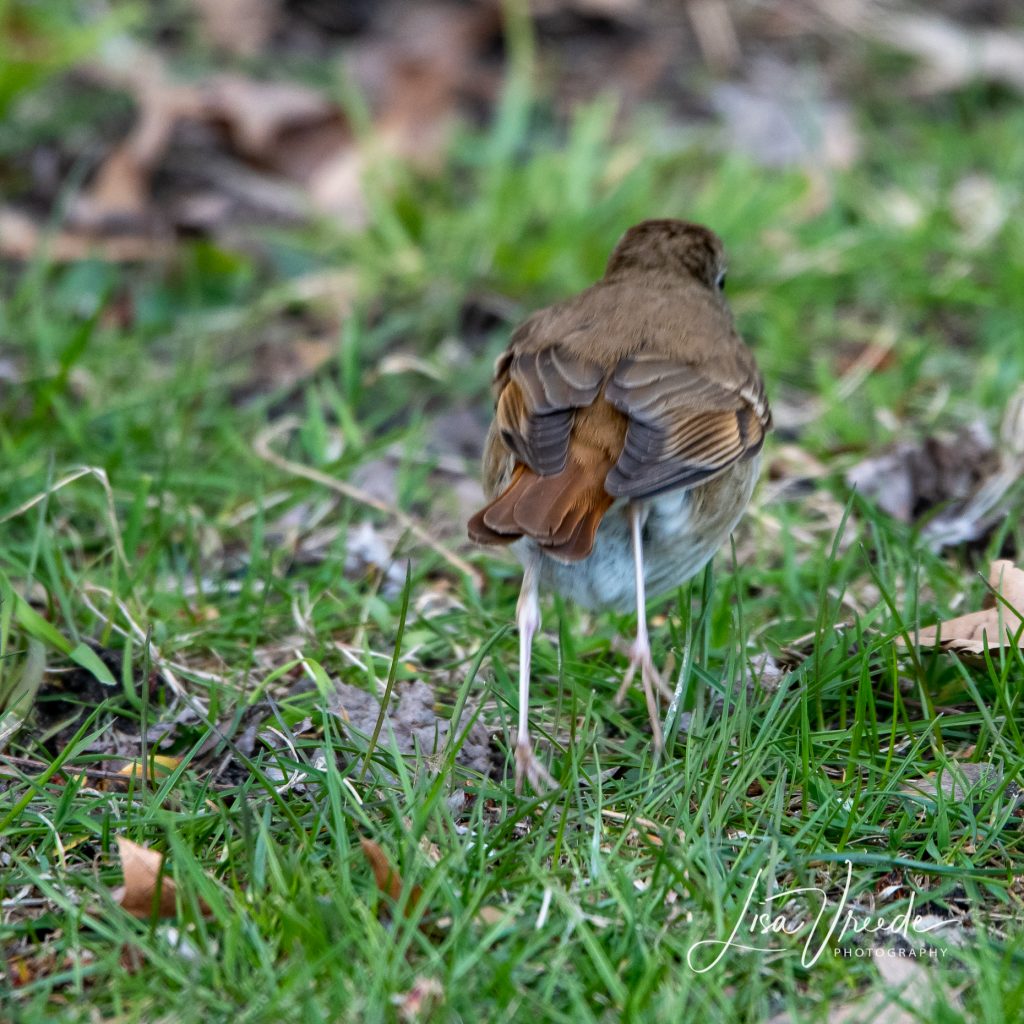
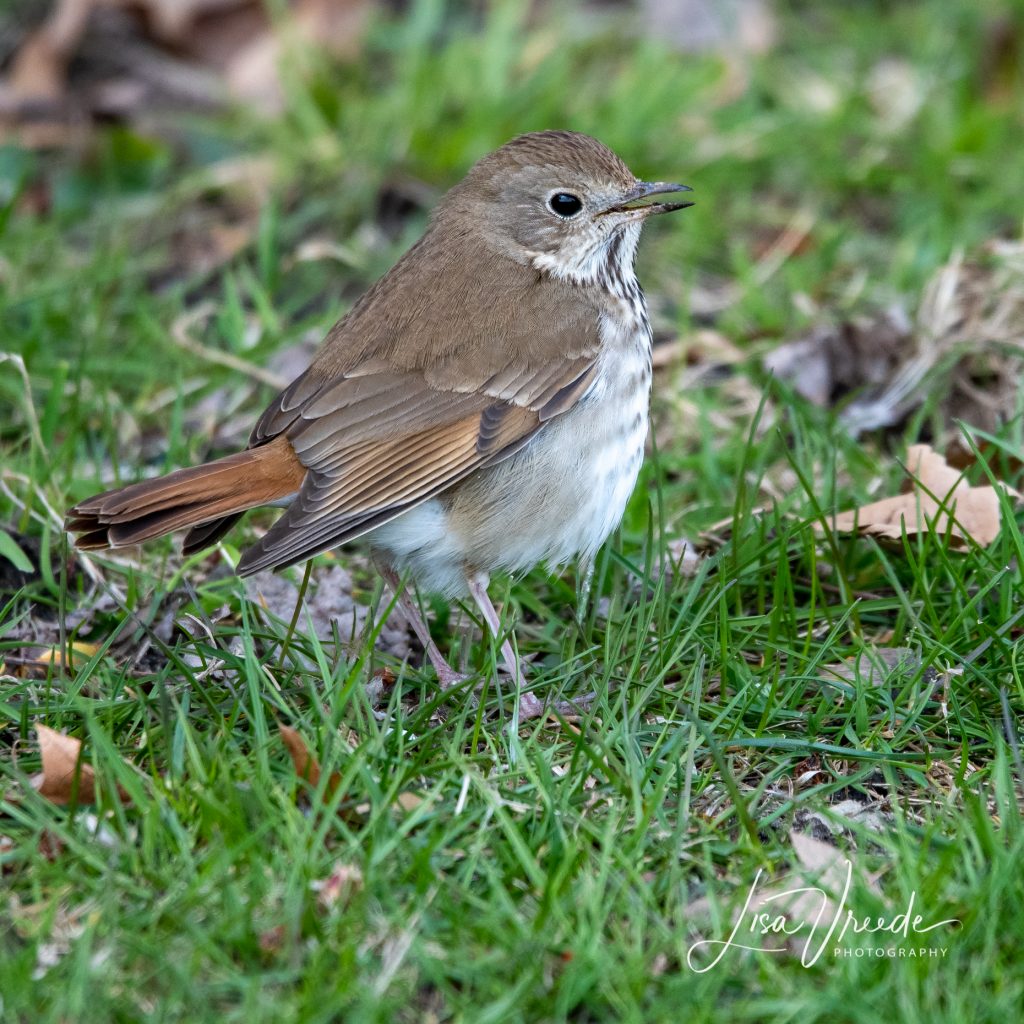
Many thanks to Bill Rapai for his photos of Red-winged Blackbirds, Canada Goose and Bonaparte’s Gull and to Lisa Vreede for her photo of the Hermit Thrush.

Rosann Kovalcik, Co-Leader


Birds seen on April 24, 2021 at Ford House


Canada Goose 

Mute Swan 

Wood Duck 

Mallard 

Bufflehead 

Pied-billed Grebe 

Killdeer 

Bonaparte’s Gull 

Ring-billed Gull 

Forster’s Tern 

Double-crested Cormorant 

Great Blue Heron 

Red-tailed Hawk 

Yellow-bellied Sapsucker 

Red-bellied Woodpecker 

Downy Woodpecker 

Northern Flicker 

Blue Jay 

American Crow 

Black-capped Chickadee 

Tufted Titmouse 

Tree Swallow 

Golden-crowned Kinglet 

Ruby-crowned Kinglet 

White-breasted Nuthatch 

Brown Creeper 

Winter Wren 

European Starling 

Hermit Thrush 

American Robin 

House Sparrow 

Chipping Sparrow 

Dark-eyed Junco 

White-throated Sparrow 

Song Sparrow 

Swamp Sparrow 

Brown-headed Cowbird 

Common Grackle 

Yellow-rumped Warbler 

Northern Cardinal 


Posted in Spring | Leave a comment |

Hummingbird Fun Facts

Posted on April 12, 2021 by Rosann Kovalcik

Why are Yellow-bellied Sapsuckers important to Ruby-throated Hummingbirds?

Yellow-bellied Sapsuckers are a type of woodpecker. True to their name, these birds drill concentric, evenly-spaced holes on trees in order to get them to weep sap. This is the first food available for hummingbirds when they arrive in spring. Ruby-throated Hummingbirds also eat the flying insects attracted to the sap wells. The hummers dart about and use their tongues to snatch the insects in mid-air.


When do I put out my hummingbird feeder?

Mid-April is generally a good time – think tax day. The earliest reports for hummers in 2012 was on March 17th; in 2010 it was April 1st; and in 2009 it was April 2nd. Although rare for hummingbirds to arrive earlier than May 1st, you may help out a migrant by being ready earlier.

Where should I place my hummingbird feeder?

Find a quiet place in the yard to hang the feeder, ideally away from your other feeding stations. Make sure the hummingbirds will be easy to see from your windows. Window mounted hummingbird feeders can be delightful.

If available, place the feeder near flowers and plants that attract hummingbirds. Use a small pole that allows the feeder to hang at the flower level.

Place the feeder near (but not directly under) protective cover where hummingbirds can seek shelter in bushes or trees. Hummingbirds also need a small snag, a branch cleared of leaves, to sit upon so that they can digest their nectar. They use snags to watch for flying insects, which they will catch on the wing, consuming them for needed protein. You can make a snag by removing leaves from a branch purposefully or you can purchase a commercial resting spot such as a Hummingbird Swing.  

 Hang the feeder in a location that has some shade to help slow nectar spoilage. However, make sure the feeder stays visible to the birds as they fly over.  Using a sun and shade guard can provide both added visibility and protection for nectar.

Place the feeder out of the reach of cats and other potential predators.

How often should I change the nectar?

 Think of nectar as sweet tea. If the weather is cooler, 60 degrees, leaving the nectar for two or three days is acceptable. However, if you left a glass of sweet tea out on a day of 90 degree weather, it may spoil and you would not drink it. The same is true of nectar – changing in hot weather every day is best. Rinse your feeder with hot water and clean the feeding ports with a brush to make sure that you prevent a build-up of mold. 

How do I make nectar?

Commercial nectar should be free of red dye. The sugar used in boxed nectar is superfine and can easily be made with boiled water, stirring until the sugar is dissolved. For a home-made version, the ratio is four parts water to one part sugar (ex: one cup of water to ¼ cup sugar). Boil the water to rid it of chlorination and allow the sugar to dissolve easily. Pour it over the sugar and stir until dissolved. Once cooled off, fill your feeder and keep the rest in a nectar bottle in the refrigerator. Do not use dyes, brown sugar or honey.

Are there times of the year when I should make the nectar stronger?

The nectar that flowers produce is the same strength of sweetness throughout the year. Since what we put in our feeders mimics nature, keeping our 4:1 nectar recipe the same is recommended. This is also the same recommended strength for orioles.

What do hummingbirds need for nesting?

A hummingbird builds its nest with thistle or dandelion down held together with strands of spider silk and sometimes pine resin. The female stamps on the base of the nest to stiffen it, but the walls remain pliable. She shapes the rim of the nest by pressing and smoothing it between her neck and chest. The exterior of the nest is decorated (probably camouflaged) with bits of lichen and moss, held on with spider webs. The nest takes 6-10 days to finish and measures about 2 inches across and 1 inch deep. You can offer what a hummingbird needs by leaving spiders in your yard, not using pesticides, and by offering soft, downy material if you do not have it naturally. 

What if hummingbirds are not coming to the feeder?

Since hummingbirds must wake up and fuel immediately, check first thing (daybreak) in the morning if you want to see if the feeder is being visited. Make sure you are changing your nectar frequently – spoiled nectar will leave a bad taste in their mouths (literally)!

What do I do to keep flying insects out of the hummingbird feeder?
  • Clean the feeder inside and out. Don’t let sugar solution splash on the outside of the feeder as it is a further attractant to bees.
  • Fill the nectar level lower than usual so the bees can’t reach it through the ports in a tray-style feeder. Sometimes this is about half-way full.
  • Move the feeder even if it is a couple feet from the original location. When a bee “scout” finds the food, it tells the others exactly where to find the source of food. If the source is not in the same place, it will remain bee-free until another scout comes across it. The birds will not have an issue with it being moved.
  • A small bowl of higher concentration sugar water, like a 1:1, on the ground may ‘pull’ the bees to that source instead of the nectar feeder source.
  • Pure almond extract around the ports has anecdotally worked for folks in the past. It doesn’t seem to bother or harm the birds.
  • Check to see if there are any yellow parts on the feeder. Many popular hummingbird feeders have yellow feeder ports or decorations. Bees and wasps are attracted to the color yellow. Use bright red fingernail polish and paint over any yellow parts of the feeder. Apply several coats of nail polish, letting each dry before applying the next coat.
  • Place the feeder away from anything that is yellow in your yard. This includes yellow flowers, lawn ornaments or decorations. Again, the yellow color will attract the unwanted insects.
  • Use our bee guards, which prevent bees from actually entering the nectar ports. We also sell a liquid meant to keep ants from crawling up your feeder poles.

Have you joined our email list? Click here to sign up, it’s free and gives you access to sales, coupons, nature news, events, and more!

Posted in Summer, Wild Bird Facts | Leave a comment |

Attracting Orioles to Your Yard

Posted on April 12, 2021 by Rosann Kovalcik

Graffius Oriole 3 small


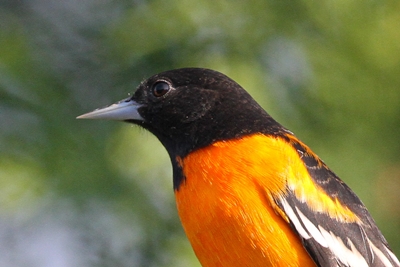
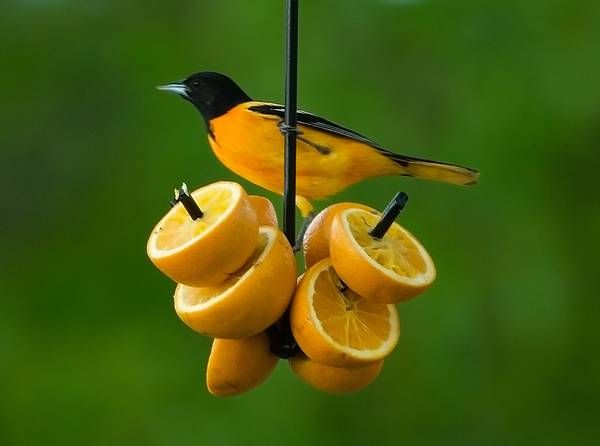
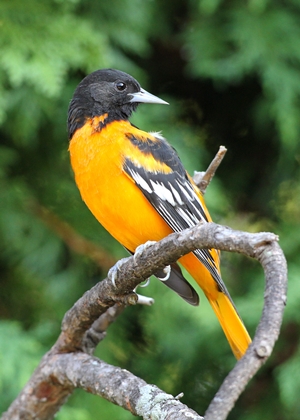
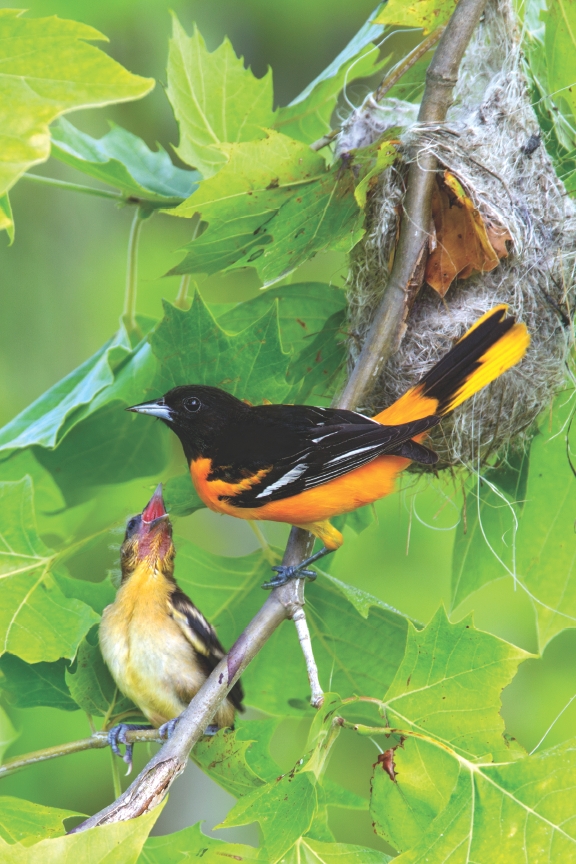
In search of an adequate food supply to raise a family, thousands of Baltimore Orioles migrate from Central America to Michigan during springtime. What does it take to attract these vibrantly plumaged orange and black birds to our yard?

When the male arrives, he is in search of a territory that will provide the basics – food, water, shelter and places to raise young – those elements allow him to carry on his genetics, the sole purpose of migration.


Undoubtedly, you will hear Orioles before you see them. The male Baltimore Oriole’s song consists of a short series of paired notes, repeated 2–7 times, lasting 1–2 seconds. The pure, liquid, flute-like sounds have a full, rich tone. Once you accustom yourself to its song, you will be able to search for them visually.

Orioles can be found in open woodlands, woodland edges, and riparian woodlands and in our shade trees in suburban neighborhoods. They do not prefer deep forests.

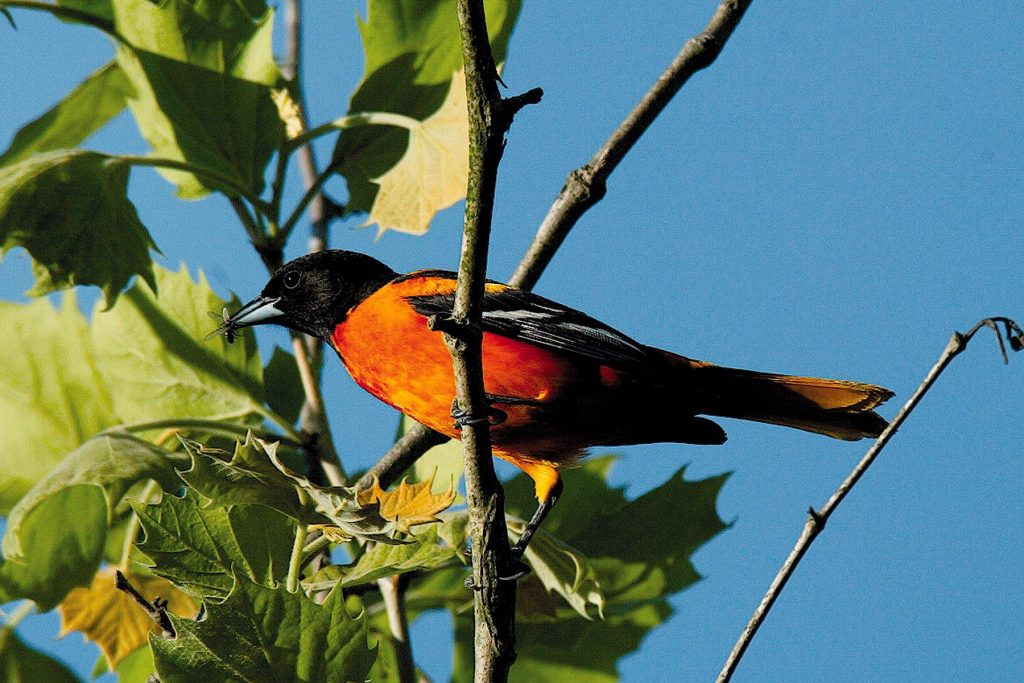
Because of Orioles’ habit of feeding at treetop level, consummate birder Pete Dunne nicknamed them The Eastern Arboreal Oriole. So why the nickname? This is a bird that is wedded to dense leaf canopy. Males sing from exposed perches to warn other males of proclaimed territory. Both the male and female land on the tallest point of a tree before slipping into the dense canopy to begin foraging for insects. These include caterpillars that emerge to eat unfurling new growth on trees.

Oak trees in particular offer more diversity of caterpillars than any other tree in Southeast Michigan. While an oak may not mature to full size during your lifetime, planting it for its food value to birds is an investment in the future of birds. Orioles eat many pest species, including tent caterpillars, gypsy moth caterpillars, fall webworms, spiny elm caterpillars, and the larvae within plant galls. Larger caterpillars are a challenge for some birds, but the Oriole has many strategies for eating them. The birds’ beak is quite pointed and is used to slice through the exterior of a caterpillar, allowing it to eat the nutritional insides. Orioles often have a feeding limb, a favored place to feed, as can be attested to by dried caterpillar skins accumulated on the branch. Orioles eat other insects as well including beetles, crickets, grasshoppers, moths, and flies and non-insects including spiders, snails, and other small invertebrates.

Baltimore Orioles sometimes use their slender beaks to feed in an unusual way, called “gaping”: they stab the closed bill into soft fruits, and then open their mouths to cut a juicy swath from which they drink with their brushy-tipped tongues. Fruits that are especially attractive to Orioles are those that are dark in color. A variety of these plants can offer the high lipid fat that the birds need for fall migration – dogwoods, chokeberry, elderberry, and viburnums. Native plants grow native caterpillars in abundance and therefore, are the perfect choice when planning your bird-friendly yard.

Orioles also have an early spring feeding strategy– they drink from the wells of Yellow-bellied Sapsuckers. These woodpeckers create purposeful holes to encourage sap to run, which in turn attracts insects, an additional food source for the birds.


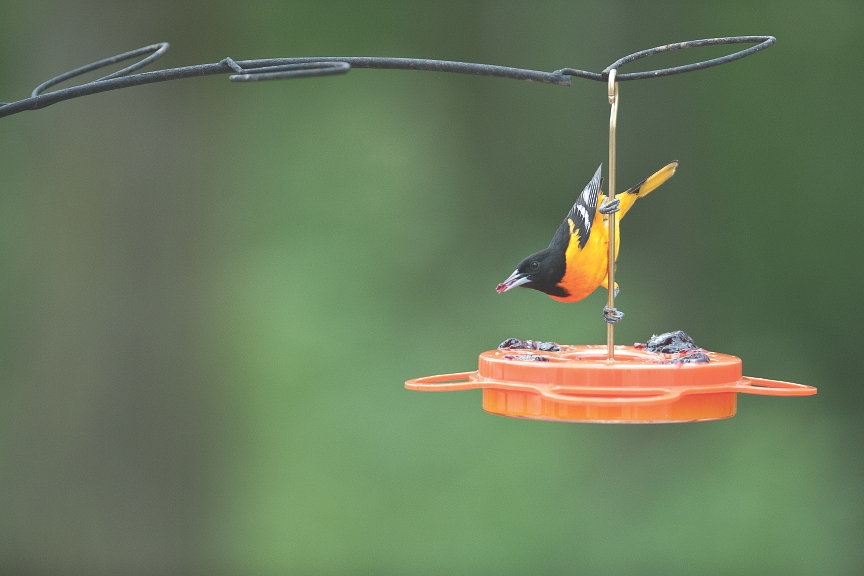
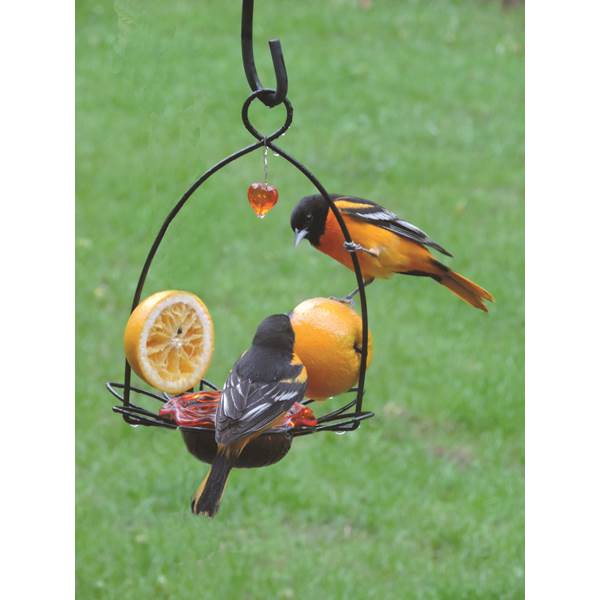
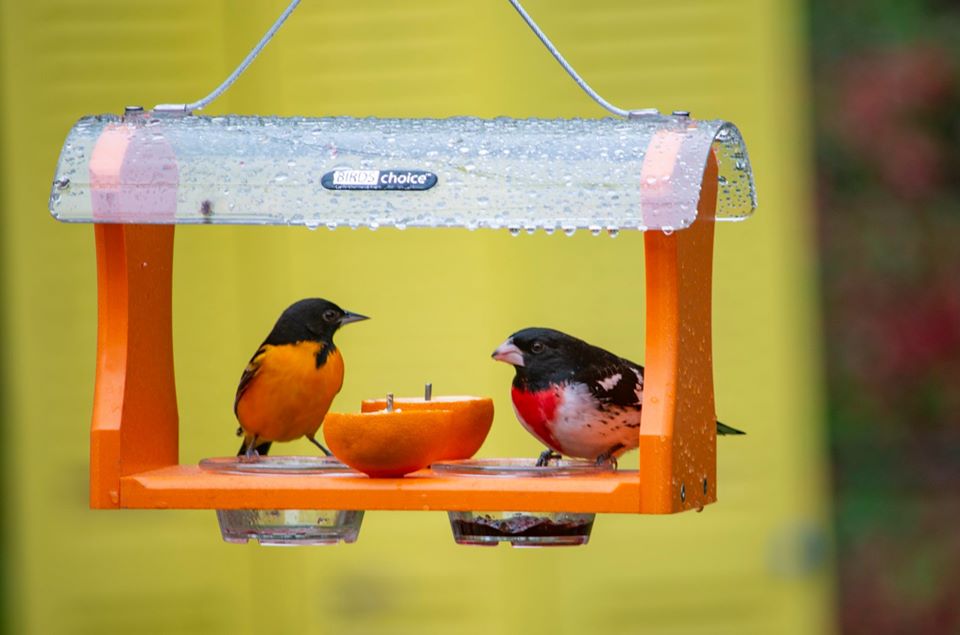
For a closer look at Orioles, you can place feeders in your yard that offer the same types of foods they find in the wild. Dark grape jelly can be offered in plastic and glass dishes, oranges can be placed on pronged feeders, and nectar feeders will round out the offerings.

Mealworms are another great food source to offer – the birds will take the worms back to their young as well as bring the young to the feeders once they are fledged. Your feeding station will be most successful if it is some distance away from other feeding stations. Your feeding station should be set up before the first week of May to attract the abundance of Orioles that migrate at that time. Once migration is over and the local birds have established their territory, you may find that the mated pair (or two if you are lucky) near your home can be very skittish at feeders. As a bonus, other birds will enjoy these offerings including House Finches, Cardinals and Rose-breasted Grosbeaks.

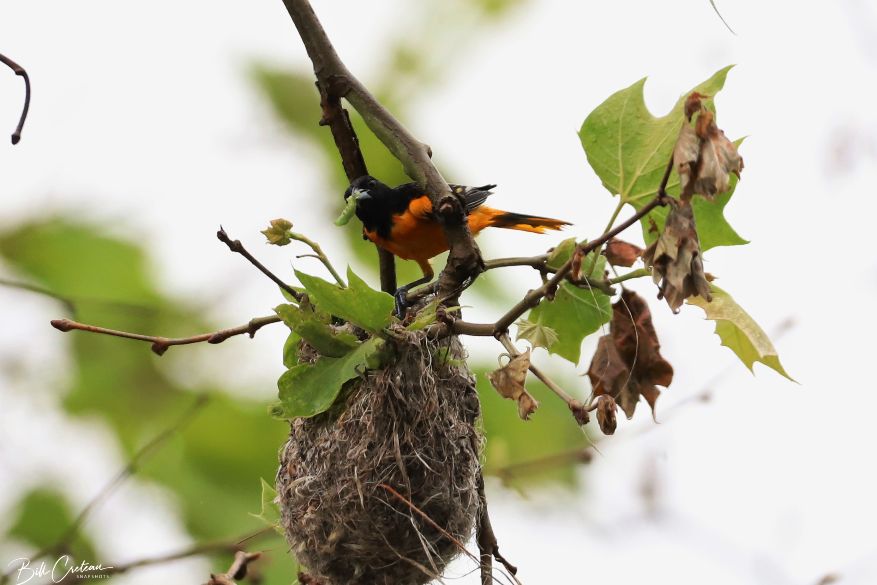
Female Orioles are responsible for the building of the nest that will hold their eggs and resultant young, usually four in number. Long strips of plant material are the backbone of their nest. Most frequently they use milkweed and dogbane, clipping the plant at the base just above where they are holding it firmly in their feet. Pulling up, they create strips that are then flown to the nest site and tied in place. Leave last years’ milkweed and dogbane standing into the spring so that these birds can utilize them, or clip it and add it to your nesting material basket. Elms were the favorite trees of Orioles for nest building before Dutch elm disease took its toll on them. Now, they favor maples, willows, poplars and oaks. Placed at the tip of branches, the sock-like structure has the advantage of being difficult for predators to reach.


The nest is a work of art, a suspended pouch woven as two separate walls. The female uses a shuttling motion to create the walls and then stitches the two halves together. The inside plant material can consist of dandelion fluff, the downy material from willows and poplars and short strips of grape bark. Natural materials can be placed in a suet basket and placed where you can enjoy these beauties helping themselves. Short strips of natural fibers (avoid polyester), hair, and string may be used by Orioles in nest construction. Fishing line and dryer lint are two materials not to be used. The fishing line is too thin and can easily entangle the bird. Dryer lint has materials that will hold moisture and would cool eggs and babies instead of keeping them warm as natural materials would. The female builds the nest over a period of about eight days. Nests are not reused, although some of the nesting material might be used in the new structure.

Graffius Oriole 2 small

Males keep a watchful eye on the female as she works, mating with her when she allows. Incubation is done by the female entirely, lasting a period of 12 to 14 days. Both parents feed the young for the next two weeks, during which time the naked hatchlings develop into fully feathered adult sized birds.

Now it is the male’s turn to take over as the young follow him for lessons on where to look for food. The female spends her time eating to regain the weight she lost and preparing herself for fall migration.

Orioles leave early back to their southerly home, our yards quieter without their songs as early as the end of August.

Oriole Father feeding baby

Well worth the effort to attract, Orioles make our time in the yard a special time indeed!

Thanks to Bill Creteau, John Graffius, Wayne Hoch and Randy Repicky for  sharing their photos

Have you joined our email list? Click here to sign up, it’s free and gives you access to sales, coupons, nature news, events, and more!

Posted in Bird Feeding Solutions, Spring, Summer, Wild Bird Facts | Tags: baltimore oriole, Bird Feeding, birds, fun facts, orange, orioles, Spring, summer, wild birds unlimited | Leave a comment |

Red-winged Blackbirds – Spring has arrived!

Posted on March 7, 2021 by Rosann Kovalcik


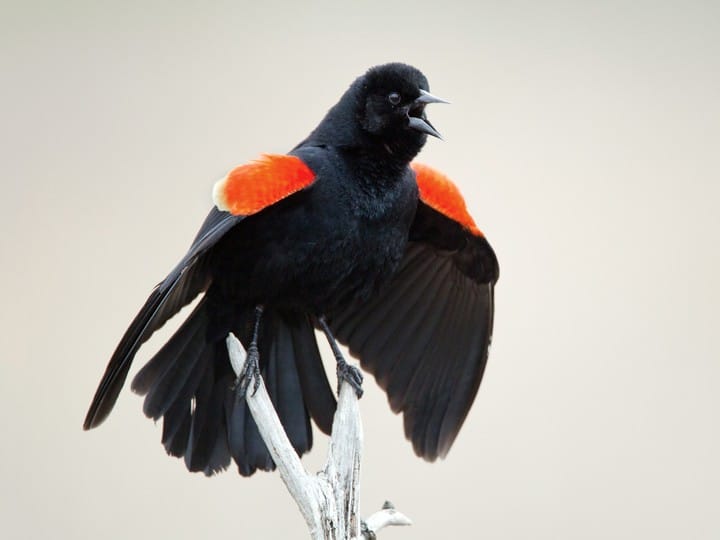
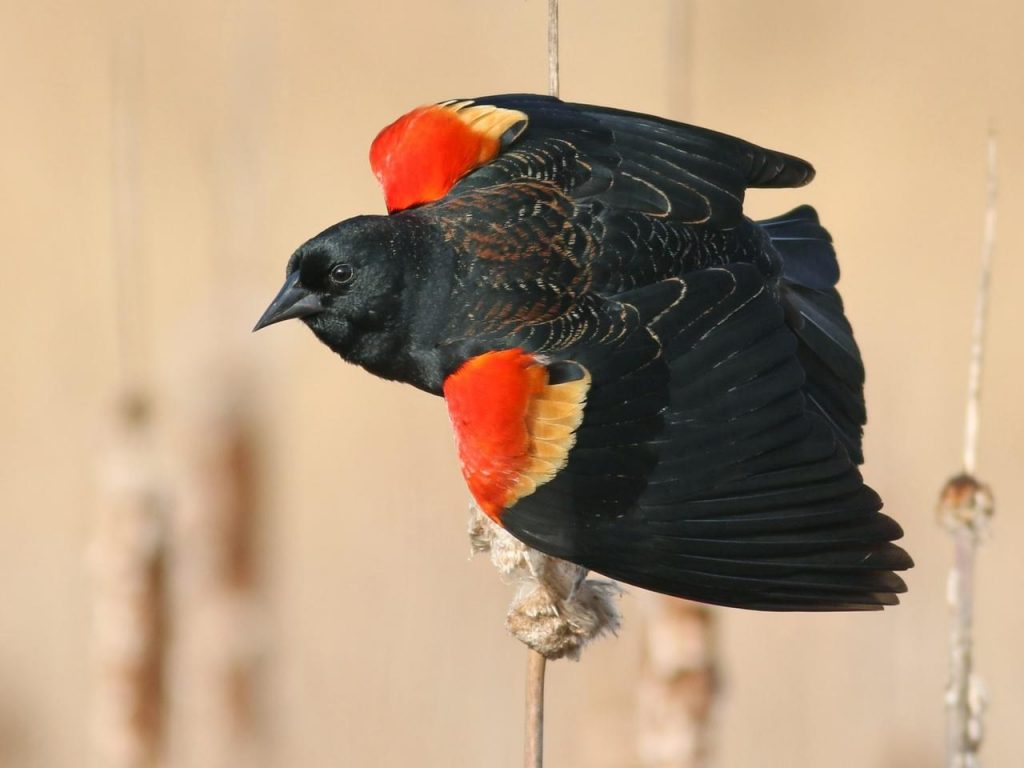
The first week of March saw a return of Red-winged Blackbirds into the state, the first wave of this migrant.  These early arriving males hope to find the most suitable areas to stake out as a breeding territory.  Their bright red shoulder patches, known as epaulets, are used to add emphasis to the song they sing.

Territory is proclaimed by Red-winged Blackbirds singing from atop prominent perches. Their song has been described in many of the field guides as “kong-a-ree” or “konk-la-ree”.  I like the version offered by my friend Jeanne.  She lived on a property that was mostly field with edges of shrubs and trees, perfect for the male Red-winged Blackbirds that had successful nesting sites.  Jeanne felt they were saying “It’s my treeee!” as they leaned forward and made themselves quite noticeable from a conspicuous perch.

Red-winged Blackbird males spend a quarter of the day defending their territories.  Chasing is a major activity, with males chasing other males out of their territory but also chasing after larger “predators” including humans.

When taking a break away from display, Red-winged Blackbirds have no need to show their red shoulder patches.  Their wings are folded tightly against their body, with their breast and back feathers covering the red shoulders.  That’s when we may notice the light yellow feathers called the median coverts, showing as a small crescent on each wing.  Other than the wing color, male Red-winged Blackbirds are black all over, beak and legs included. In good light you can see the outlines of feathers edged in brown, a great way to study feathers.  Their glossiness is beautiful in the sunshine.


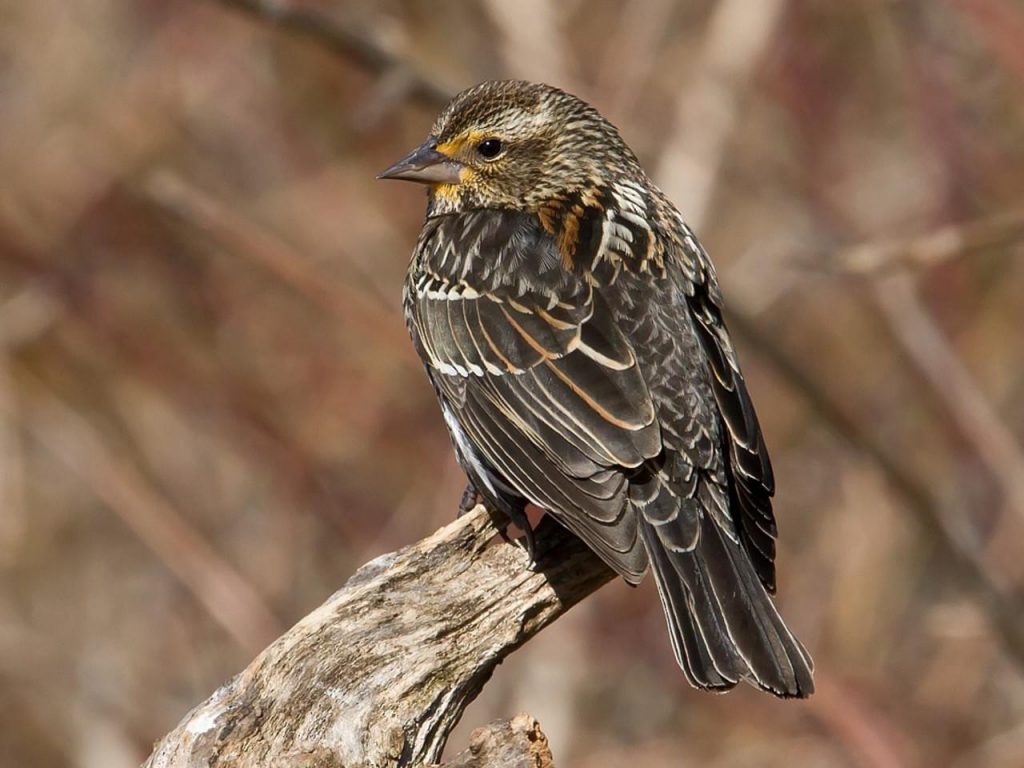
Females look quite a bit different with heavily streaked breasts, a noticeable buffy colored eyebrow and throat with a warm brown color on the back.  The females have a salmon colored wash over their face and throat.


The territory of Red-winged Blackbirds consists of plants that would allow for the construction of a nest hidden away near the bottom of cattails or grasses and sometimes using small shrubs and trees. The females are the nest builders, winding stringy plant material around upright stems, lining the nest with wet vegetation, decaying wood (think mulch), adding a layer of mud and then topping it with fine, dry grasses.  One nest picked apart by a naturalist in the 1930s had been made by weaving together 34 strips of willow bark and 142 cattail leaves, some 2 feet long. When finished, a typical Red-winged Blackbird nest is 4 to 7 inches across and 3 to 7 inches deep.  Ornamental grasses in our landscapes have provided great habitat for these birds.


Male Red-winged Blackbirds have a lot to defend as they may have as many as fifteen females within their territory.  They will mate with all of them and so will the males from the surrounding areas.  Studies have shown that ¼ to ½ of the young in a males’ territory are sired by a male other than him.

Insects make up the majority of Red-winged Blackbirds diets in the summer, supplemented with seeds.  They are adept at using their pointed bill to probe and open aquatic plants in order to reach the insects inside.  Our large fields of grain are a boon to their population as they supply a bountiful food source throughout the winter.

Red-winged Blackbirds will visit bird feeding stations with a preference for millet.  They don’t prefer safflower seed.  Mixes that contain corn, milo, wheat and other agricultural excess seeds are very attractive to them.


Posted in Uncategorized | Leave a comment |

Mother Birds

Posted on May 10, 2020 by Rosann Kovalcik

Mother Birds

Happy Mother’s Day to all of the Moms out there.  Let’s take a moment to celebrate some of our local Mother birds.

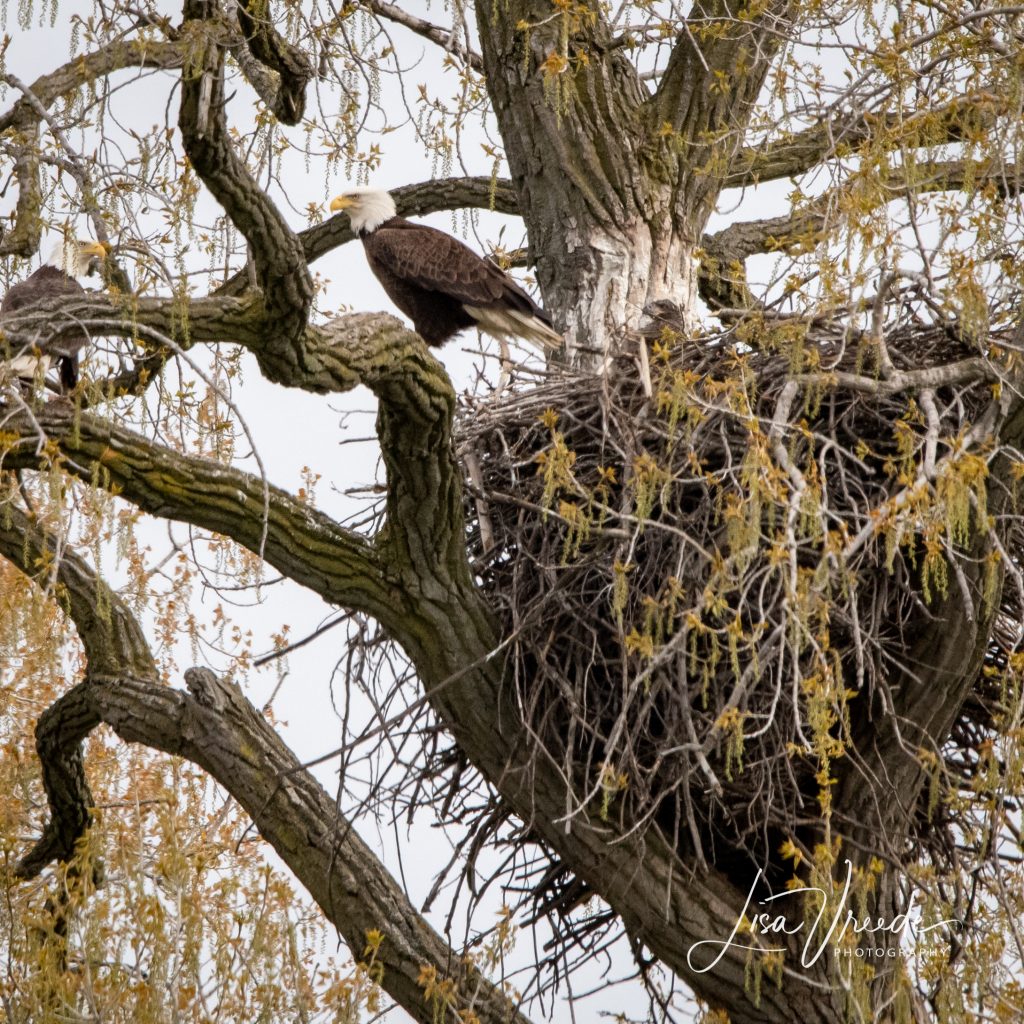
Sitting on eggs for over a month of incubation, the Bald Eagle shows what parental dedication is all about.  Our local pair at the Country Club of Detroit fly to the Lake to catch fish for the youngsters, and have been witnessed bringing their catches back to the nest to feed the fledglings.  This large raptor attends to her young for the entire summer as it will take this long for the young ones to learn to fly and develop hunting skills.  I was privileged to listen to the details of the nest building from a customer whose house faces the Country Club.  In a lot next to hers, the Bald Eagle would come down and take large branches off the ground to use as the base for this massive nest.  The inside is lined with smaller twigs, grasses and moss.

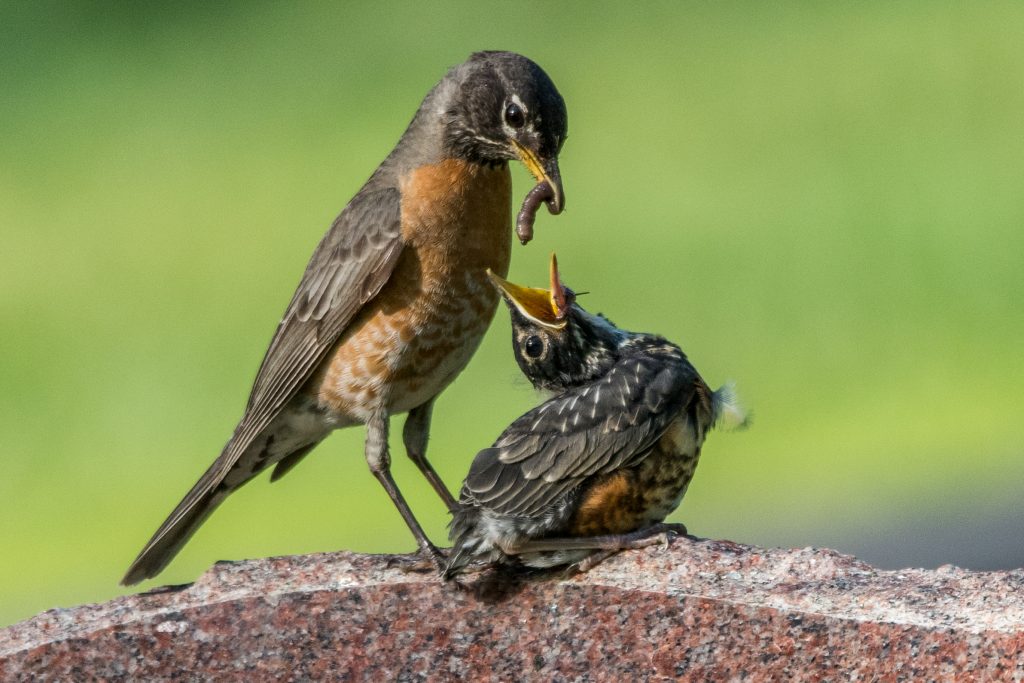
Many other Mother Birds, such as the familiar American Robin, sit on eggs for only two weeks, and it is the female alone who does the incubating. The young leave the nest after another two weeks, during which time the male helps with feeding.  However, Robins start breeding very early as many of you are already witnessing.  They may have two or three broods of young within the season, making for a summer full of parenting.

Oriole mothers create a master of a nest, a woven pendulous hanging “sock-like” nest.  The nest may take ten to fourteen days to create, placed close to the ends of branches so that it is unlikely that a predator is able to take the eggs or young.  Think about the fact that the first-year females have no blueprint to follow when weaving this nest.  As she builds, she tangles the nesting material with her beak and pushes it into shape much like felted wool. I once watched an oriole come to my yard and land on the ground at the base of the coneflowers that I had left standing all winter.  She clipped at the bottom of the plant and then pulled backward, creating a long strand of material with which to work into her nest.  That one moment changed the way I felt about “cleaning up” my yard in the fall.  Although I haven’t witnessed a similar moment again, I imagine that it is happening when I am not watching.

Hummingbird moms are solely responsible for creating their nest, incubating and feeding their young.  Many times, they will start creating a second nest while the first brood are still being fed.  That’s a lot of work, especially considering that they need to find spider webs to hold their woven nest together and onto the branch.  The web allows the nest to stretch as the young get older.  The spider webs are also used as the sticky substance that holds the moss and lichens into place on the outside of the nest, acting as camouflage.  Do you have all of these nesting materials in your yard for the hummingbirds to use?  Leave the webs and don’t spray for spiders or other insects.  In fact, insects comprise half of a hummingbirds’ diet and she feeds her young this half nectar/half insect diet.  If you don’t have mosses in your yard naturally, consider a small container of them to provide the nesting material so many birds can use.

Enjoy watching the hard working Mother Birds in your yard.

Posted in Nesting, Spring | Leave a comment |

Hermit Thrush

Posted on April 27, 2020 by Rosann Kovalcik

One of our early migrants has been spotted by many customers with excitement – Hermit Thrush.  Other than the thrushes that we readily recognize, the American Robin and the Eastern Bluebird, there are a group of thrushes that can look quite similar.  Here are some tips as to how to tell this one apart from the remaining thrushes in the Genus Catharus.

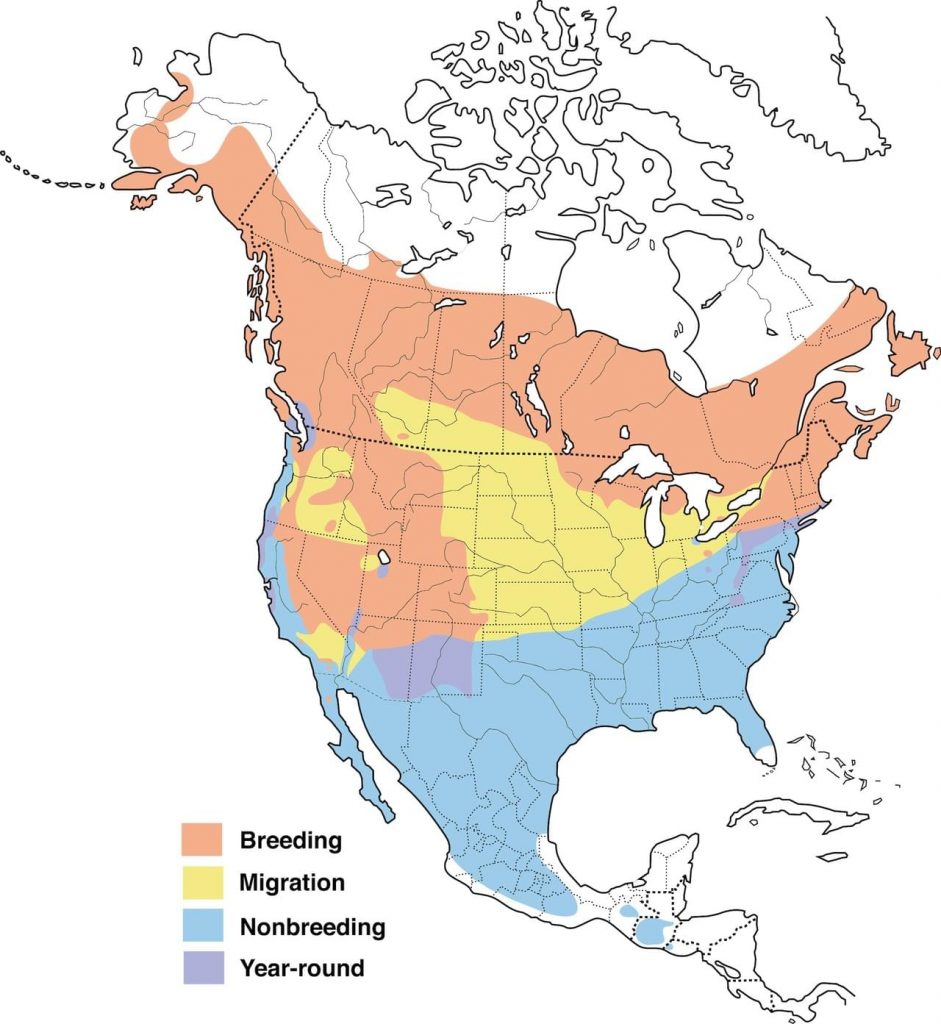
First off, it is the thrush that arrives the earliest so in late April, if you are seeing a thrush, chances are it is a Hermit Thrush.  Why is that?  Because it is the only thrush that winters in the United States, which means it has less of a distance to migrate and therefore, arrives on breeding grounds first.  The other thrushes of this genus all spend winters in Central and South America.

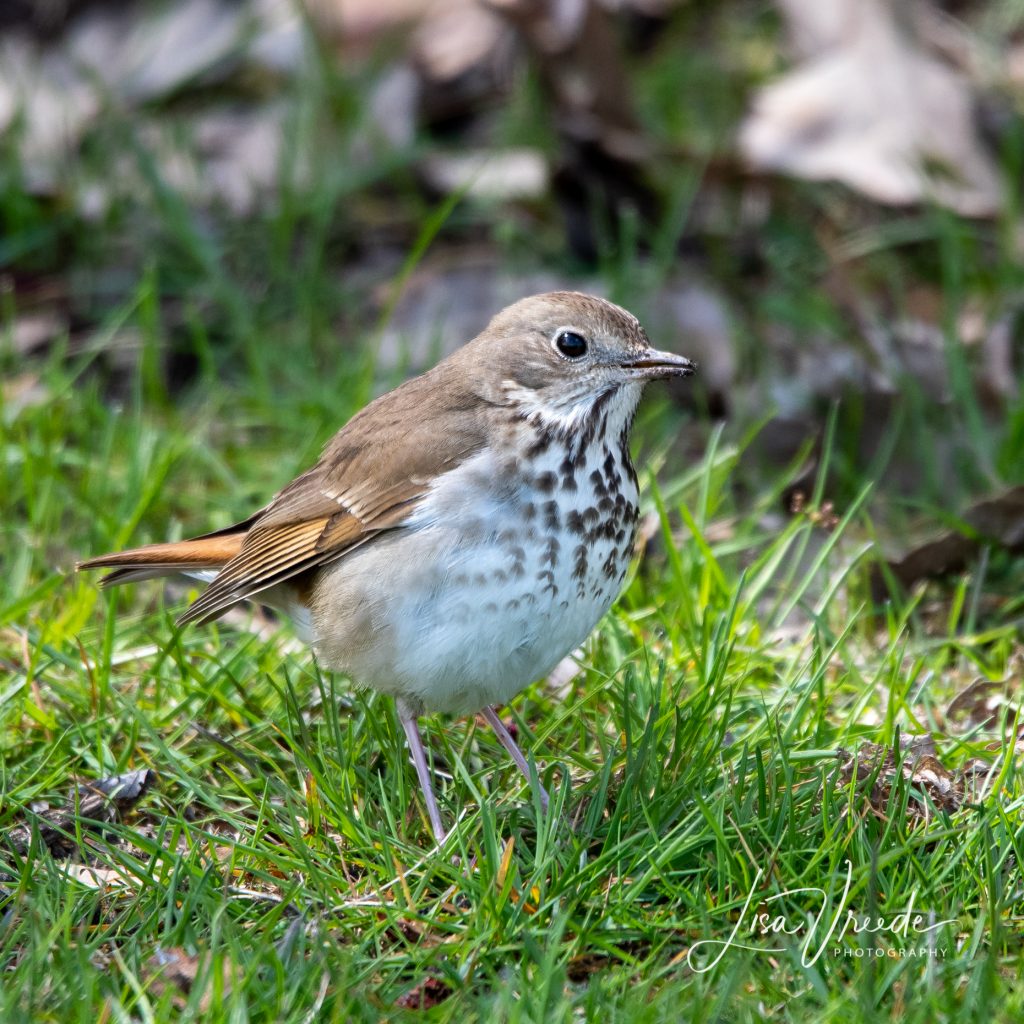
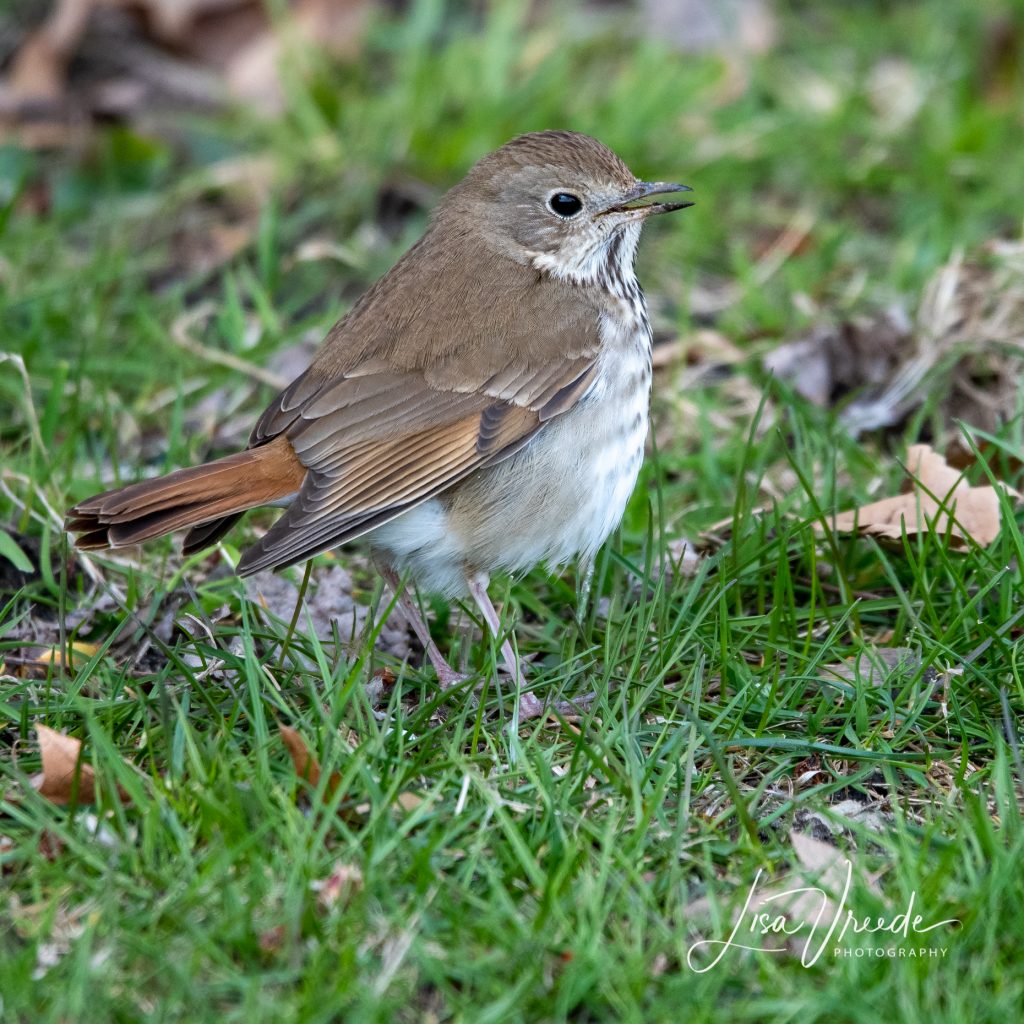
Notice the reddish tail and the reddish tips of the wings.  No other Catharus Thrush has these field marks.  The chest of a Hermit Thrush has bold, black spots.  In poor light conditions, the whiteness of the chest will stand out.  Also look for the narrow but complete eye ring on Hermit Thrush.

As you watch its behavior, observe how it will quickly raise and slowly lower its tail, another field mark.  Hermit thrushes also habitually rapidly flick their wings as they jerk their tail.  As well, the Hermit Thrush will also stand with its’ tail held in a slightly upright posture.

Watching this bird feed can be quite entertaining.  It moves with energetic, springy hops and then a pause, similar to a hopping Robin yet faster.   The Hermit Thrush may often fly up to capture prey.  If you see this thrush feeding in the lower portion of trees, it moves by hopping from branch to branch in search of insects and berries.   After each time that it alights, it will often mark each relocation with that characteristic jerk up and then lowering of the tail.  Hermit Thrushes search leaf litter (another important reason to Leave the Leaves) for insects such as beetles, caterpillars, bees, ants, wasps and flies.  They may also eat small amphibians and reptiles.

Thrushes are known for their amazing songs.  Hermit Thrush is no exception.  As described by David Allen Sibley, the song is “ethereal, fluting, without clear rising or falling trend; begins with a long whistle followed by two or three higher twirling phrases fading at the end”.

If you are lucky enough to see this bird in its’ breeding habitat, perhaps you will have the pleasure of hearing its’ song.  Hermit Thrushes prefer drier, more open under-story forests and the edges of forests as opposed to the interiors.

Many thanks to Lisa Vreede for her outstanding photographs of this Hermit Thrush.

Enjoy your birds!

Posted in Uncategorized | Leave a comment |

Wild Thing – You Make My Heart Sing!

Posted on February 18, 2020 by Rosann Kovalcik

Wild Thing – you make my Heart Sing!

With the longer daylight hours comes the moment that I anticipate every January – the first day that I hear the Cardinal singing!  This year it was a little later by a few days – on January 25th, instead of my early date of the 19th .  It is a pleasure to linger outside for a few moments before I get into my car, listening for the beautiful notes to greet me in the stillness of the morning.

“Cheer, cheer, cheer” or “Birdie, Birdie, Birdie” – the Cardinal typically repeats its’ introductory notes three times.

Shortly after smiling over that sweet song, I heard the White-breasted Nuthatch pair calling softly to each other.  As early nesters in our area, they are already pair bonded and keep in touch with their one syllable call notes.

Another favorite I often hear this time of year is Purple Finch.  Notably, this bird sings from the top branches of the neighbor’s birch tree every year about this time.  Could it be the same bird returning year after year?  I never miss it as it is not a common song to my ears at any time of the year.  And each year I grab my binoculars and confirm that this complex song is from my “buddy”, keeping my hearing birding skills challenged once more.

Birds song is prompted by the length of day, the sunlight causing a hormonal response.  We may think of song as “happiness”.  In actuality, male birds sing to define the boundaries of their proposed territory.  This also has the effect of letting the females know that the territory is ready for her when mating time is at hand.  For Cardinals, nesting time will be April in Michigan.

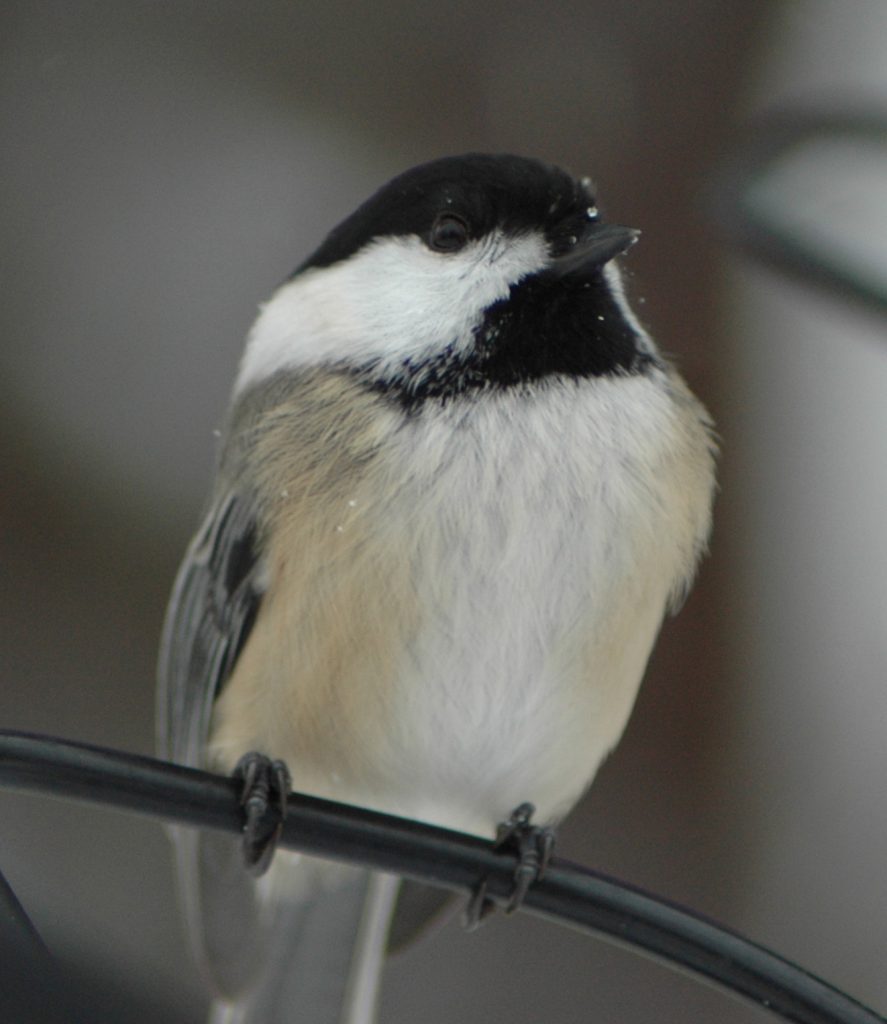
Within the next month, listen for Chickadees as they begin to switch from their namesake calls to their breeding song – a clear two or three noted whistle.  I like to think of them as saying “Hey Sweetie!”  The shorter version has the first note higher pitched than the second and can be described as “fee-bee”.

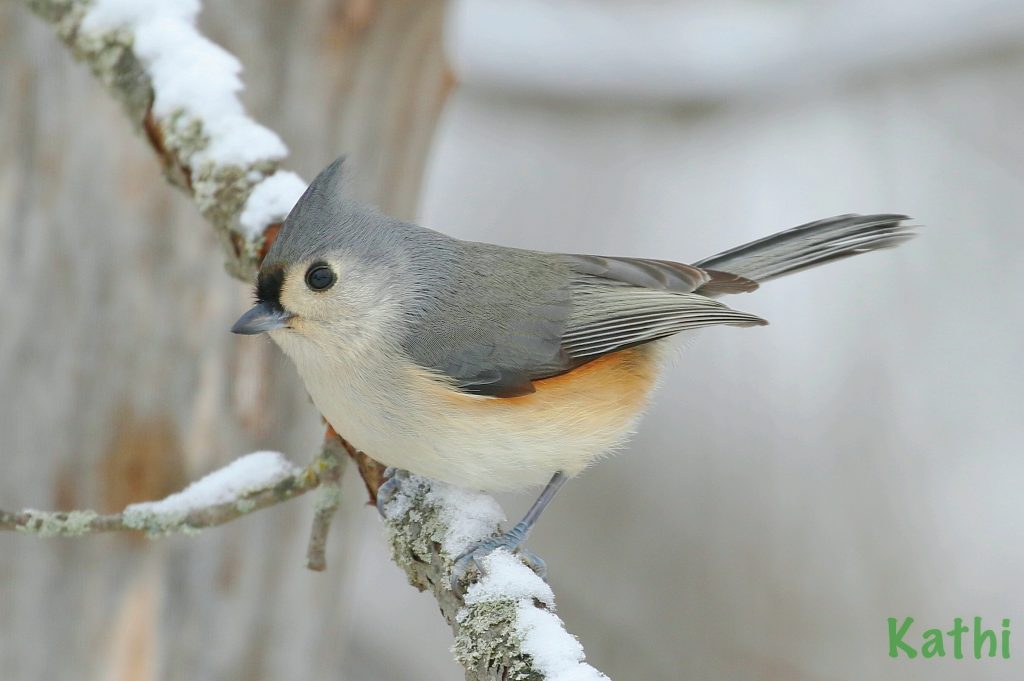
Cavity nesting birds that are resident to this area will sing early as they begin to nest earlier than the migrants that will arrive later.   In addition to the Nuthatch and Chickadee, you may be lucky to have a Tufted Titmouse pair in your area.  Listen for their very loud call which sounds as if they are saying “Peter, peter, peter” or some variation on that sequence.

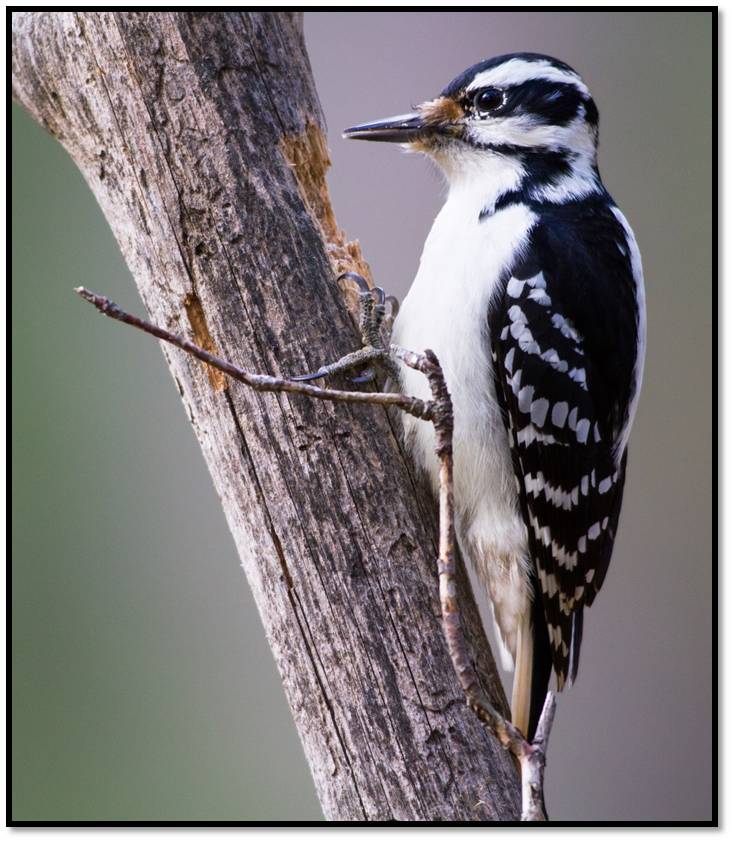
Other cavity nesters include all of our resident Woodpeckers including Downy Woodpecker, Hairy Woodpecker and Red-bellied Woodpecker.  Each of them has a distinctive drumming sequence.  This drumming takes the place of singing in Woodpeckers.  I have a snag on my oak tree that has been hollowing out over the years.  The Downy Woodpecker has figured out that it resonates well when he drums on it, sending out his signal loud and clear.  These parts of trees provide a great service for those birds – consider keeping dead branches, trimmed down to a few feet for safety.

In the months to come, migrants will begin to arrive and their songs will fill the air.  For now, I am content to listen to the resident birds who make my heart sing early in the year with the chords they strike within my soul.


Enjoy your birds!

Posted in Bird Songs | Leave a comment |

Reconnecting with the Common – A Celebration of Mallards

Posted on February 6, 2020 by Rosann Kovalcik

Mallard Duck by Tim Lintz

Mallards, A Reintroduction

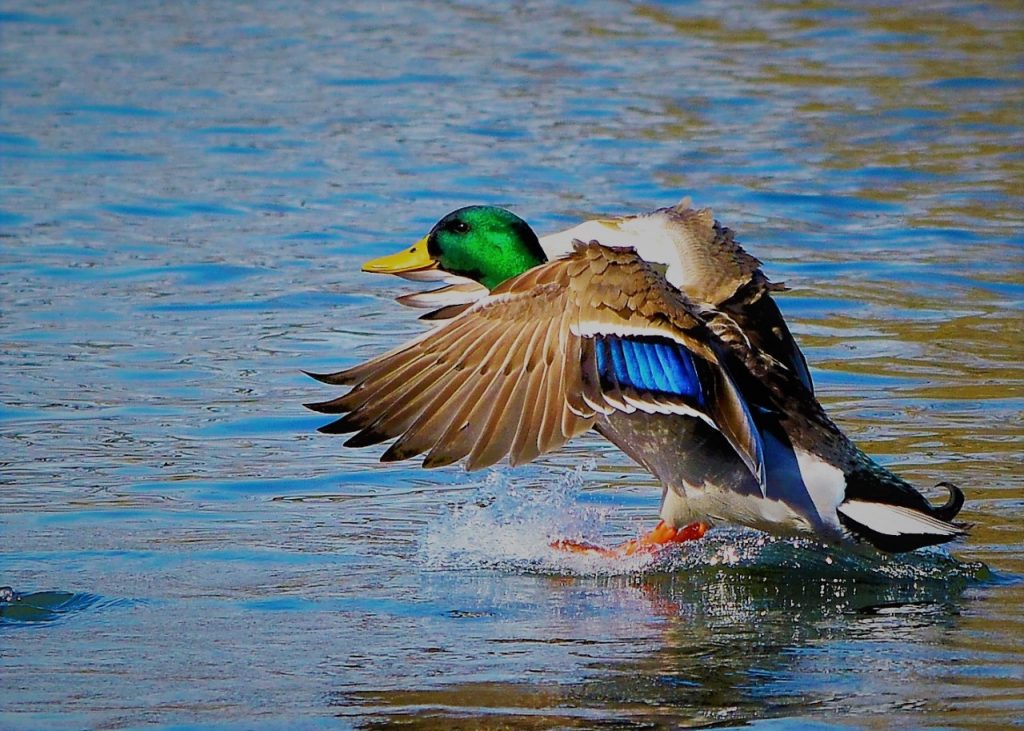
Although common in our state, the Mallard Duck male is anything but common in appearance. He is eye-catching with his bold green head, bright yellow bill and equally bright orange legs. He also has a splash of iridescent blue in the wings (on the speculum). By comparison, the female is plain in coloration. This helps her stay concealed for safety during nesting.

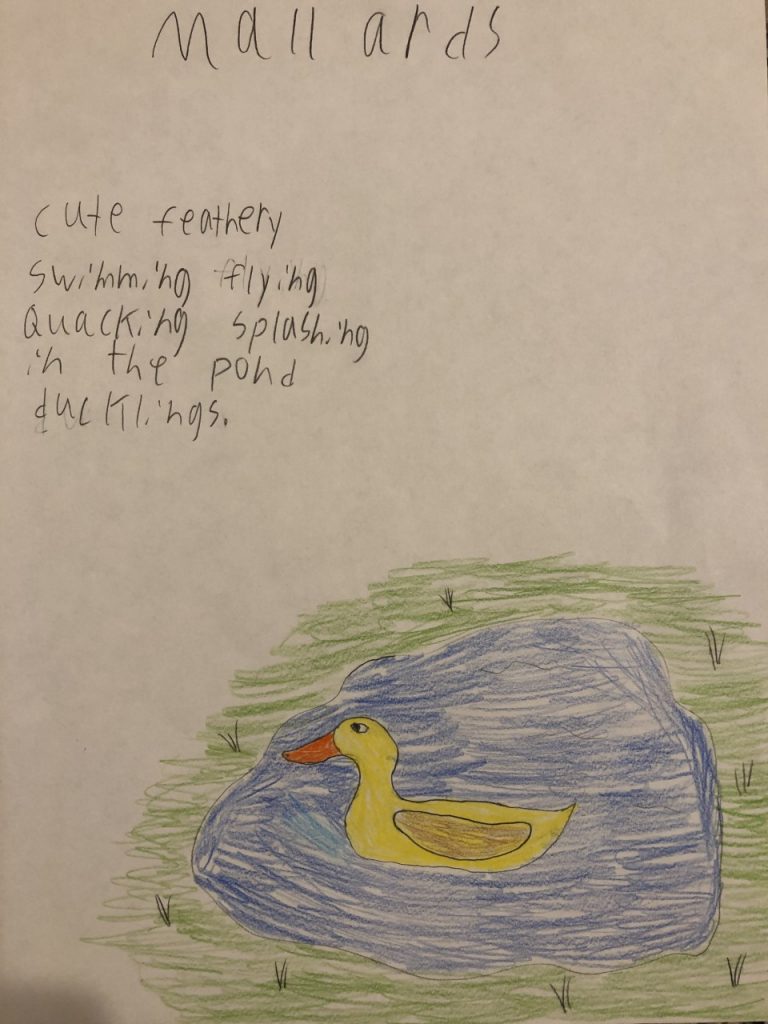
My granddaughter, Isabelle, has helped me see Mallards in a re-energized light. She’s so captivated, she’s drawn and written poetry about them. I am grateful these ducks are so common. This makes it easy for her to observe them in the fresh water ponds near her house.

A Poem & Drawing by Isabelle

The Mallard is a dabbling duck, meaning it does not typically dive for food. Instead, Mallards tip end-up and uses their beaks to grab plant food. They will also eat insects, mollusks and crustaceans. Mallards dive for food when needed, although their bodies are not built for this. Their legs are positioned in the middle of their body, which is not ideal for diving. Diving ducks, on the other hand, dive freely with legs near the back of their body.

Fun Facts About Mallards

Migrating Mallards can fly 55 miles per hour!

The “quack” you hear is from the female, as the male gives a quieter, raspy sound.

At the end of breeding season, Mallards lose their flight feathers and cannot fly for 3 to 4 weeks. During this time, they gather in groups in sheltered places as their feathers regenerate. Their body feathers molt during this time into a less striking plumage called “eclipse” plumage.

Many hunters target Mallards for sport. It was hunters who discovered the oldest known Mallard. The bird had been banded in Louisiana in 1981 and was shot in Arkansas in 2008, making it at least 27 years old.

A Place in the Ecosystem

Mallards play an important role in creating habitat. In a recent article published by Audubon, a scientist revealed his discovery of their eating habits after tracking their movements. As the article states, Mallards use the landscape as one big buffet. They will eat plants in one place and as they travel throughout the day, they excrete these seeds into areas sometimes as far away as five miles. This creates habitat, maintaining existing patches of healthy plant communities and creating new habitats. Read the full article here https://www.audubon.org/news/mallards-are-everywhere-and-thats-great-wetlands

Enjoy these ducks as much as Isabelle does, as they return to Michigan from their wintering grounds in the months to come.


Rosann Kovalcik, Owner

Wild Birds Unlimited, Grosse Pointe Woods

Have you joined our email list? Click here to sign up, it’s free and gives you access to sales, coupons, nature news, events, and more!


Posted in Wild Bird Facts | Tags: birds, duck, Grosse Pointe Woods, habitat, mallard, Michigan, nature, wild birds unlimited | Leave a comment |

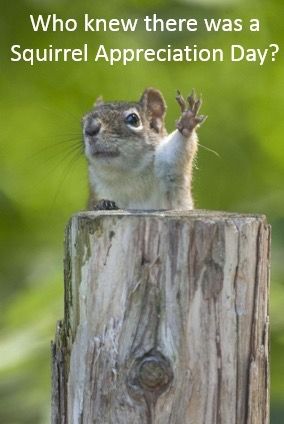
Squirrel Appreciation Day is January 21st

Posted on January 20, 2020 by Rosann Kovalcik

Squirrels: An Introduction

Soft, fluffy and entertaining – the definition of a squirrel. In our area we have both Fox Squirrels and Gray Squirrels. You may also see black squirrels, color variants of Gray Squirrels. Both species mate December through February. You may have noticed “chasing”, which is part of the mating ritual. Females give birth to naked, helpless young about 45 days after mating. They nurse the young until about three months of age. They will also mate again in May to June. Males do not help with the raising of the young. Squirrels build nests of twigs and leaves about 35 to 40 feet up, often in the sturdy crotch of a tree.

Food: Dining, Stashing, Chewing

Squirrels are omnivores and will eat all types of seeds including acorns, hickory, walnut, mulberry and hawthorn seeds. They will also consume bird eggs, birds, insects, arthropods and carrion.

Squirrels gather and stash seeds, an important job in the ecosystem. Some of the seeds are never refound, instead sprouting into new trees. These small mammals also serve as a food source for Red-tailed Hawks, Coopers Hawks, owls, coyotes and fox.

Another amazing aspect of squirrels is their teeth. They grow continuously and are very effective at chewing, as those of us who have them around well know.

Other Fun Facts

Those who feed the birds know of the squirrels’ leaping abilities. They can leap ten feet from a solid object such as the side of a tree as well as any man-made structure. It seems as if the only surface that they are unable to climb is glass.

Here is your word of the day – vibrissae. These thick hairs (whiskers) are found on the chin, nose, above and below the eyes, and forearms of squirrels. Squirrels rely on these hairs to enhance their sense of touch.

The Flip Side of Appreciation

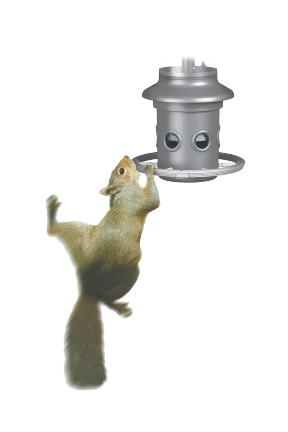
However, many people are quick to exclaim about “those darned squirrels!” Who cannot relate to the success of squirrels at our bird feeders? Getting into the feeders is their full-time occupation and they are relentless in their efforts. Looking to keep them out of your feeders? We have answers for you at Wild Birds Unlimited in Grosse Pointe Woods!

Deterrents: Feeders

There are some very effective squirrel resistant feeders including the Eliminator. This feeder has a perch that closes with the weight of a squirrel. The length of the feeder prevents the squirrel from hanging from the top of the feeder or reaching the seed ports below.

Baffles

Placement of feeders that do not have a weight device is important if you do not intend to feed the squirrels. If using a pole system, there are steel baffles that are too wide for their paws to get a sufficient grip and too long for them to over reach the baffle. This type of baffle needs to have its top at five feet off of the ground with all feeders hanging so that the bottom of the feeders are above that five foot position. We do not recommend plastic baffles, as squirrels can easily chew through this material. This type of baffled pole system is only effective if placed ten feet from any object the squirrel can jump from. This includes trees, patio furniture, pots, grills and other feeding setups. When using a baffle above a feeder, the baffle needs to be quite wide or shaped to create a slide assisting the squirrels’ exit. Both types of baffles are carried at WBU GPW.

Seeds

Safflower seed used alone is another effective remedy against feeding squirrels as most do not prefer its’ taste. Hot pepper treated seed is also a good deterrent.

Whether you watch them and have names for the ones in your yard or are among those that wave your fist as you exclaim “Those Darned Squirrels”, let’s commend them on Squirrel Appreciation Day.


Posted in Bird Feeding Solutions, Squirrels | Tags: Bird Feeding, bird feeding solutions, Grosse Pointe Woods, solutions, squirrel, squirrel appreciation day, wild birds unlimited | Leave a comment |

Recent Posts

  • Welcome the Wood Duck as our State Duck
  • Killdeer – our most common Plover returns
  • Red-tailed Hawks, the Common Buteo
  • Bald Eagles –
  • What other owls can you find ?

Archives

  • March 2026
  • March 2023
  • February 2023
  • January 2023
  • April 2022
  • March 2022
  • December 2021
  • September 2021
  • April 2021
  • March 2021
  • May 2020
  • April 2020
  • February 2020
  • January 2020
  • November 2019
  • August 2019
  • July 2019
  • March 2019
  • February 2019
  • December 2018
  • October 2018
  • August 2018
  • July 2018
  • May 2018
  • April 2018
  • March 2018
  • January 2018
  • December 2017
  • November 2017
  • October 2017
  • September 2017
  • August 2017
  • July 2017
  • May 2017
  • April 2017
  • February 2017
  • January 2017
  • December 2016
  • October 2016
  • September 2016
  • August 2016
  • July 2016
  • May 2016
  • February 2016
  • October 2015
  • August 2015
  • July 2015
  • June 2015
  • March 2015
  • October 2014

Categories

  • Bird Feeding Solutions
  • Bird Songs
  • Events & Outings
  • Fall
  • Native Plants
  • Nesting
  • Spring
  • Squirrels
  • Summer
  • Uncategorized
  • Wild Bird Facts
  • Winter

Enter your email address:

Delivered by FeedBurner

  • Prev
  • 1
  • 2
  • 3
  • 4
  • …
  • 7
  • Next
© Wild Birds Unlimited of GPW - Website by TBD Web Services