• Home
  • About Us
  • Blog

Goldfinches – Plant It, and They Will Come

Posted on September 5, 2021 by Rosann Kovalcik

For as many summers as I can recall, I have had one pair of American Goldfinches nesting in my yard. The male displays over the open space above my back yard, singing as he flies and then alighting in the birch trees at my neighbors. All of the activity to and from the grove of birches by both the male and female goldfinches would be a strong indication that they choose it for their nest site.   When the female goldfinch is on the nest it is obvious, as only her male will be coming to my feeder.  In fact, he comes more frequently as he brings food to her as she sits on the nest, incubating the eggs.  Once
Read More…

Posted in Native Plants, Nesting, Summer | Leave a comment |

Bird Walk at Ford House April 24, 2021

Posted on April 25, 2021 by Rosann Kovalcik

Our group this morning at the Ford House consisted of many first-time birders.  It was as delightful to see their reactions to the birds they could see as much as it was a delight to see the returning migrants ourselves.  The group was led by me, Bill Rapai (President, G. P. Aududon) and Jim Szelc, who used to carry the telescope for the crowd.  In this covid cautious Bird Walk era, we rely upon him for dispensing great information and encouragement as well as his knowledgeable commentary. Tree Swallows had returned and were very vocal over the middle section of Bird Island, landing on the bare branches of the central tree and then taking off in pursuit of insects.  A

Read More…

Posted in Spring | Leave a comment |

Hummingbird Fun Facts

Posted on April 12, 2021 by Rosann Kovalcik

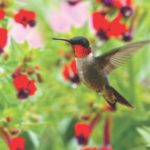
Why are Yellow-bellied Sapsuckers important to Ruby-throated Hummingbirds? Yellow-bellied Sapsuckers are a type of woodpecker. True to their name, these birds drill concentric, evenly-spaced holes on trees in order to get them to weep sap. This is the first food available for hummingbirds when they arrive in spring. Ruby-throated Hummingbirds also eat the flying insects attracted to the sap wells. The hummers dart about and use their tongues to snatch the insects in mid-air.   When do I put out my hummingbird feeder? Mid-April is generally a good time – think tax day. The earliest reports for hummers in 2012 was on March 17th; in 2010 it was April 1st; and in 2009 it was April 2nd. Although rare for hummingbirds to

Read More…

Posted in Summer, Wild Bird Facts | Leave a comment |

Attracting Orioles to Your Yard

Posted on April 12, 2021 by Rosann Kovalcik

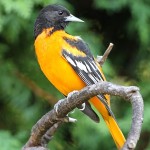
In search of an adequate food supply to raise a family, thousands of Baltimore Orioles migrate from Central America to Michigan during springtime. What does it take to attract these vibrantly plumaged orange and black birds to our yard? When the male arrives, he is in search of a territory that will provide the basics – food, water, shelter and places to raise young – those elements allow him to carry on his genetics, the sole purpose of migration.   Undoubtedly, you will hear Orioles before you see them. The male Baltimore Oriole’s song consists of a short series of paired notes, repeated 2–7 times, lasting 1–2 seconds. The pure, liquid, flute-like sounds have a full, rich tone. Once you accustom

Read More…

Posted in Bird Feeding Solutions, Spring, Summer, Wild Bird Facts | Tags: baltimore oriole, Bird Feeding, birds, fun facts, orange, orioles, Spring, summer, wild birds unlimited | Leave a comment |

Red-winged Blackbirds – Spring has arrived!

Posted on March 7, 2021 by Rosann Kovalcik

  The first week of March saw a return of Red-winged Blackbirds into the state, the first wave of this migrant.  These early arriving males hope to find the most suitable areas to stake out as a breeding territory.  Their bright red shoulder patches, known as epaulets, are used to add emphasis to the song they sing. Territory is proclaimed by Red-winged Blackbirds singing from atop prominent perches. Their song has been described in many of the field guides as “kong-a-ree” or “konk-la-ree”.  I like the version offered by my friend Jeanne.  She lived on a property that was mostly field with edges of shrubs and trees, perfect for the male Red-winged Blackbirds that had successful nesting sites.  Jeanne felt

Read More…

Posted in Uncategorized | Leave a comment |

Mother Birds

Posted on May 10, 2020 by Rosann Kovalcik

Mother Birds Happy Mother’s Day to all of the Moms out there.  Let’s take a moment to celebrate some of our local Mother birds. Sitting on eggs for over a month of incubation, the Bald Eagle shows what parental dedication is all about.  Our local pair at the Country Club of Detroit fly to the Lake to catch fish for the youngsters, and have been witnessed bringing their catches back to the nest to feed the fledglings.  This large raptor attends to her young for the entire summer as it will take this long for the young ones to learn to fly and develop hunting skills.  I was privileged to listen to the details of the nest building from a

Read More…

Posted in Nesting, Spring | Leave a comment |

Hermit Thrush

Posted on April 27, 2020 by Rosann Kovalcik

One of our early migrants has been spotted by many customers with excitement – Hermit Thrush.  Other than the thrushes that we readily recognize, the American Robin and the Eastern Bluebird, there are a group of thrushes that can look quite similar.  Here are some tips as to how to tell this one apart from the remaining thrushes in the Genus Catharus. First off, it is the thrush that arrives the earliest so in late April, if you are seeing a thrush, chances are it is a Hermit Thrush.  Why is that?  Because it is the only thrush that winters in the United States, which means it has less of a distance to migrate and therefore, arrives on breeding grounds

Read More…

Posted in Uncategorized | Leave a comment |

Wild Thing – You Make My Heart Sing!

Posted on February 18, 2020 by Rosann Kovalcik

Wild Thing – you make my Heart Sing! With the longer daylight hours comes the moment that I anticipate every January – the first day that I hear the Cardinal singing!  This year it was a little later by a few days – on January 25th, instead of my early date of the 19th .  It is a pleasure to linger outside for a few moments before I get into my car, listening for the beautiful notes to greet me in the stillness of the morning. “Cheer, cheer, cheer” or “Birdie, Birdie, Birdie” – the Cardinal typically repeats its’ introductory notes three times. Shortly after smiling over that sweet song, I heard the White-breasted Nuthatch pair calling softly to each

Read More…

Posted in Bird Songs | Leave a comment |

Reconnecting with the Common – A Celebration of Mallards

Posted on February 6, 2020 by Rosann Kovalcik

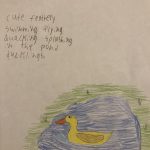
Mallards, A Reintroduction Although common in our state, the Mallard Duck male is anything but common in appearance. He is eye-catching with his bold green head, bright yellow bill and equally bright orange legs. He also has a splash of iridescent blue in the wings (on the speculum). By comparison, the female is plain in coloration. This helps her stay concealed for safety during nesting. My granddaughter, Isabelle, has helped me see Mallards in a re-energized light. She’s so captivated, she’s drawn and written poetry about them. I am grateful these ducks are so common. This makes it easy for her to observe them in the fresh water ponds near her house. The Mallard is a dabbling duck, meaning it does

Read More…

Posted in Wild Bird Facts | Tags: birds, duck, Grosse Pointe Woods, habitat, mallard, Michigan, nature, wild birds unlimited | Leave a comment |

Squirrel Appreciation Day is January 21st

Posted on January 20, 2020 by Rosann Kovalcik

Squirrels: An Introduction Soft, fluffy and entertaining – the definition of a squirrel. In our area we have both Fox Squirrels and Gray Squirrels. You may also see black squirrels, color variants of Gray Squirrels. Both species mate December through February. You may have noticed “chasing”, which is part of the mating ritual. Females give birth to naked, helpless young about 45 days after mating. They nurse the young until about three months of age. They will also mate again in May to June. Males do not help with the raising of the young. Squirrels build nests of twigs and leaves about 35 to 40 feet up, often in the sturdy crotch of a tree. Food: Dining, Stashing, Chewing Squirrels are omnivores

Read More…

Posted in Bird Feeding Solutions, Squirrels | Tags: Bird Feeding, bird feeding solutions, Grosse Pointe Woods, solutions, squirrel, squirrel appreciation day, wild birds unlimited | Leave a comment |

Recent Posts

  • Welcome the Wood Duck as our State Duck
  • Killdeer – our most common Plover returns
  • Red-tailed Hawks, the Common Buteo
  • Bald Eagles –
  • What other owls can you find ?

Archives

  • March 2026
  • March 2023
  • February 2023
  • January 2023
  • April 2022
  • March 2022
  • December 2021
  • September 2021
  • April 2021
  • March 2021
  • May 2020
  • April 2020
  • February 2020
  • January 2020
  • November 2019
  • August 2019
  • July 2019
  • March 2019
  • February 2019
  • December 2018
  • October 2018
  • August 2018
  • July 2018
  • May 2018
  • April 2018
  • March 2018
  • January 2018
  • December 2017
  • November 2017
  • October 2017
  • September 2017
  • August 2017
  • July 2017
  • May 2017
  • April 2017
  • February 2017
  • January 2017
  • December 2016
  • October 2016
  • September 2016
  • August 2016
  • July 2016
  • May 2016
  • February 2016
  • October 2015
  • August 2015
  • July 2015
  • June 2015
  • March 2015
  • October 2014

Categories

  • Bird Feeding Solutions
  • Bird Songs
  • Events & Outings
  • Fall
  • Native Plants
  • Nesting
  • Spring
  • Squirrels
  • Summer
  • Uncategorized
  • Wild Bird Facts
  • Winter

Enter your email address:

Delivered by FeedBurner

  • Prev
  • 1
  • 2
  • 3
  • 4
  • …
  • 8
  • Next
© Wild Birds Unlimited of GPW - Website by TBD Web Services