• Home
  • About Us
  • Blog

Category Archives: Bird Feeding Solutions

Ten Things You Can Do to Save Song Birds

Posted on October 6, 2014 by admin

 blog6pic1

For a bird lover like me, there is not finer time to be out watching wild birds than during Spring migration. The wood warblers have arrived as they settle in to breed or more likely, carry on further north to do so. Their fabulous colors and patterns, their diminutive size and their fascinating song all combine to keep me in awe of their journeys from Central and South America.

As joyful as it is to watch them, it is also heart breaking to know that millions of song birds are lost yearly as a result of the actions of humans. One of my mentors in the world of birding and environmental awareness was Fred Charbonneau. He loaned me a book, Silence of the Songbirds, by Bridget Stutchbury. For you fellow bird lovers’ out there, I heartily endorse this book. Not only did the author set forth a very interesting read as to the various topics, solutions were offered to the challenges faced by migrant birds. Here is her version of Ten things You Can Do to Save Songbirds.

1) Buy Shade Grown Coffee – Forest songbirds that lived in the tropics often live in traditional coffee farms where there are plenty of trees and food for birds. Most commercial coffee comes from sun coffee farms that have few trees and use lots of fertilizers and pesticides. Buy accordingly and make sure your coffee shop is aware of your preference.
2) Buy only organic produce from tropical countries – Tropical countries use large amounts of pesticides that are highly toxic to birds, including chemicals that are banned or restricted in North America. Non-organic banana plantations use one of the highest pesticide loads of any crop. Buy accordingly and make sure that your grocer is aware of our preference.
3) Buy organic for crops with heavy pesticide use – some crops in North America are relatively dangerous to birds because of the type of pesticide used. Crops such as potatoes, corn and cotton pose a chemical threat to birds.
4) Buy wood and paper products certified by the Forest Stewardship Council (FSC) – Companies certified by the FSC use sustainable logging practices that help make sure the boreal forest will always be a home for the billions of songbirds that nest there. In my experience, few lumber sellers are aware of FSC and I spent a great deal of time educating them when I was attempting to make a purchase.
5) Buy paper products made from recycled paper – The boreal forest is being cut down to fuel the enormous demand for paper products (toilet paper, paper towel, mail-order catalogs, cards). Buy accordingly from the many choices that are available.
6) Turn city lights off at night during migration – Many songbirds migrate at night and are attracted to city lights, which they think are stars. Millions of songbirds die every year after getting trapped among our towering skyscrapers. Encourage your building owner to comply during migration – mid-March through June. Handouts regarding this issue available at Wild Birds Unlimited.
7) Reduce bird-window collisions – Birds cannot see glass and fly toward reflections of trees or toward what looks like an opening in the wall. Place bird feeders very close (less than two feet) or very far (more than seven feet) from windows to reduce fatal injuries to your visitors. Consider adding Window Alerts to your windows that are the source of strikes. The material that the Alerts are made of act to give birds a reference to the presence of glass.
8) Make your backyard bird-friendly by planting shrubs and trees – During migration, tired and starving songbirds will land almost anywhere in search of a safe place to rest and eat. Invite them to your backyard by offering cover and fruiting trees and shrubs, preferably native. Reference the growers of native plants at the Michigan native Plant Producer Association handout available at Wild Birds Unlimited or at www.mnppa.org.
9) Keep your cat indoors – An average outdoor cat kills about one songbird per week, so a typical community with a hundred cats that roam outdoors will kill over 1,000 songbirds during the breeding season. There are over 75 million cats in North America! If your neighbor has a cat, give them the brochure Cats Indoors, available at Wild Birds Unlimited or at www.abcbirds.org.
10) Go pesticide-free on your lawn – The ingredients in many lawn and garden pesticides are moderately or highly toxic to birds (e.g., acephate, malathion,dichlorvos) There are a number of landscape companies that are pesticide free. Contact local Motion at 313-881-2263 for company information.

Although it would be ideal if all readers could embrace and effectuate all of these changes as well as inspire others to do so, remember that every journey begins with a single step. Choose one, choose all, but I hope that you make a choice to make a difference.

Enjoy your birds!
Rosann
Wild Birds Unlimited of Grosse Pointe Woods, MI
Posted in Bird Feeding Solutions, Wild Bird Facts | Tags: bird feeders, fall bird feeding, Grosse Pointe Woods, Michigan, song birds, winter bird feeding | Leave a comment |

Get Ready for Fall and Winter Bird Feeding

Posted on October 6, 2014 by admin

Let’s talk about the importance of cleaning your bird feeder At Wild Birds Unlimited, of Grosse Pointe Woods, Michigan, we know with the change to cooler temperatures, many people will be getting their yard ready for fall and winter wild bird feeding. At Wild Birds Unlimited of Grosse Pointe Woods, we can help you review your feeding strategy in order to get the most enjoyment from the hobby of bird feeding.

Good, quality seeds are the staple of any feeding station in the colder months. Once natural seeds have been depleted, birds will look to supplement their diet with the bird seed at your feeders. The most favored seed is the black oil sunflower, favored by more birds than any other seed. Using sunflower as the main seed in a blend and adding other favored seeds such as safflower and white proso millet will bring in all of the resident birds. Birds that perch while they eat prefer the sunflower and safflower, whereas the ground feeding birds prefer the millet that falls to the ground from the bird feeder.

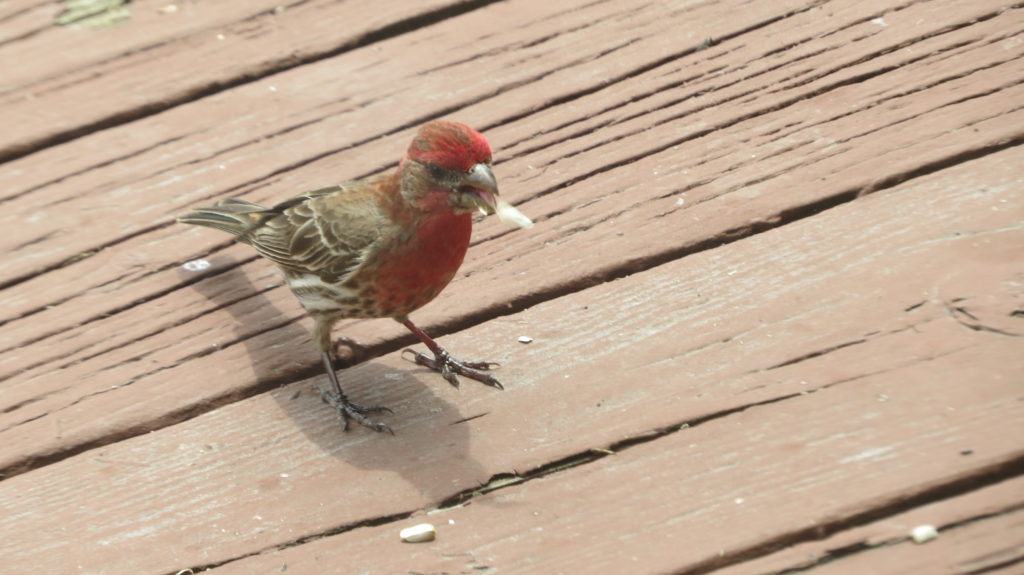
House Finch with a safflower seed, by Andrea Rose

Before you fill your wild bird feeder, make sure that it has been cleaned and sterilized. A good soak in some warm water will loosen all of the dirt that builds up in most tube feeders. The soft bristles of feeder brushes allow you to scrub without scratching the feeders. To sterilize, add one part vinegar or bleach to ten parts water and let the feeder soak for at least ten minutes. Always rinse thoroughly before letting the feeder dry completely and filling. With a wooden feeder, follow the same steps without a prolonged soak.

Make sure that the placement of your bird feeders allows birds to fly to cover in the form of bushes or evergreens in the event that a cat or a hawk pursues them. If you use a number of bird feeders, it is a good idea to keep some distance in between them so that the birds are not competing with each other for space. Offering seeds at a lower level for the ground feeding birds by using a platform feeder will give those birds their own space as well as keeping the seed dry. Thistle, or nyger, is the seed of choice for American Goldfinches and other winter finch visitors. Suet is the favored bird feeding station delicacy if you are trying to satisfy woodpeckers, chickadees and nuthatches. This high fat food goes a long way in keeping birds fueled with the energy that they need. In the colder months, birds don’t necessarily need different foods; they just need more of it! Don’t be surprised to see your feeders empty more rapidly in response to the dip in temperature.

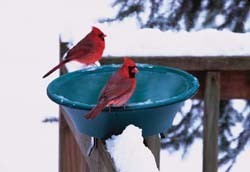
Water is a necessity for birds all through the year and winter is no exception. Heaters can be added to existing baths or, complete baths with a heater built in can be purchased. And then, there is always the daily ritual of taking the hot water out each day and replacing the frozen water with this new source! Whichever you use, your birds will appreciate this necessity of life being provided to them.

blog4pic1
One of the most forgotten elements of a favorable winter habitat is shelter. When the temperature drops and the wind increases, birds need shelter more than anything. Evergreens can provide this element but if your yard lacks them, consider adding a winter roost box or a birdhouse. I was delighted to learn that this years’ fledged downy woodpecker has been using a birdhouse that I placed in my yard. Every night at the same time, he lands on the roof and looks around, and once “The coast is clear”; he enters the house for shelter through the night. There are roost boxes that can be placed within the yard to provide shelter for a number of birds at one time. Sharing body heat, the chance of survival increases for those birds that roost together.

From your point of view, the placement of bird feeders is all about your point of view. If you situate them where you can’t enjoy them, bird feeding will become a chore as opposed to a hobby for you to enjoy. Ask yourself where in your home you are most likely to sit and watch the birds. Don’t rule out the side or front yards if they are where you find yourself looking out the window. A small window bird feeder added to the kitchen is another way to enhance the hobby for your enjoyment. Feel good about yourself for providing for these fragile creatures during this time of challenge for them.

Enjoy your birds!

Rosann Kovalcik,

Owner of Wild Birds Unlimited, Grosse Pointe Woods

Have you joined our email list? Click here to sign up, it’s free and gives you access to sales, coupons, nature news, events, and more!

Posted in Bird Feeding Solutions, Fall, Winter | Tags: bird feeders, birds, fall bird feeding, Grosse Pointe Woods, Michigan, winter bird feeding | Leave a comment |

Recent Posts

  • Welcome the Wood Duck as our State Duck
  • Killdeer – our most common Plover returns
  • Red-tailed Hawks, the Common Buteo
  • Bald Eagles –
  • What other owls can you find ?

Archives

  • March 2026
  • March 2023
  • February 2023
  • January 2023
  • April 2022
  • March 2022
  • December 2021
  • September 2021
  • April 2021
  • March 2021
  • May 2020
  • April 2020
  • February 2020
  • January 2020
  • November 2019
  • August 2019
  • July 2019
  • March 2019
  • February 2019
  • December 2018
  • October 2018
  • August 2018
  • July 2018
  • May 2018
  • April 2018
  • March 2018
  • January 2018
  • December 2017
  • November 2017
  • October 2017
  • September 2017
  • August 2017
  • July 2017
  • May 2017
  • April 2017
  • February 2017
  • January 2017
  • December 2016
  • October 2016
  • September 2016
  • August 2016
  • July 2016
  • May 2016
  • February 2016
  • October 2015
  • August 2015
  • July 2015
  • June 2015
  • March 2015
  • October 2014

Categories

  • Bird Feeding Solutions
  • Bird Songs
  • Events & Outings
  • Fall
  • Native Plants
  • Nesting
  • Spring
  • Squirrels
  • Summer
  • Uncategorized
  • Wild Bird Facts
  • Winter

Enter your email address:

Delivered by FeedBurner

  • Prev
  • 1
  • 2
  • 3
© Wild Birds Unlimited of GPW - Website by TBD Web Services